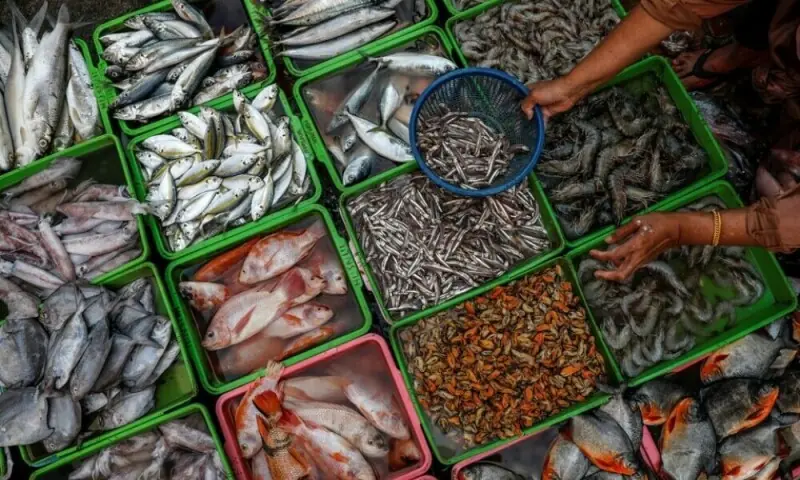

KARACHI: Federal Minister for Maritime Affairs Muhammad Junaid Anwar Chaudhry on Saturday announced setting up of a 100-acre seafood processing and export zone at Korangi Fisheries Harbour Authority (KoHFA), with an estimated investment of USD60-80 million.
The project will shift Pakistan’s seafood industry from raw exports to high-value processed products to position the country in Gulf, East African and Asian markets.
“This initiative will bridge medium-scale seafood processors and value-added plants with global buyers by providing modern infrastructure, certification standards, and efficient export logistics,” Chaudhry said, adding that the project reflects the government’s commitment to developing the blue economy.
The minister said the project cost is based on regional benchmarks from countries including Vietnam, China, and Ecuador, which have successfully developed similar seafood industrial parks. The zone will be developed under a public-private partnership or build-operate-transfer (BOT) concession model, with private investors handling development, operations, and maintenance while KoHFA retains regulatory oversight.
The planned facilities will include 20 to 25 medium to large-scale seafood processing units designed for fish, shrimp, and cephalopod processing, along with value addition and export-grade packaging capabilities. These units will support products ranging from primary processing to ready-for-market seafood items.
The zone will feature a state-of-the-art cold storage and blast freezing complex with multi-temperature storage ranging from minus 18 to minus 40 degrees Celsius for safe handling of fresh and processed seafood. Ice plants and flake ice stations with a daily capacity of 50 to 100 tonnes will support fish landing, processing, and transportation requirements.
Under the preferred BOT concession model, the private partner will finance, develop, and operate the facilities, with ownership reverting to KoHFA at the end of the concession period, expected to be 20 years with possible extensions. Alternative models may include development and operations partnerships between KoHFA and private seafood exporters or manufacturers.
Revenue streams will be generated through lease rentals, processing fees, cold storage and logistics services, utilities provision, export revenue sharing arrangements, and margins from value-added products. The estimated internal rate of return is projected between 13 and 17 percent, based on comparable regional seafood park projects.
The project will be fully financed and operated by the private sector, while KoHFA will contribute land, jetty access, and institutional facilitation to support investors.
Chaudhry emphasized that the initiative aligns with Pakistan’s National Blue Economy Policy, Vision 2030, and the United Nations Sustainable Development Goal 14 on life below water.
Copyright media, 2026




 American Dollar Exchange Rate