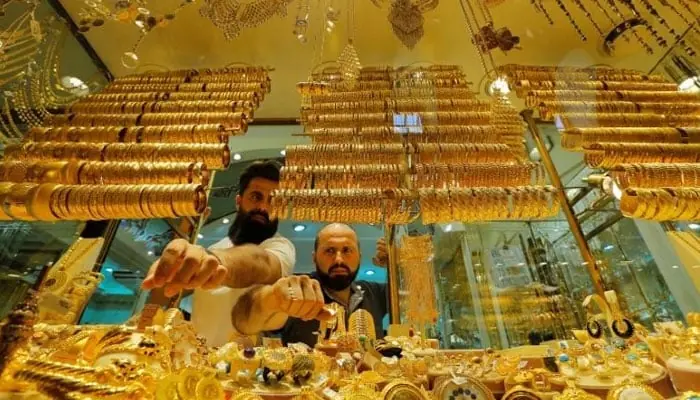

Pakistan’s annual gold demand is estimated at 60 to 90 tons, which amounts to nearly $8 billion-$12 billion at current market value. Yet more than 90% of this trade takes place in the informal and undocumented market, according to the Competition Commission’s latest report.
As per the report titled ‘Competition Assessment Study of Pakistan’s Gold Mark’, released on Wednesday, this lack of documentation and oversight not only obscures the true scale of the market but also hampers regulatory efforts, allowing for potential market distortions and unaccounted economic activity.
Wedding, festivities drive local demand
The report noted that gold plays a significant social and economic role in Pakistan, with 70% of its demand driven by weddings and festivals, serving as a hedge against inflation through substantial household savings.
“On the demand side, annual gold consumption has ranged between 60 to 90 tonnes in recent years, positioning Pakistan as one of the major gold markets in South Asia. On the supply side, Pakistan is largely dependent on imports for its gold requirements,” read the report.
Citing data from government agencies, the report noted that the country imported gold worth $17 million in FY24.
Meanwhile, the country’s official gold reserves stand at nearly 64.76 tonnes, valued at almost $9 billion by late 2025.
Reko Diq to transform Pakistan’s gold value chain
CCP’s report noted that the Reko Diq mine is set to transform the country’s gold value chain, with operations forecasted to generate up to $74 billion in revenue over its 37-year lifespan.
Reko Diq is a massive, undeveloped copper and gold deposit located in Balochistan, believed to be one of the world’s largest. The project is owned 50% by Barrick, 25% by three federal state-owned entities, 25% by the Government of Balochistan, of which 15% is on a fully funded basis, and 10% is on a free carried basis.
The project, which aims to start production in 2028, is expected to become a world-class copper-gold mine, contributing to Pakistan’s economic development.
CCP noted that Pakistan stands at a pivotal juncture with the imminent operationalisation of the Reko Diq mine, projected to produce 17.9 million ounces of gold over its lifespan.
“This domestic supply – worth an estimated $54 billion at current prices – presents a historic opportunity to reshape the gold market’s fundamentals. However, without urgent reforms, Reko Diq’s output risks being absorbed into the same inefficient system, perpetuating informality, price distortions, and missed export potential.
“The mine’s success hinges on parallel investments in refining, hallmarking, and regulatory infrastructure to ensure its gold integrates seamlessly into formal supply chains,” it said.
Regulatory challenges
CCP noted that Pakistan’s gold market operates under a complex regulatory framework involving multiple institutions, including the Ministry of Commerce (MoC), Federal Board of Revenue (FBR), State Bank of Pakistan (SBP), Trade Development Authority (TDAP), and Pakistan Gems & Jewellery Development Company (PGJDC).
“This fragmented oversight, combined with high compliance costs and weak enforcement of hallmarking standards, creates market distortions that favour informal trade and smuggling,” read the report.
CCP highlighted that the recent suspension of SRO 760 has further exacerbated regulatory instability, highlighting the urgent need for policy harmonisation and stronger institutional coordination to promote transparency and fair competition in Pakistan’s gold market.
SRO 760 suspended: Pakistan’s gem & jewellery exports come to a standstill
It shared that geographically, gold trade is concentrated in urban hubs like Karachi and Lahore.
On gold pricing, it shared that daily gold rates are largely influenced by associations rather than transparent market mechanisms, suggesting that there is no comprehensive regulation to regulate the gold market in the country.
Recommendations
The report recommended establishing a unified regulatory authority to transform Pakistan’s gold market into a competitive and transparent sector.
“Mandatory assaying and hallmarking should be implemented to ensure quality and build consumer trust. Digital transformation, including blockchain traceability, can enhance transparency and reduce illicit trade.
“A gold banking system, inspired by Türkiye’s model, would mobilise idle household gold into the formal financial sector. Strengthening data governance and reforming taxation and labour policies are also critical to fostering a dynamic and inclusive gold market. These measures, if implemented cohesively, can unlock the sector’s potential and align it with international best practices,” it said.





 American Dollar Exchange Rate