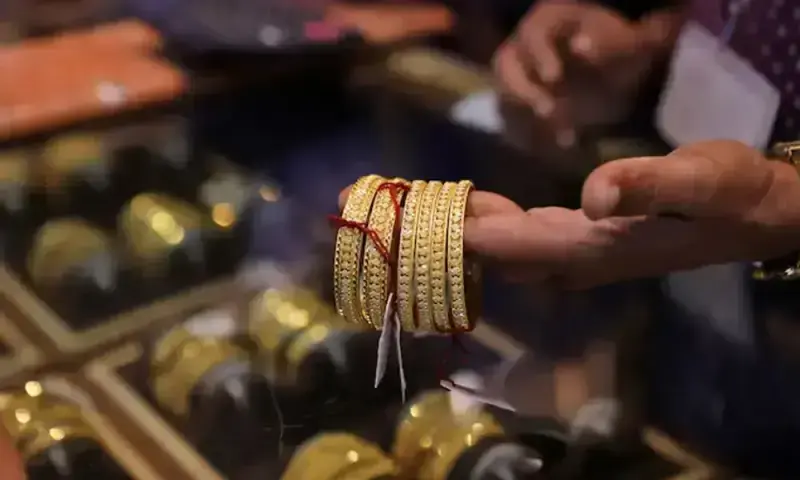
KARACHI: In the bustling wedding halls in Karachi, Lahore, and other Pakistan cities, where tradition once dictated that brides be adorned in heavy gold sets, families are now scaling back, opting for imitation jewellery or silver-plated alternatives. The culprit? A significant rise in global gold prices, pushing gold price per tola to Rs400,000 in Pakistan.
Record high in global gold prices, amplified by geopolitical tensions and macroeconomic shifts, is reshaping both social customs and financial decisions across Pakistan.
For Sheikh Manzoor Ahmed, a recent groom, the financial strain was palpable. “Even a small gold item was out of reach,” he said. “We could barely cover the wedding expenses — gold was a luxury we simply couldn’t afford.”
Such stories are becoming more common. Traditionally, in Pakistani society, it has been customary for both the bride’s and groom’s families to exchange gold sets, as symbols of prosperity and respect. But that tradition is being challenged by an economic reality too heavy for many households to bear.
Rising prices and changing norms
Gold, long considered a safe haven for investors, has seen its price surge both globally and locally. In Pakistan, the price of gold per tola has hit record highs in recent days, with some market analysts warning it could hit Rs450,000 within six to eight months if current trends persist.
“Where clients once purchased 10 tolas for a wedding, they now settle for half that — or less,” said Syed Amjad Jelani, a veteran gold trader in Karachi’s Saddar jewellery market. “People are being forced to rethink deeply held traditions.”
Local jewellers say foot traffic has declined sharply. “We’re mostly selling imitation sets these days,” said Faisal Osama, whose family has run a gold business for three generations. “The emotional significance remains, but the material is no longer real gold.”
According to Abdul Sami, another seasoned dealer, the shift is dramatic. “In the 80s and 90s, gold was bought regularly, not just for weddings but for daily wear. Now, even for weddings, brides receive only 2.5 to 3 tolas, far below the 5 to 7 tolas that were standard a generation ago“.
A generational reckoning
For middle-income families, the pressure to maintain tradition amid rising costs can be emotionally taxing.
Mohsin Raza, an employee at a private company, is preparing for the weddings of both his daughters. “I’ve saved for years,” he said. “But if I buy gold for my elder daughter like we used to – six or seven tolas – how will I afford the same for the younger one?”
By contrast, Salman Ahmad, a groom whose wedding is approaching, expressed relief. “My parents bought the gold some years ago, when prices were lower. It’s one less thing to worry about.”
These contrasting stories underscore a growing divide: those who had the foresight or financial flexibility to purchase early, and those left scrambling amid volatility.
The global picture
Internationally, gold prices are climbing due to a mix of geopolitical instability, central bank hoarding, and monetary policy shifts in the United States.
“Gold demand is no longer driven by consumers. It’s now the central banks that are moving the needle,” said Abdullah Abdul Razzak Chand, Vice President of the Society Welfare Jewellers Association in Karachi. He cited the ongoing Israel–Palestine conflict and recent interest rate cut by the US Federal Reserve as key factors behind the current rally.
“If the war ends, we could see a $300 per ounce correction,” he noted. “But for now, the market remains bullish.”
Indeed, central bank behaviour reflects rising risk aversion. A 2025 survey by the World Gold Council found that 95% of global central bankers expect reserves to rise this year, with 43% planning to increase their own holdings, the highest figure on record. Deutsche Bank recently revised its 2026 forecast to $4,000 per ounce, citing prolonged dollar weakness and further rate cuts.
Muhammad Qasim Shikarpuri, President of the All Pakistan Gems and Jewellers Sarafa Association, echoed this view.
“If the Fed cuts rates again, gold will shoot up. We’re already hearing talk of another 25 basis point cut — if that happens, we could be looking at $4,000 gold and Rs450,000 per tola domestically.”
He also pointed to past US trade policies, such as tariffs imposed by former President Donald Trump, and ongoing regional instability, including the US military presence in Afghanistan, as contributors to the elevated risk premium built into gold markets.
Local solutions and policy gaps
In Pakistan, some in the industry are calling for urgent policy reform.
“The government needs to allow commercial imports of gold and issue licenses to local traders,” Chand urged. “This would stabilise prices, stimulate the jewellery sector, and generate much-needed tax revenue.”
With gold now largely confined to wedding-season purchases and even those reduced in scale, Pakistan’s gold industry is on the brink of a transformation. Once a cultural cornerstone, gold jewellery is being reimagined as a luxury few can afford.
Still, for many families, the emotional value remains intact, even as the substance changes. “Whether it’s imitation or silver-plated,” said Mohsin Raza, “the love we give to our daughters on their wedding day is just as real.”
 American Dollar Exchange Rate