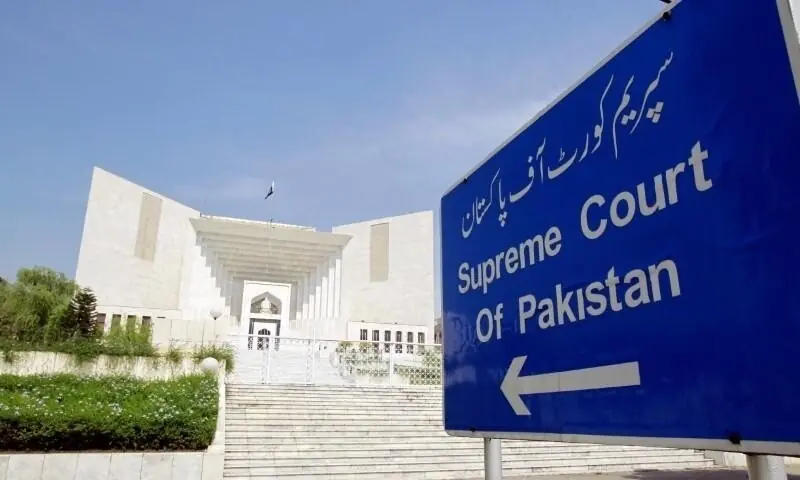

The Supreme Court’s Constitutional Bench (CB) on Thursday ruled that the eight-judge majority judgment announced on July 12, 2024, was not justified in granting relief to the Pakistan Tehreek-i-Insaf (PTI) by invoking Article 187 of the Constitution that empowers the court to do complete justice when no issue regarding the grant of reserved seats to the party was pending before it.
Headed by Justice Aminuddin Khan, the CB through a short order on June 26 had overturned the July 12, 2024, majority judgment by declaring the PTI eligible for reserved seats for women and non-Muslims in the national and the provincial assemblies.
In its detailed verdict issued on Thursday, 10 judges of the 12-judge CB held that there was no justification in giving relief to the PTI under Article 187, especially when appeals were filed and pursued by the Sunni Ittehad Council (SIC) under Article 185 (3) of the Constitution.
The facts and circumstances of this case did not require application of Article 187, the detailed judgment said, adding that the exercise of authority purportedly under Article 187 to grant relief to a party that was not before the court, to remove from office MNAs and MPAs who had been declared elected and who were not before the court, and to issue declarations and directives that were outside the scope of the statutory or constitutional authority of this court, was not warranted.
The July 12 judgment, being in excess of the jurisdiction vested in the Supreme Court and being contrary to the statutory and constitutional provisions, suffers from errors apparent on the face of the record which float on the surface, the CB observed in its detailed verdict, adding that it therefore had to be set aside.
Apex court must stay within its limits
The apex court, the Constitutional Bench explained, enjoys the jurisdiction to interpret the statutes and the Constitution and its authority remains absolute insofar it remains within limits.
It cannot be called into question by any other department of government or even by another constitutional institution, be it the legislature or the executive, it said, while stressing that the authority to interpret the law and the Constitution does not confer the authority to the top court to rewrite the Constitution or the law.
The CB emphasised that the will of the legislature and the Constitution-makers has to be respected and given effect to. It cannot be negated or usurped by the judiciary by scribing artificial meanings to the clear language of the Constitution or by derogating from the plain meaning of its words.
Any court or judge, including the Supreme Court judges, has no jurisdiction to read their personal likes and dislikes into the Constitution or to ignore or circumvent its commands, the detailed judgement said. The power to interpret is a very wide and formidable power indeed but that power is negated, not enhanced, when the court proceeds, under its guise, to rewrite the Constitution, the CB ruled.
Explaining its stance further, the CB said the July 12 judgment ignored the rights of the returned candidates who were elected on reserved seats in the National Assembly and later took oath. Thus, they enjoy a number of protections as returned candidates under the Constitution and the Elections Act, 2017, but were disregarded, the CB regretted.
These rights ensure that their election could not have been declared void, except through an election petition. Moreover, the review petitioners and several other returned candidates on reserved seats were not a party to the proceedings before the apex court; besides, no one had challenged the election of the petitioners before the court.
The premise for this exercise of authority without any constitutional mooring was that election disputes are not between candidates but are matters that concern the constituency and the nation, the CB explained, adding this was clearly contrary to the explicit language of Article 225 of the Constitution.
It had been observed in the July 12 judgment, the CB observed, that an election case could not be equated to “an ordinary civil case” and “the proceedings therein are inquisitorial in nature.”
The proceedings before the court were two civil appeals under Article 185 of the Constitution, the CB stated in the detailed order. These were adversarial proceedings and were being litigated between parties. No Supreme Court judgment supported the proposition and none was cited in support of the novel proposition that election disputes were inquisitorial not adversarial and were adjudicated and decided as civil disputes, the CB observed.
The CB also held that the order of quashing the notification of the Election Commission of Pakistan (ECP) of May 13, 2024, and undoing the election of the notified persons cannot be sustained in law and under the Constitution and is accordingly set aside.
The dissenting note
Meanwhile, Justice Ayesha A Malik and Justice Aqeel Ahmed Abbasi, who had earlier dismissed the review petitions in liminie, in a six-page note expressed reservations to the constitution of the CB hearing the review petitions.
Originally, the review petition was heard by a 13-judge bench, of which five judges including Justice Syed Mansoor Ali Shah, were available yet they were not included in the bench.
This exclusion is based on Article 191A of the Constitution inserted through the 26th Amendment, which requires the formation of CBs, the note said, adding that the excluded judges were not nominated for CB by the Judicial Commission of Pakistan (JCP).
The note stressed that the JCP, which was established under the Constitution must uphold and safeguard the basic principles and values of the Constitution which include the independence of the judiciary.
The JCP functions within a constitutional scheme predicated upon the rule of law, separation of powers and supremacy of the Constitution, the note said, adding that it was incumbent upon members of the JCP to discharge their functions with integrity and in a manner that exemplifies constitutional propriety ensuring that the independence and integrity of the judiciary is always protected and maintained.
A corresponding constitutional duty is also placed on three-judge committee formed under Article 191A that fixes cases before the CB. When the Constitution of the bench give rise to doubts about fairness, the legitimacy of the entire process is called into question, the note said.








 American Dollar Exchange Rate