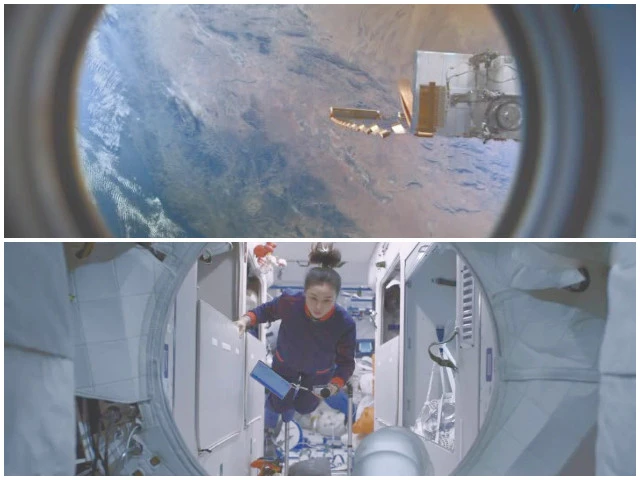
A century of Chinese sci-fi films mirrors country’s tech ascent, turning fantasies into realities
Renowned Chinese science fiction writer Liu Cixin is accustomed to suspending his disbelief to appreciate surreal scenes in movies but a new documentary had him reminding himself that everything was real.
“The scenes outside the window of the space station are not special effects, but real. The three people inside are not actors, but Chinese astronauts,” he said, after watching an 8K ultra-high-definition documentary ‘Shenzhou-13’, filmed by the crew of the space ship.
The work impressed Liu deeply. He said the visuals were more fantastical than what sci-fi literature can often bring to mind.
The release of the documentary, a few weeks ago, came a century after ‘The Invisible Clothing’ — the first Chinese film to include sci-fi elements — was shot and screened in Shanghai in 1925.
‘The Invisible Clothing’ was adapted from a story by Xu Zhuodai – “China’s Charlie Chaplin”. It was essentially a comedy, following a man who dons an invisibility cloak to beat his wife’s lover. Xu had added a sci-fi aspect to fulfil a cinematic dream.
“It was a movie with sci-fi elements,” said Shi Chuan, a professor at the Shanghai Theatre Academy, adding that the technology, filmmaking skills and audience expectations at the time were far from what they are today.
Shi noted that the late 1920s saw a burst of experimentation in Chinese cinema, producing numerous “bizarre” films reflecting the imagination of the era, though most reels did not survive.
‘Death Ray on Coral Island’, released in 1980, is widely considered to have been China’s first true sci-fi film, showcasing lasers, robots and other futuristic equipment. But following its release, sci-fi fell into a long period of obscurity.
The 1990s brought a change, as China began importing Hollywood blockbusters. Films like ‘Star Wars’ captivated audiences and inspired a new generation of Chinese writers.
In 2015, Liu Cixin won the Hugo Award for his sci-fi trilogy, ‘The Three-Body Problem’, marking a breakthrough that helped propel Chinese sci-fi onto the global stage.
Four years later, ‘The Wandering Earth’ was adapted from another of Liu’s works and released in theatres, cementing a new era for Chinese sci-fi film. The blockbuster, which was released during the Spring Festival holiday, raked in 4.6 billion yuans ($ 647 million).
On Sept 20, on the sidelines of the Xingyun (Nebula) Awards for Chinese Science Fiction, a special event marked 100 years of Chinese sci-fi film.
Huang Mingfen, a professor at Xiamen University, said that Chinese sci-fi has undergone three phases of transformation: scientific enlightenment, industrial storytelling and cosmic philosophy.
NO LONGER A DREAM
China’s sci-fi boom has coincided with real advances in technology and manufacturing. Devices resembling the exoskeleton “mechs” seen in ‘The Wandering Earth 2’ are already available to consumers and used in industrial settings.
 American Dollar Exchange Rate