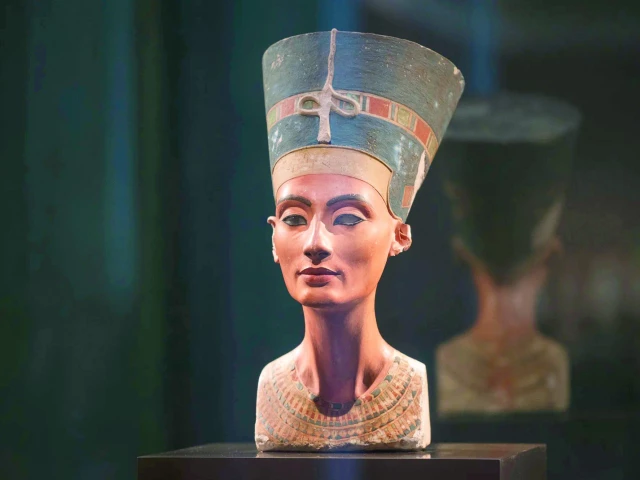
Discovered in Egypt in 1912 by German archaeologists, its unveiling stunned audiences from Cairo to London

One hundred years ago, in a courtyard at the Neues Museum in Berlin, the world came face to face for the first time with one of its most enduring beauty icons: Queen Nefertiti. Discovered in Egypt in 1912 by German archaeologists, her 3,300-year-old stucco-coated limestone bust went on display in 1924. Its unveiling stunned audiences from Cairo to London and sparked a century-long fascination with her aesthetic.
In an article on CNN, Zahra Hankir unfurls the fascinating and mystic poetic figure.
In the bust, Nefertiti is seen wearing a wide collar and a flat-topped crown with a golden band and uraeus (a headdress featuring a sacred serpent), decorated in greens, yellows, browns and blues. Research indicates that she was a royal and noblewoman who reportedly bore six daughters, one of whom is said to have married Tutankhamun, but little else is known about Nefertiti’s life and origins. Egypt in the 14th century BC was not ethnically or racially homogeneous, and many scholars surmise that, based on her depictions and the region’s population, Nefertiti would be considered a woman of color in today’s terms.
“Nefertiti’s bust is so perfect; she’s so self-possessed,” Dr Cheryl Finley, a professor of art history at Spelman College in Atlanta, told CNN. “That’s what really grabs the attention and imagination. It’s her confidence, and her gaze, of course. It’s something that attracts us all.”
Following the bust’s discovery in the 1920s, Nefertiti quickly became an “it” girl. The meaning of her name, ‘the beautiful one has arrived,’ proved particularly apt, as her face was plastered across advertisements for kohl, and her likeness appeared in beauty columns.
Nefertiti’s style continued to influence fashion decades after the bust’s discovery. In Dior’s Spring 2004 show, John Galliano showcased looks that included tall Nefertiti hats. In 2015, Christian Louboutin launched a lipstick collection that drew inspiration from the royal wife, featuring gold-and-black vials adorned with crowns. (Nefertiti likely used the natural clay earth pigment red ochre for her lips). Jewelry designers like Azza Fahmy have evoked her in their pieces, while Azzedine Alaïa’s Fall 2017 line paid tribute with black turbans, one of which was famously worn by supermodel Naomi Campbell.
In the modern day, Nefertiti’s significance as a cultural icon remains strong. On TikTok and Instagram, influencers recreate the queen’s looks in tutorials. Her likeness inspires items as varied as mass-produced T-shirts and mugs to $14,000 dresses and high-end perfumes. In the beauty industry, Black and brown-owned brands like Juvia’s Place and UOMA Beauty have marketed makeup that pays homage to Nefertiti. Even plastic surgeons name-drop her with the “Nefertiti Lift” — a non-invasive cosmetic technique that uses Botox to enhance the jawline.
“Nefertiti’s bust… transcends time,” explained Finley. “It also enables people to draw their own power from it.”
But the story of how the bust of Nefertiti found its way to Berlin in the first place is mired in controversy. After being transported to Europe in 1913, one year after its discovery in Egypt, the piece was hidden from public view for over a decade. In 1924, to much fanfare, it was put on display at the Neues Museum, where it still remains, spurring an ongoing debate about its rightful resting place (a recent petition led by Egyptologist Zahi Hawass has reignited calls for its repatriation, saying that its removal from the country was “unjustified” and against “the spirit of Egyptian laws”.)
When the bust was first unveiled, White Western women sought to emulate Nefertiti’s look. A 1933 New York Times article encouraged women to recreate her angular features – albeit without darkening the skin, echoing structural imbalances in the beauty industry, which fetishized non-European aesthetics yet discouraged and discriminated against darker skin tones. Women began to fashion their looks after Nefertiti’s style, lining their eyes like her cat-eye, wearing tops that imitated the era’s collars, and donning tall hats or styling their hair high to resemble her crown. Replicas of the bust even appeared in American hair salons, promising the allure of her ‘exotic’ beauty.
“And why wouldn’t you want to look like her?” said Dr. Elka Stevens, an associate professor of visual culture and studio art at Howard University in Washington, D.C. “Take the crown off, drop her in any society, and she can fit in.”
Nefertiti may have been more palatable to European audiences as some of the bust’s features align well with Western aesthetic preferences, explained Professor Charmaine A. Nelson of the University of Massachusetts Amherst. The queen, she noted, defied “so much of the history of the Western perception of Black women and women of color, (which) is as ‘other,’ as ‘grotesque,’ as ‘unaesthetic body,'” said Nelson, who teaches Black diasporic art and art history. “It’s really striking and probably works in the favor of the White gaze that her hair is covered,” she added, suggesting that textured hair, particularly Afro-textured styles, have historically challenged Eurocentric beauty standards.
In some ways, Nefertiti tells us more about ourselves than she does about her. Although she is one of ancient history’s most recognizable figures, much of her life remains a mystery — a gap that allows her persona to be molded into whatever icon society needs at any given time.
As the wife of Pharaoh Akhenaten, Nefertiti played a major role in Egyptian politics. Together, the pair led a religious revolution by abandoning polytheism and promoting worship of the sun god Aten. Nefertiti was often portrayed with her husband in elaborate attire, suggesting her fashion was tied to her political grativas. But 12 years into Akhenaten’s reign, she vanished from historical records, leading to endless theories about her fate — was she forced into exile, did she fall ill, or was she murdered? Some speculate that she may have even assumed a new identity as a co-regent.
Nefertiti’s legacy has been whitewashed in various ways; a 2018 3D reconstruction, for example, sparked backlash for its lighter skin tone. Such efforts reflect attempts to whiten Egypt and to “make claim to it as closer to Europe than to (Black) Africa,” Nelson notes.








 American Dollar Exchange Rate