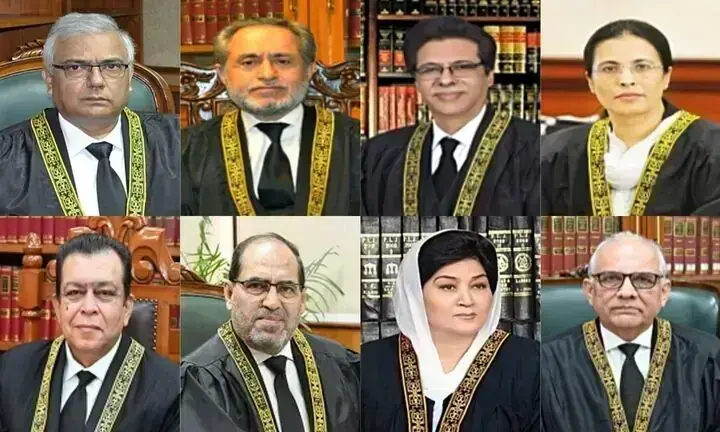
Justice Ayesha Malik wondered on Wednesday whether Article 191A of the Constitution meant that a full court could no longer be formed as the Supreme Court’s (SC) Constitutional Bench (CB) heard petitions against the 26th Amendment.
Article 191A was an addition to the Constitution made under the 26th Amendment to form constitutional benches in the Supreme Court to specifically deal with cases pertaining to constitutional matters, with its judges nominated by the Judicial Commission of Pakistan (JCP).
The Amendment was passed by Parliament during an overnight session in October last year, with the PTI claiming seven of its lawmakers were abducted to gain their favour as the party opposed the legislation. The Balochistan National Party-Mengal (BNP-M) also alleged its two senators were being pressured, with both later defying party line to vote in the tweaks’ favour.
The legislation, which altered judicial authority and tenure, has been a lightning rod for debate, with both opposition parties and legal experts questioning its impact on the judiciary’s independence.
The tweaks took away the SC’s suo motu powers, set the chief justice of Pakistan’s (CJP) term at three years and empowered a Special Parliamentary Committee for the appointment of the CJP from among the three most senior SC judges. It also paved the way for the formation of the CB, which is now hearing petitions against the very legislation that enabled its establishment.
The bench hearing the pleas is headed by Justice Aminuddin Khan and also includes Justices Mazhar, Jamal Khan Mandokhail, Ayesha Malik, Syed Hasan Azhar Rizvi, Musarrat Hilali, Naeem Akhtar Afghan and Shahid Bilal Hassan.
Senior lawyer Abid Shahid Zuberi, also a former Supreme Court Bar Association (SCBA) president, continued his arguments for the fourth consecutive hearing today. The hearing was adjourned till October 20 (Monday).
Thus far, Zuberi, Lahore High Court Bar Association (LHCBA) lawyer Hamid Khan, Balochistan High Court Bar Association (BHCBA)’s counsel Munir A. Malik, and petitioner Barrister Salahuddin Ahmed have presented their arguments.
They have sought the formation of a 16-member full court as per the number of judges present in the SC in Oct 2024, when the Amendment was passed. Judges have questioned whether the CB has the power to issue orders for the constitution of a full court, as requested by petitioners.
Today’s hearing
At the outset of the hearing, petitioner Advocate Akram Sheikh brought up the matter of a “good judicial environment”.
At this, Justice Mandokhail, referring to his exchange with Justice Ayesha yesterday, said: “What happened yesterday should not have happened.”
Sheikh also urged the bench to fix a duration for lawyers to present their arguments, at which Justice Aminuddin noted that time restrictions applied to everyone.
Assuring the bench that he would conclude his arguments today, Zuberi said he would cite past court orders that define the difference between a bench and a full court.
Justice Hilali then asked whether judges will have to stop calling a full court a bench, to which Zuberi replied in the affirmative. Citing several rulings, the lawyer said constituting benches was the Practice and Procedure Committee’s power.
Zuberi reiterated that he was requesting a full court, adding, “You can [only] form a bench.”
Justice Mazhar noted that the verdicts cited by Zuberi were from before the 26th Amendment was passed, when Article 191, under which the CB was formed, was not present.
Justice Mazhar said, “The Constitutional Bench can hear the case of the 26th Amendment. If needed, all judges of the Constitutional Bench can be included.
“But you are saying that so and so judges should be part of it, and not the others, so this is strange,” he added.
Zuberi then replied that there were no restrictions on the CB forwarding the matter to the CJP. Justice Aminuddin remarked, “It is one thing to refer a matter to the chief justice, and another to pass a judicial order.”
Zuberi was then told to read out Clauses 3 and 5 of the Constitution’s Article 191A. Justice Ayesha asked, “Does any rule prevent this bench from issuing a judicial order to form a full court? What is stopping us from ordering the Judicial Commission to nominate all judges as a judge of the Constitutional Bench?
“Are we saying that the Judicial Commission ranks above the Supreme Court?” she asked.
At this, Justice Mandokhail observed that the SC could reverse any unconstitutional decision made by the JCP. “I acknowledge that there is no bar on the JCP to nominate all judges as part of the Constitutional Bench,” he said.
Here, Justice Aminuddin remarked, “Constitutional will be read as it is written here; interpretations of one’s choice cannot be made.”
Justice Mazhar then said he agreed with Justice Ayesha’s interpretation of Article 191A.
Addressing Zuberi, he said, “Now, your arguments will change … Let’s suppose the Judicial Commission nominates all judges as part of the Constitutional Bench, now who will form a full court? According to you, the [Practice and Procedure] Committee has the power to only form benches.”
Justice Mazhar asked whether the CB should form a full court itself or send the matter to the JCP, to which Zuberi replied that the matter should be sent to the CJP. Justice Mazhar remarked that Zuberi’s argument was over then. Zuberi contended that the top judge could constitute a full court if he was the CB’s head.
At one point during the hearing, Justice Rizvi asked whether there had been examples of other countries, where CBs had existed for a long time, of sending constitutional matters to regular benches. Zuberi replied that he was not aware of any such case, but argued that South Africa’s supreme court could hear appeals of decisions made by its constitutional court.
Justice Mandokhail pointed out that in India, the chief justice was given the authority to form CBs, but the situation in Pakistan was different, as the CJP did not have that power. Justice Aminuddin noted that Zuberi wanted a 16-member bench rather than a full court.
Justice Ayesha then remarked, “Does Article 191A mean that a full court can never convene now? Can decisions of a larger bench no longer be overturned?”
“Our case is exactly this,” Zuberi said, at which Justice Ayesha sought arguments from him on his request to form a pre-Amendment full court bench. Justice Afghan questioned what would happen if all judges could not be nominated for the CB in the JCP’s voting process, even if the current bench orders the commission to do so.
“Can we influence this voting process? Can we stop the voting process through a judicial order?” he asked. Zuberi replied that the CB could still pass the directives, and it was the JCP’s authority to decide who could be included in the CB.
Here, Justice Mandokhail recalled, “The committee requested the Judicial Commission once or twice to give us more judges, [but] there was an objection in the Commission that not to take any judge’s name, rather specify the number of them.”
Justice Aminuddin observed that as the CB head, it was his “privilege” to suggest names of judges to the JCP for the CB. At one point, Justice Hilali remarked that the full court matter could only be sent to the chief justice, as the JCP could nominate the rest of the CB judges, but it could not include other judges in the CB.
During the hearing, Justice Aminuddin also stated that the SC currently had a total capacity of 34 judges.
Justice Hilali remarked, “If we go back to before the 26th Amendment and want the chief justice to form a full court, then the chief justice (Yahya Afridi) is a beneficiary of the 26th Amendment. Then, [senior puisne judge] Justice Mansoor [Ali Shah] is an affected party of the 26th Amendment. Does this mean that the matter will again come back to Justice Aminuddin then?”
Zuberi replied that it would be the chief justice’s discretion and he could not “dictate” the matter. “I cannot have a bench of my choice formed. I am only saying that this is an important case of this country; the collective wisdom of all the judges should be present.”
The ex-SCBA president argued that while the laws stated that the CB will hear constitutional matters, nowhere was it written that a full court cannot hear those. He added that neither was the full court’s jurisdiction taken away through Clauses 5 and 8 of Article 191A, nor was its authority to pass judicial orders limited.
Here, Justice Mandokhail asked the lawyer whether the CB could consider the Amendment in the matter of challenging it or not. Zuberi responded that the judges could and that he had no objection to it.
Justice Mazhar indirectly recalled an objection raised in a previous hearing by a lawyer who urged the court to ignore the 26th Amendment. “I have not said so. You can consider it. It is a part of the Constitution; hence, we are challenging it,” Zuberi replied.
Justice Hilali wondered whether the current CB could issue orders in the capacity of the Supreme Court. Upon Zuberi saying that it can do so, Justice Mandokhail observed, “You are saying two different things […] On the one hand, you are saying that we can hear the case, but on the other, you are saying that those judges brought under the 26th Amendment cannot.”
At one point, Justice Hilali asked Zuberi whether he had challenged only the amendments related to the judiciary.
The lawyer replied in the negative, detailing that he had also challenged the tweaks pertaining to the Election Commission of Pakistan (ECP)<mark>. An amendment made to Article 215 allows the chief election commissioner (CEC) and an ECP member to continue to hold office until his successor enters upon the office”, notwithstanding the expiration of his term.
Justice Mandokhail pointed out the amendments related to the right to a clean environment and riba, asking if those had been contested as well in the petition. Zuberi responded in the negative.
However, he added, “I have also challenged the procedure through which the Amendment was passed. Our main issue is the independence of the judiciary.”
Zuberi then concluded his arguments. Subsequently, the hearing was adjourned till Monday.
 American Dollar Exchange Rate