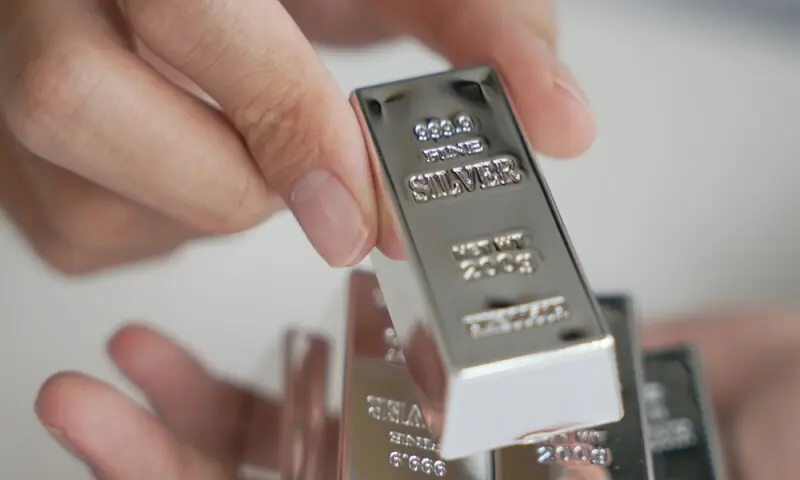
Silver prices in Pakistan have significantly surged over the past three months, closely tracking the global upward trend driven by geopolitical uncertainty and investor demand.
The precious metal has gained 27% in the local market, rising from Rs4,012.76 to Rs 5,100 per tola last week, while international prices climbed 32.9% over the same period, and currently trading above $50 per ounce.
The rally in silver, traditionally viewed as gold’s less glamorous cousin, has been bolstered by similar macroeconomic forces fueling gold’s record-breaking ascent. Gold prices in Pakistan are at record high and hovering around Rs450,000 per tola.
According to market participants, silver’s rise is being driven not only by safe-haven flows amid geopolitical instability but also by robust industrial demand and strategic shifts in global commodity portfolios.
Cross-commodity momentum and de-dollarisation
Ahsan Mehanti, CEO of Arif Habib Commodities, attributed the current bull run to broad-based strength across the commodities complex.
“The global rise in oil, gold, and silver is part of a larger trend. Cross-commodity demand is playing a major role, particularly as palladium prices decline, often an inverse indicator for silver,” he said.
Gold’s glitter dims for Pakistan weddings amid soaring prices
He added that news related to US government shutdown had also impacted the silver prices.
In parallel, easing trade tariffs between the United States and the European Union, along with tentative progress in Middle East peace talks, have also improved sentiment in the precious metals market, according to Mehanti.
BRICS drive demand through de-dollarisation
Zaki ur Rehman, Chief Business Officer at the Pakistan Mercantile Exchange (PMEX), pointed to the large-scale accumulation of gold and silver by BRICS nations as a significant driver of price action.
“With the de-dollarisation agenda accelerating, particularly among China, India, and Russia, metals like gold and silver are increasingly being viewed as alternative stores of value,” he said.
PMEX saw record trading volumes last week, with Rs70 billion worth of transactions – well above the usual Rs50–60 billion range – as traders responded to gold’s historic surge past $4,000 per ounce.
Silver’s dual role: safe-haven and industrial metal
While silver has traditionally played second fiddle to gold, analysts note its unique position as both an investment asset and a critical industrial material.
Adnan Yunus, COO at Interactive Commodities Pvt Ltd, highlighted silver’s growing role in technology and manufacturing.
“Silver’s use in solar panels, electric vehicles, lithium batteries, and electronics such as smartphones and laptops is rising steadily. This dual demand – investment and industrial – is a key differentiator in today’s market,” he said.
He also cited broader geopolitical risks, including US-China trade tensions, the China-Taiwan dispute, and political instability in Europe as factors enhancing silver’s appeal.
Local supply meets global standards
In Pakistan, the silver market is seeing growing formalisation, with three companies – PSL, KBE, and BMW – producing bullion bars that conform to international standards. These bars, ranging from 10 to 100 tolas, feature barcodes, serial numbers, and 999.0 purity certification, reflecting a maturing domestic bullion industry.
Abdullah Abdul Razzaq Chand, Vice President of the Society of Jewellers & Welfare Association (Tariq Road), said silver was no longer simply a cheaper alternative to gold.
“Investment flows are now entering silver globally. In Pakistan too, we are witnessing increased demand not just for jewellery, but also for industrial-grade silver.”
He noted that while gold remained a preferred asset for jewellery and financial hedging, silver’s broader utility in electronics and green technologies was creating new demand dynamics.
Outlook: sustained momentum amid volatility
With silver’s strategic role in energy transition technologies and its correlation to gold as a monetary asset, analysts expect demand to remain strong. However, short-term volatility could persist due to shifting geopolitical developments and macroeconomic indicators, particularly in the US and China.
As Pakistan’s silver market becomes more integrated with global pricing trends and local production aligns with international standards, investors and industrial users alike are likely to maintain a close watch on the metal’s trajectory.
With assistance from Hussain Azfal (Graphics) and Junaid Sanawar (Data).
 American Dollar Exchange Rate