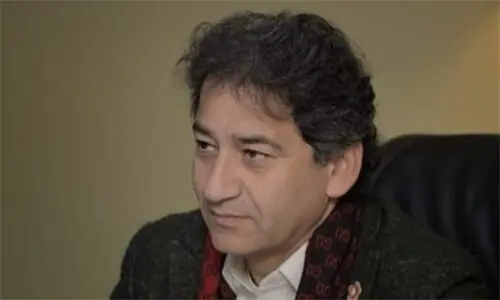

PESHAWAR: The Peshawar High Court has declared that the start of an inquiry by the Khyber Pakhtunkhwa Anti-Corruption Establishment (ACE) against Pakistan Tehreek-i-Insaf leader and MNA Mohammad Atif Khan seven years after the lodging of a complaint is based on mala fide intent and tainted with ulterior motives or political overtones.
A bench consisting of Justice Mohammad Naeem Anwar and Justice Kamran Hayat Miankhel ruled: “The investigating authorities cannot claim unfettered discretion to conduct inquiries or investigations according to their whims; their authority is always subject to the control of law and constitutional supervision of the courts.”
“In the present case, as stated earlier, the revival of a dormant complaint after seven years, particularly, when the matter had earlier been referred to NAB and closed, suggests that the impugned inquiry is not founded on genuine investigative purpose but is tainted with ulterior motives or political overtones,” it ruled.
The bench made several observations against the ACE in its detailed judgement in a petition filed by Atif Khan, seeking quashing of call-up notices to him by the ACE on Oct 31 and Nov 1, 2024 in the inquiry started in connection with alleged irregularities in a private housing society named Fazal Garden, Mardan and Malam Jabba land lease by the then government.
Declares no ‘unfettered discretion’ with ACE to conduct inquiries
The bench has in Sep this year pronounced a short order whereby the call-up notices were declared to be without lawful authority and had quashed all the consequential proceedings arising therefrom.
Senior lawyer Shumail Ahmad Butt represented the petitioner and stated that the issuance of the impugned notices was only to ‘subject’ his client to undue harassment and public humiliation to tarnish his reputation.
He said the matter of Malam Jabba land lease had already been subjected to rigorous investigation by the National Accountability Bureau, which found no trace of any illegality or impropriety and thus the matter stood as past and closed transaction.
The bench observed that the record revealed that the petitioner was a member of the provincial assembly and held the office of minister for education. It was added that on May 28, 2018, the former district nazim of Mardan Himayatullah Mayar, had filed a complaint alleging that the petitioner had illegally transferred 500 kanal agricultural ‘government land;’ in the name of his father and subsequently a private housing society was constructed through government funds.
“The record reveals that the complaint forming the basis of the impugned inquiry was lodged in 2018, while the inquiry No. 8l pertains to year, 2014, but no preliminary or open inquiry was initiated by the Anti-Corruption Establishment (ACE) for almost seven years. The Establishment remained dormant throughout this prolonged period, and only in 2025, after a considerable lapse of time, an inquiry was commenced on the very same complaint containing no fresh allegations or additional material,” the bench observed.
“Though, the Rule provides limited discretion to the competent authority to extend the time for reasonable grounds, yet there is no provision permitting revival of a stale complaint after several years of inaction,” the bench observed.
The court further ruled: “Thus, the initiation of an inquiry after seven years not only defeats the object of Rule 6 (KP ACE Rules 1999), which was designed to ensure prompt and fair investigations and to prevent misuse of administrative machinery for belated or extraneous purposes but also renders the action of Anti-Corruption Establishment highly suspicious; such conduct smacks of mala fide and cannot withstand judicial scrutiny.”
The court further pointed out “In the circumstances initiation of the present inquiry after a lapse of seven years on an old complaint without the discovery of any new material or authorisation under Rule 3, and that too without specific information of the inquiry, amounts to an arbitrary, mala fide, and unlawful exercise of jurisdiction. Such action is inconsistent with Rule 6 of Khyber Pakhtunkhwa Anti-Corruption Establishment Rules, 1999, and violative of constitutional guarantees of due process and fair treatment.”
“It is settled law that ordinarily the superior Courts do not interfere in matters during the investigation phase, as the same falls within the exclusive domain of the investigating agency. However, when mala fide is apparent on the face of record or the action is without lawful authority, the courts cannot remain silent spectators,” it declared.
The bench also referred to multiple judgements of the superior courts on the matter.
Published in media, November 1st, 2025







 American Dollar Exchange Rate