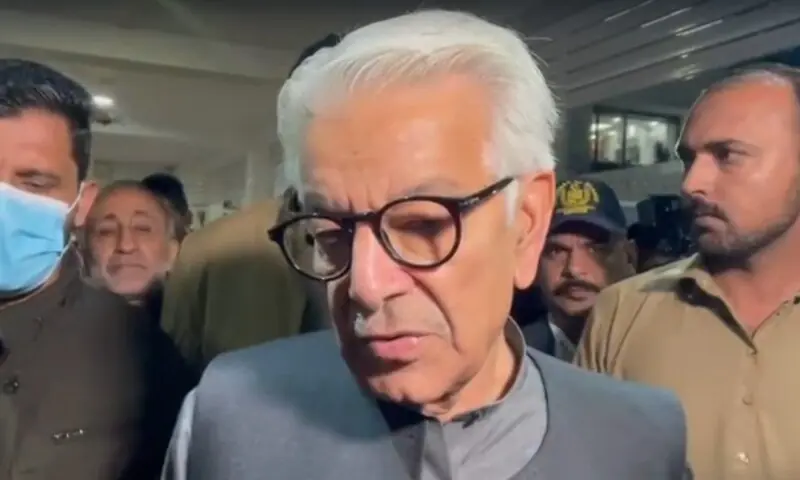
Defence Minister Khawaja Asif on Wednesday confirmed that Pakistan’s delegation had departed for tomorrow’s talks with the Afghan Taliban in Istanbul to find a solution to the current tensions between the two neighbours.
A second round of discussions between Pakistani and Afghan Taliban delegations had begun in Istanbul on October 25, following days of border hostilities, but Islamabad’s long-standing concern over terror attacks emanating from Kabul remained a major point of contention, resulting in a stalemate. A breakthrough came after Turkiye and Qatar salvaged the dialogue process for the second time in less than a week, following Pakistan’s announcement on Oct 29 that the talks had “failed” and that its negotiators were preparing to return home.
The talks produced a three-point understanding — the continuation of the ceasefire, the establishment of a monitoring and verification mechanism to ensure peace, and penalties for violations. The operational details of that mechanism are expected to be finalised when the “principals”, senior representatives from both sides, meet again in Istanbul on November 6.
Talking to the media outside Parliament today, Asif said: “The delegation has gone today and the negotiations will begin tomorrow morning. Let’s hope Afghanistan makes use of wisdom and peace is restored in the region.”
He said Pakistan had a single-point agenda, Afghanistan clampdowns on attacks on the former from the latter’s soil.
Questioned on whether there was hope of a positive development, Asif said talks were only engaged in if there was a possibility of progress; otherwise, it was a waste of time.
27th Constitutional Amendment
Separately, the defence minister said he could not share details regarding the reservations or the discussions taking place over the proposed 27th Constitutional Amendment, adding that the draft would take its “final shape” by next week before being tabled in Parliament.
Asif said PPP Chairman Bilawal Bhutto-Zardari had a complete right to express his opinion on the amendment and that the government was engaging with other political parties in the same spirit to gain their opinion and input.
The defence minister, however, declined to comment on the rumoured proposed changes in the upcoming constitutional amendment.
Border skirmishes and talks
Pakistan and Afghanistan saw a worsening of ties during recent weeks, which featured border skirmishes, counter-statements and allegations.
The hostilities began last month when an attack was launched on Pakistan from Afghanistan on the night of October 11. The attack had followed an allegation from the Afghan Taliban of airstrikes by Pakistan into Afghanistan — an accusation which Islamabad has neither confirmed nor denied.
For its part, Islamabad has long demanded that the Taliban stop terror groups from using its soil against Pakistan. The Taliban, however, deny the allegation of allowing terrorists to operate from Afghan soil.
Meanwhile, Pakistan continues to grapple with the issue of terrorism and has suffered multiple casualties among security forces in intelligence-based operations.
After the initial skirmish on October 11, multiple others took place along the Pakistan-Afghanistan border. Meanwhile, strikes by Islamabad also targeted Gul Bahadur group camps in Afghanistan.
Eventually, the two sides came together for dialogue in Doha, which resulted in a temporary ceasefire, as well as a commitment to reconvene in Istanbul to work on mechanisms for lasting peace and stability between the two countries.
Türkiye and Qatar have deep ties with Pakistan, while Qatar also played a major role in the negotiations between the Afghan Taliban and Nato forces.
 American Dollar Exchange Rate