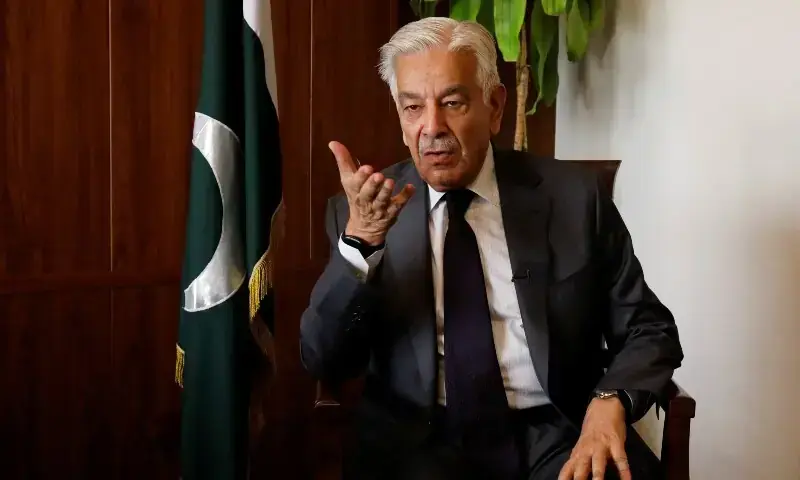
Defence Minister Khawaja Asif on Tuesday said Pakistan was in a “state of war” after at least 12 people were killed and 36 were injured on Tuesday in a suicide blast in the federal capital, adding that it was futile to hope for any positive outcome of talks with Kabul after the incident.
The incident occurred as international events were being hosted in the capital, including the Inter-Parliamentary Speakers’ Conference and the 6th Margalla Dialogue, while a cricket match between the Greenshirts and Sri Lanka was also being held in Pindi.
Prime Minister Shehbaz Sharif blamed the incident on terrorists “active with Indian support”. The incident comes following a breakdown in negotiations with the Afghan Taliban government.
“We are in a state of war. Anyone who thinks that the Pakistan Army is fighting this war in the Afghan-Pakistan border region and the remote areas of Balochistan should take today’s suicide attack at the Islamabad district courts as a wake-up call: this is a war for all of Pakistan, in which the Pakistan Army is giving daily sacrifices and making the people feel secure,” said the defence minister in a post on X.
“In this environment, it would be futile to hold out greater hope for successful negotiations with the rulers of Kabul.”
He said Kabul could put a stop to the ongoing terrorism in Pakistan, “but bringing this war all the way to Islamabad is a message from Kabul, to which … Pakistan has the full strength to respond”.
Elaborating on his post later in an interview on Hum News show ‘Faisla Aap Ka’, Asif said he wanted to remain careful about talks with Afghanistan or their results since he could not say with absolute certainty that they would fail. He added that negotiations should still be held but the decision would have to be taken by Pakistan’s leadership and defence forces.
Asif said today’s incident was a “huge escalation in this war and we will have to seriously review what path we have to adopt for them”.
He further said today’s attack, as well as the incident in Wana, had “raised the stakes in this state of war against Afghanistan”. “We should take this with the utmost seriousness,” he added.
The defence minister said Pakistan was “prepared to face the enemy on both the western and eastern borders”.
He added: “If these people want a final round and for all-out hostility to begin, then what other option will we have. I am a proponent of negotiations but you should sit at the talking table with sincerity and the objective of peace should be pursued with sincerity.”
The minister said today’s incidents must be taken into account in any future talks.
Questioned about the failure of the talks in Istanbul, Asif said the entire matter boiled down to the Afghan Taliban not wanting to curb terrorism.
Earlier today, PM Shehbaz said that Kabul must understand that lasting peace could only be achieved by reining in terrorist groups operating from Afghan soil.
The premier especially called attention to the recent border clashes between Pakistan and Afghanistan, calling Islamabad’s response “firm and decisive, teaching an unforgettable lesson”.
Three top Turkish officials are due in Islamabad this week to discuss tensions between Afghanistan and Pakistan, according to Turkish President Recep Tayyip Erdogan.
Turkiye and Qatar have been acting as mediators between Islamabad and Kabul following an escalation of tensions between the two neighbours over the past weeks.
Border clashes and talks
Talks between Pakistan and the Afghan Taliban followed weeks of shuttle diplomacy after deadly border clashes last month plunged relations between the two neighbours to their lowest point since the Taliban seized power in Kabul in 2021.
The hostilities began when an attack was launched on Pakistan from Afghanistan on the night of October 11. The attack had followed an allegation from the Taliban of airstrikes by Pakistan into Afghanistan — an accusation which Islamabad has neither confirmed nor denied.
For its part, Islamabad has long demanded that the Taliban stop terror groups from using its soil against Pakistan. Taliban, however, deny the allegation of allowing terrorists to operate from Afghan soil.
Meanwhile, Pakistan continues to grapple with the issue of terrorism and has suffered multiple casualties among security forces in intelligence-based operations.
After the initial skirmish on October 11, multiple others took place along the Pakistan-Afghanistan border. Meanwhile, strikes by Islamabad also targeted Gul Bahadur group camps in Afghanistan.
A ceasefire was then agreed upon on October 15 in the evening, and eventually, the two sides came together for dialogue in Doha.
Since the skirmishes between Oct 11 and 15, Pakistan and Afghan Taliban representatives have held two rounds of talks — first in Doha and then in Istanbul — but a final agreement has not yet been achieved.
After the Doha talks, a temporary ceasefire continued to prevent border hostilities while the two sides committed to reconvene in Istanbul to work on mechanisms for lasting peace and stability between the two countries.
On October 25, the second round of talks between the two sides began in the Turkish capital. But, Information Minister Attaullah Tarar announced in a post on X on October 29 that the talks “failed to bring about any workable solution”. He also asserted that Pakistan would continue to take all possible measures to protect its citizens from terrorism.
However, mediators Turkiye and Qatar intervened and managed to salvage the dialogue process, with an October 31 joint statement released by Turkiye stating that “further modalities of the implementation will be discussed and decided” during a principal-level meeting in Istanbul on November 6.
For the third round, under the joint mediation of Turkiye and Qatar, delegations from both sides arrived in Istanbul last week but could not come to an agreement.
 American Dollar Exchange Rate