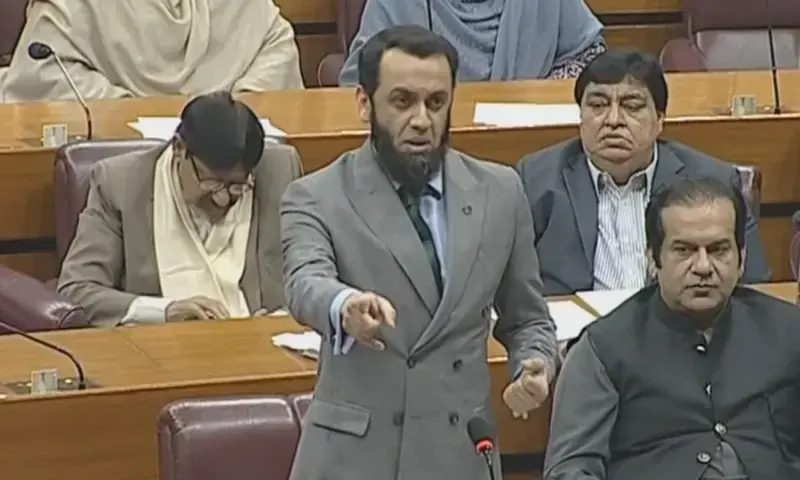

As the National Assembly (NA) resumed debate on the 27th Constitutional Amendment bill on Wednesday — a day after Law Minister Azam Nazeer Tarar tabled the draft for deliberation in the lower house of Parliament — Information Minister Attaullah Tarar derided the opposition for rejecting the proposed legislation.
Referring to opposition members’ speeches before his, he said it seemed the other could not recall any events preceding 2022 — when Imran Khan, who party is now in the opposition, was removed as the prime minister.
He took an exception to the opposition protest movement against the 27th Amendment under the slogan of Aise dastoor ko subh-e-be-nur ko main nahi manta main nahi janta (This constitution, this morning bereft of light, I refuse to accept, I refuse to acknowledge).
They read this but fail to say “Iss khule jhoot ko zehen ki loot ko main nahi manta main nahi janta”. (This blatant lie, this stealth of intellect, I refuse to accept, I refuse to acknowledge).
“When they read this couplet of Habib Jalib, they do it selectively. When they talk about fascism, they talk about what they deem fascist,” he said.
He alleged that the PTI had been accepting of “fascism” in the past, saying that in contrast, when Parliament — the highest institution of the country — was on its way to pass a constitutional amendment through a legal strategy, political process and consultation today, they had a problem with it.
“This selective morality, selective justice, double standards — what exactly is their politics other than this?,” Tarar said, asking why the PTI did not chant such slogans when former NA deputy speaker Qasim Khan Suri made the unconstitutional move of dismissing the no-confidence motion against ex-premier Imran Khan in 2022.
“This is their selective memory,” the PML-N leader added. He noted that many politicians were once part of the PML-N, including PTI’s Shahid Khattak, and said a person “who cared more about his own self than national interests sowed the seeds of hatred”.
“Will he apologise now? […] Will he apologise today for violating the Constitution? It was violated in this very assembly, in this chair. They talk about an apology, so I would like to hand them the list of their sins,” Tarar said.
The minister questioned whether PTI’s Shehryar Khan Afridi gave any suggestions for “improving” any clause in the proposed 27th Amendment.
“Their selective memory and thinking do not go back any further than 2020,” Tarar said, referring to the PTI. “They should apologise for what they did in 2017 and the way they came into power through the back door.”
The PML-N leader also criticised the PTI for consistently bringing up the Form-47 controversy following the 2024 general elections.
He taunted the opposition party for having different factions: “There is one faction which brings laptops inside the assembly, but it is Zain Qureshi who suffers, and these people who are sitting here turn on their YouTube camera and preach to people.”
Tarar quipped that some leaders would be part of the government cabinets but would “flee on the first flight they can find when things get even slightly difficult”. “It is a policy of their party to play good cop, bad cop. They will sit here and talk about the political process while someone out there in different countries will attack state institutions.”
He regretted that “most of Mahmood Khan Achakzai’s speech today was all about Kabul”.
“It is a new trend now to say something that will become a headline in India or Kabul,” he decried.
He then accused the PTI of “polluting the minds of political workers and inciting them to commit crime for political interests”, and later “ditching them” — a reference to May 9, 2023 protests and their consequences for the party.
Continuing his criticism, he said the PTI had not given any recommendation for the proposed amendment and boycotted parliamentary committee meetings.
“They refuse to become a part of the process.”
He said the PTI had not learned anything in the past four years. “If they had, they would have held talks on the 27th Amendment and become a part of the political process.
“Had they done some research […] we would have had a productive discussion here in the house. We would have sent out a message to the world that Pakistan’s Parliament had held a very fruitful debate on the matter.”
Speaking of Article 243, which deals with the command of armed forces, he mentioned the improved perception of Pakistanis world over.
Referring to Achakzai’s speech again, he said the use of Afghan soil for terrorism in Pakistan would not be tolerated.
He argued that the primary purpose of the 27th Amendment was to improve governance, defence and the delivery of justice. The minister also maintained that the amendment was not being passed in haste and all issues included in it were being discussed for years under the Charter of Democracy.
However, speaking before him, PTI’s Shehryar Khan Afridi had alleged that the government was “protecting themselves in their haste”.
Referring to a proposed change under the amendment to grant the president lifetime immunity from criminal proceedings, he said had President Asif Ali Zardari refused this relief, his respect and honour would have increased. “But today, his actions have resulted in not just the funeral of his honour, but also the PPP’s.”
He termed the 27th Amendment “a simple mockery of the people of Pakistan” and called for the government to learn from past instances. He said the 27th Amendment was a “scar on the face of democracy. The 27th Amendment will humiliate us globally at all levels”.
PPP’s Nafisa Shah defends her party’s role
PPP’s Nafisa Shah also addressed the house, defending her party’s role in the proposed legislation.
Responding to the opposition’s criticism, she said the PPP’s role in the 26th or 27th Constitutional Amendments would have to be viewed taking into consideration the clauses that had not been included in those bills.
“I want to make a list of those. Some of them are a work in progress, but some of them are those that the PPP had already crushed,” Shah continued. “And for that, you will have to acknowledge and laud the PPP’s role”.
She then went on to say that some of the provisions that had not been included in the amendment bill were those regarding the federal structure and resources.
Shah then held up a paper, apparently the draft of the 27th Constitutional Amendment bill, and said: “Article 163-A is not mentioned in here. Why is it so, and why is it important? It is important because whether it is the 18th Amendment [or the] NFC (National Finance Commission) award, 163-A is a very important provision.”
She said the proposed changes pertaining to this subject had not been included in the bill because the PPP refused to accept them. The provincial autonomy has to remain intact, she emphasised.
“So, 163-A, which is limiting the provincial share in the NFC, has not been tabled,” she asserted, adding, “I think you have to credit the PPP for that.”
Shah further stated that changes had also been recommended to “enhance executive powers, executive magistracy”. The PPP, she said, had also raised objections to this proposal and did not let it become a part of the bill.
Likewise, the PPP had also ensured the exclusion of amendments pertaining to dual nationality in the bill.
Moving on to the appointment of the chief election commissioner (CEC), she called for the opposition to engage on this matter.
“There is an ongoing debate on this, and all political parties should sit together on this,” she emphasised, adding that the provision relating to the CEC’s, too, had not been tabled.
On the proposed amendments to Article 243 of the Constitution, which deals with the command of armed forces, she said the suggested changes were about the “command structure”.
“The reform of this command structure just has to be viewed in the perspective of [us] winning a war, winning a difficult war,” Shah said, adding that the other war that the country was engaged in could not be pinned down.
Referring to yesterday’s bomb blast in Islamabad, she said, “This asymmetric war is not just on wars. It is neither [being fought] in the east or the west. Neither it is being fought on our frontiers with Afghanistan nor on the eastern border.
“This is going on internally. And to face these proxy wars, asymmetric wars, we not just need national unity, but also we need to support our armed forces.”
On the basis of these ground realities, Bilawal took the stance to “support this change in command”, she explained.
Shah then went on to address the “most contentious” issue of judicial structure under the proposed amendment. She highlighted two key matters in this regard: the establishment of a Federal Constitutional Court and the transfer of judges.
“We have a historical baggage, having faced the consequences of such judicial judgements that are quoted in jurispudence world over because they are strange concoctions. This is the doctrine of necessity,” she said, adding: “It was a concept that had been buried in jurisprudence. In fact, it had been buried in the annals of history.”
But then, she continued, “some judge — I think you will better remember his name, justice Munir I think — he brought it out of nowhere. And this dictum means that which is illegal by law is law by necessity”.
This dictum was used to dismiss elected parliaments, constituent assemblies
and several prime ministers, she added.
In view of this, late prime minister Benazir Bhutto and PML-N supremo Nawaz Sharif maintained in their wisdom that “we do not want a judiciary that rationalises unconstitutional rule, that dismisses elected prime ministers, dismisses parliaments”.
It was in this perspective that the establishment of an FCC was suggested, and therefore, “we are talking about a constitutional court here”.
On the transfer of judges, she said the PPP endorsed the relevant proposed changes to the extent that transfers should not be used to “arm twist the judges”.
Earlier in her speech, she admitted that many provisions of the proposed 27th Amendment “are something that really need a lot of discussion, that may be a little bit controversial”. But, she continued citing PPP Chairman Bilawal Bhutto-Zardari, “the circumstances that we are in, you cannot let go off whatever space you are getting — be it a mile or an inch — if you have to move toward civilian supremacy”.
“We have to take whatever space we get. Boycott is not an option,” she asserted.
She added that the PPP had “always engaged positively with the Constitution, with the parliament”.
According to a post on the PPP’s Twitter, Bilawal, along with sister and MNA Aseefa Bhutto-Zardari, has also reached Parliament.
Speaker urges opposition to hold dialogue
The NA proceedings began today with NA Speaker Ayaz Sadiq giving the floor to Pakhtunkhwa Milli Awami Party (PkMAP) chief Mehmood Khan Achakzai. At this point, the live feed from the NA on its YouTube channel was disrupted.
When the live feed restored, Speaker Sadiq appeared on the screen, thanking Achakzai. He said Prime Minister Shehbaz had repeatedly invited the opposition in the house to hold talks.
“As the speaker of the National Assembly of Pakistan, I am ready to facilitate a dialogue between the government and the opposition. We will find ways out when you hold talks,” he continued.
The stream was then briefly disrupted again, and when it resumed, Sadiq was saying if “you want to find an excuse not to hold negotiations, then it is our bad luck. Accept my offer, hold talks. You will get results through talks.”
Following that, PTI Chairman Barrister Gohar Ali Khan asserted that “we never gave up on dialogue”.
“When our mandate was stolen, [Imran] Khan sahib had nominated Shibli sahib, Omar sahib and Ali Amin Gandapur to hold dialogue. People then started saying that we wanted to talk to the establishment and not politicians.
“So I visited Khan sahib, and we announced outside Adiala Jail that Achakzai sahib had the complete mandate if he wanted to engage the party and make any suggestions from his platform. Achakzai sahib is present here [today]. Efforts were made, but nothing transpired,” Gohar said, with the live stream being disrupted again at this point.
When it resumed, the PTI chairman was reiterating his party’s request to let Khyber Pakhtunkhwa Chief Minister Sohail Afridi meet PTI founder Imran Khan in jail.
Responding to him, the speaker said: “Gohar sahib, when your offer was made, you did not even come to me personally. The prime minister showed grace and formed a high-powered committee of the allies.”
The committee held three meetings, but they were not boycotted by this side, Sadiq said, pointing towards the treasury benches. The meetings were boycotted from this side, he added, pointing towards the opposition benches.
How many votes are required?
According to the NA’s agenda for today, after discussion on the proposed legislation, the bill will then be moved by the law minister for the house’s approval.
The PML-N-led coalition government on Monday succeeded in manouvering the passage of the contentious bill through the Senate amid the opposition’s protest.
It now needs the NA’s approval, which means the support of a two-thirds majority in the 336-member house, followed by the president’s assent.
The ruling coalition commands the required number, with the PML-N holding 125 seats, PPP 74, Muttahida Qaumi Movement-Pakistan 22, Pakistan Muslim League-Quaid five, Istehkam-i-Pakistan Party four, and the Pakistan Muslim League-Zia and Balochistan Awami Party and National Peoples Party one seat each. Meanwhile, the opposition has 103 seats.
‘If bill is tabled today, it will surely be passed’
Speaking to the media outside Parliament today, Information Minister Attaullah Tarar said if the amendment bill was tabled in the NA for voting today, it would surely be passed.
He also expressed his wish for the opposition to have “engaged in a fruitful clause-by-clause discussion” on the bill.
Creating an uproar without even going through the bill and spinning a narrative would not result in any gain, he said.
Upon being asked whether PML-N supremo Nawaz Sharif would be visiting Parliament today, he said: “We will also have him meet you”.
Opposition to the bill
The bill proposes the creation of a Federal Constitutional Court (FCC) as well as changes to the military leadership structure.
Taking exception to the proposed tweaks, opposition alliance Tehreek Tahafuz Ayeen-i-Pakistan has announced a nationwide protest movement against the proposed amendment, urging the people to take a stand against the “extremely dark and dangerous” change in the Constitution.
While debating it in the NA yesterday, PTI Chairperson Barrister Gohar Ali Khan accused the government of attempting to “create another elite class” by means of the bill. He made these remarks particularly in reference to a proposal in the bill to grant the president lifetime immunity from criminal proceedings and arrests, except for the period during which he holds public office following the end of their tenure.
Gohar also warned that “with the passing of the [27th] Amendment, democracy here will only exist in name,” adding that his party “will not accept” it.
Sardar Latif Khosa from his party accused the PPP of “playing naughtily” with the Constitution at the behest of the ruling PML-N.
Similarly, PTI leader Amir Dogar warned the 27th Amendment would paralyse the judiciary, adding that none of its clauses served the public interest.
On the other hand, PML-N’s Barrister Daniyal Chaudhry defended during yesterday’s NA session the planned establishment of the FCC, saying the move was aimed at preventing extra-judicial decisions and reducing the Supreme Court’s (SC) workload.
Speaking on the occasion, PPP leader Shazia Marri asserted that President Asif Ali Zardari did not seek immunity as he had already endured eight years of imprisonment without conviction. She said the PPP would never compromise on the 18th Amendment or the rights of the people.
Health Minister Syed Mustafa Kamal of the MQM referred to Article 140-A, which relates to local governments, and said his party’s proposed amendments to the article “are not dead yet” and would be discussed as part of a 28th amendment.
Defence Minister Khawaja Asif endorsed the MQM’s call for strengthening local governments to address people’s issues at the grassroots level.
Former and sitting judges, as well as lawyers, have also voiced opposition to the proposed amendment, particularly citing its implications for the Supreme Court.
Passage of the bill so far
The government’s plan to make a 27th Amendment to the Constitution is taking shape roughly a year after it managed to get the 26th Constitutional Amendment approved.
The 26th Amendment was passed by Parliament during an overnight session in October 2024, with the PTI claiming seven of its lawmakers were abducted to gain their favour as the party opposed the legislation. The Balochistan National Party-Mengal (BNP-M) also alleged its two senators were being pressured, with both later defying party line to vote in the tweaks’ favour.
In the following months, even though the 26th Amendment remained mired in controversy and continued to face challenges in the court, the power corridors in Islamabad remained abuzz with talk of a possible 27th Constitutional Amendment.
The speculation about whether the government intended to further tweak the Constitution was put to rest when PPP Chairperson Bilawal Bhutto-Zardari announced on social media platform X on November 3 that a Prime Minister Shehbaz-led delegation had sought his party’s support for the amendment.
Subsequntly, PM Shehbaz had also held consultations with other ruling allies to secure support for the controversial amendment.
The bill was then tabled in the Senate on Nov 8, just hours after it was approved by the federal cabinet in a meeting chaired by PM Shehbaz via a video link from Baku. It was subsequently referred to the Senate and NA standing committees on law and justice, which approved it the very next day with some minor changes to the initial draft.
Law Minister Tarar tabled it in the Senate for voting on Nov 10. The contentious bill was approved by the upper house of Parliament after 64 lawmakers voted in its favour, with members of the opposition staging a noisy walkout. The PML-N led coalition government had managed to secure a two-thirds majority to get the bill passed with the unexpected support of two opposition senators who voted against their party lines.






 American Dollar Exchange Rate