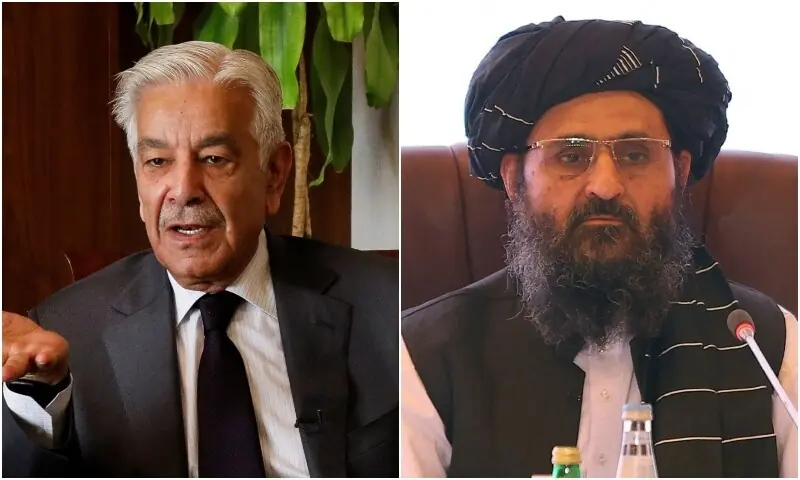

Defence Minister Khawaja Asif on Wednesday was dismissive of Afghanistan’s intent to reduce transit trade, saying the move would only “benefit” Pakistan.
Relations between Pakistan and the Afghan Taliban are at their lowest point in the four years since the group came to power.
Border crossings between the two countries have remained closed since October 11 and trade has been at a standstill following ground fighting and Pakistani airstrikes across their 2,600-kilometre frontier that killed dozens on both sides in the worst fighting since the Taliban’s 2021 takeover of Kabul.
“For us [it will have no impact], instead, I think it will be a relief for us because the amount of goods that are booked for Karachi Port from Afghanistan, ultimately, all end up in Pakistani markets,” said Asif while speaking on Geo News.
The defence minister added that the goods imported from across the border had no consumption in Afghanistan and ended up disrupting Pakistan’s local markets. The minister also added, “When their trade traffic reduces here, then terrorism that penetrates Pakistan in the guise of trade and other forms will also reduce, and border management will improve for us.
“I think this is a blessing in disguise for us that they’re seeking alternate routes and Pakistan will only benefit from this, not lose out in any way.”
‘Find alternate routes’
Earlier today, Afghanistan’s Deputy Prime Minister for Economic Affairs, Mullah Abdul Ghani Baradar, asked Afghan traders to find alternative routes instead of Pakistan while speaking at a gathering of merchants, industrialists, and officials from the Ministry of Finance in Kabul.
“The Pakistani route has not only harmed our traders but has also caused difficulties for the markets and the people,” the Taliban deputy prime minister claimed.
“I urge all traders to quickly complete the search for alternative routes for exports and imports so that Afghanistan’s exports and imports are not affected,” Mullah Baradar said.
He cited the closure of borders by Pakistan as the reason for the decision and sought guarantees that borders would not be shut in the future. The Taliban official said roads would remain closed until Pakistan provided “credible guarantees”.
“If Pakistan wants the routes to be opened, it will do so with firm and credible guarantees that they will not be closed again under any circumstances or conditions,” he said.
“Even before this, when it was time for Pakistani goods to be produced, the routes were open, but when it was the season for our fresh fruits, Pakistan used to close the routes under various pretexts, even causing the fruits to spoil,” Baradar claimed.
“We are telling you clearly that if traders export or import goods from Pakistan after this, the Islamic Emirate will not be responsible for their problems and their voices will not be heard.”
Mullah Baradar added that those who import medicines from Pakistan should start importing from other countries as soon as possible.
“If someone has made purchases and contracts in Pakistan, they are given three months to clear all their accounts there and close them,” he said.
He also asked the country’s finance ministry not to allow anyone to import medicines from Pakistan.
The Taliban official added that Pakistan had closed trade routes many times and they were still closed. “It has gained political interests through trade and humanitarian issues and has harmed traders and industrialists of both countries. We have taken these decisions based on these reasons.“
The Taliban government decided to restrict trade with Pakistan after the third round of talks in Turkiye ended inconclusively. Officials from both countries have blamed each other for the “failure” of the talks, and the possibility of a resumption remains unclear.
What do Pakistani traders say?
Engineer Manzoor Elahi, former senior vice president of the Sarhad Chamber of Commerce and Industry, said Pakistan would suffer more if Afghanistan stopped trade with the country as Iran and India provided Afghanistan with cheaper medicines.
“Uzbekistan and Russia export them (Afghanistan) sugar. They do not need us, but we need them. Our industries would be affected,” Elahi told media.
“Iran and Turkey have captured our market in Afghanistan. They now import items from Uzbekistan, Tajikistan, Russia and Ukraine. They do not need us, but we need the Afghan market,” he said.
He added that Pakistan would not only lose the Afghan market but would also lose the Central Asian market.
“We export several items to Central Asia, and currently, between 500 and 1,000 containers of kinnows go to Afghanistan and Central Asian states daily. Fruit, bananas, and fresh fruit will be badly affected. Around $100-200 million worth of daily markets will be affected in Central Asia,” the business leader said.
Ziaul Haq Sarhadi, vice-president of the Pak-Afghan Joint Chamber of Commerce and Industry (PAJCCI), said around 8,000 trucks have been stranded on both sides since border crossings were closed last month.
Sarhadi told media that traders do not object to Pakistan’s security concerns but appeal to the government to allow stranded trucks to cross the border on humanitarian grounds.
Head of the Afghan chapter of the PAJCCI, Khan Jan Alokozai, said Afghan traders still want to do business via Pakistan as it is the shortest route.
However, he told media that Mullah Baradar’s concerns about the border closure were genuine and should be addressed.
“Pakistan is important for Afghanistan and Afghanistan is important for Pakistan, but if borders are closed, then we would be forced to find alternate routes,” Alokozai said.
He said Pakistan would lose the Central Asian market if the current situation remains the same, adding that Pakistan exports 300,000-500,000 tonnes of potatoes to Central Asia via Afghanistan during the season.
The month-long closure of the Torkham border crossing has caused a cumulative loss of over $45m and another Rs16.5 billion in terms of exports and imports, respectively, through Pakistan’s trade with Afghanistan.
Sources among official and trading circles had told media that Pakistan had already lost over 65 per cent of the Afghan market to Iran, some Central Asian States, Turkiye and even India due to hostile and aggressive trade policies dictated by security issues since the installation of the Taliban regime in Kabul in August 2021.
They said that while major Pakistan and Afghan exporters had lifted their capital from the export-import business between the two neighbouring countries due to the repeated border closure and a hostile environment for traders and investors, the month-long closure of all border points had seriously dented the confidence of the remaining “bunch” of small traders.
The sources said that while the uncertain situation had also dealt a severe blow to the burgeoning local manufacturing industry in Khyber Pakhtunkhwa, the border closure had seriously impacted the manufacture of hundreds of daily items in Punjab and Sindh, which were exported to Afghanistan under the head of miscellaneous items daily before the closure of the border.
They said that Afghanistan was currently importing cement, garments, shoes and slippers, a variety of edibles, including different vegetables, fresh fruits, fish, chicken and other poultry items, animal feed and confectionery items.
The sources said that the prolonged border closure had negatively impacted the potato and banana exports, while the kinnow export was also in doldrums if immediate steps were not taken to ease border tensions.





 American Dollar Exchange Rate