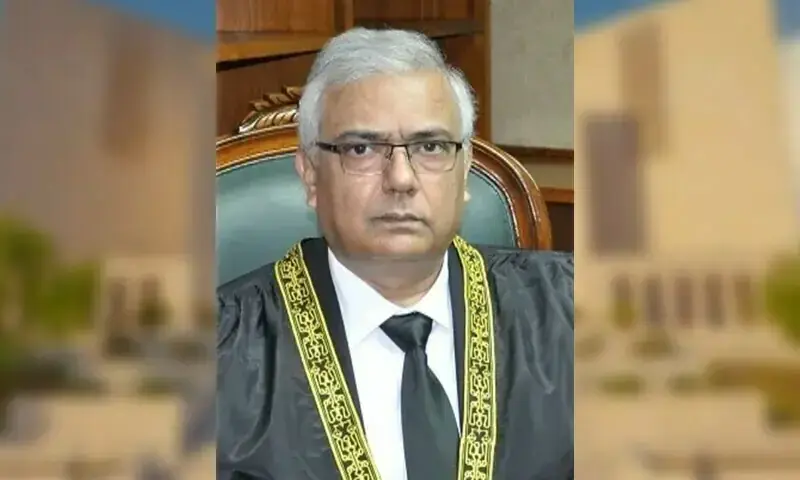

Justice Aminuddin Khan was on Thursday appointed the inaugural Chief Justice of the Federal Constitutional Court (FCC).
The development comes hours after the 27th Constitutional Amendment was signed into law by President Asif Ali Zardari and shortly after Supreme Court Justices Mansoor Ali Shah and Athar Minallah resigned from their offices in protest.
A notification from the law ministry said President Zardari made the appointment under clause (3) of Article 175A read with Article 175C of the Constitution, adding that it would come into effect from the date that Justice Khan took his oath.
The judge will take the oath at the Presidency tomorrow at 10am. The chief justices and judges of superior courts, high-ranking officials have been invited to participate in the oath-taking ceremony
Justice Khan was born in Multan in 1960. A second-generation lawyer, he earned his LL.B from University Law College, Multan, in 1984 and began practice under his father, Khan Sadiq Muhammad Ahsan.
He became an advocate of the Lahore High Court (LHC) in 1987 and of the Supreme Court in 2001. He joined Zafar Law Chambers in Multan in 2001 and worked with the legal firm until he was elevated to the position of a judge in 2011, where he decided civil cases on the Multan and Bahawalpur benches.
He was sworn in as a Supreme Court justice in 2019, taking his oath of office from then-chief justice Asif Saeed Khosa.
He was made the head of the Supreme Court’s Constitutional Bench in November 2024, while ranking fourth in seniority among Supreme Court judges.
Justice Khan has decided thousands of cases pertaining to civil matters and most of his judgments have been upheld by the Supreme Court. During his career, he assisted renowned lawyers like Mian Nisar Ahmed and Umar Ata Bandial.
Sources had told media the FCC would initially comprise six other judges — four from the Supreme Court and two from the high courts — besides the chief justice. The names being discussed for the inaugural composition included Justice Hasan Azhar Rizvi, Justice Musarrat Hilali, Justice Aamer Farooq, and Justice Baqar Najafi from the SC, while Justice KK Agha of the Sindh High Court and Justice Rozi Khan Barrech, the incumbent Chief Justice of Balochistan High Court, were being considered from the high courts.
The sources had also said that the initial strength of the FCC would be determined through a Presidential Order, while any subsequent increase in the number of judges would require approval through an Act of Parliament.
Officials at the law ministry confirmed that the President, acting on the advice of the prime minister, would issue the formal appointment orders. They added that under the provisions of the amendment, the President would be constitutionally empowered to make such appointments to the newly-constituted court.
The proposal to establish the Federal Constitutional Court was revived as part of the judicial reforms package incorporated in the 27th Constitutional Amendment Act.
The amendment aimed to rationalise the jurisdiction of the Supreme Court and introduce greater efficiency in the adjudication of constitutional questions.
According to government officials, the creation of the FCC is intended to reduce the Supreme Court’s workload, ensure timely adjudication of constitutional cases, and strengthen the independence and credibility of the judicial system. The concept of a separate constitutional court is not new.
It was first introduced in the Charter of Democracy (CoD) signed by the PPP and the PML-N in 2006.
The CoD envisaged the establishment of a specialised court dedicated solely to constitutional matters, allowing the Supreme Court to focus primarily on its appellate jurisdiction.
The idea resurfaced during discussions on the 26th Constitutional Amendment, but was shelved at the time following resistance from the Jamiat Ulema-i-Islam-Fazl and certain other political factions.
Under the current proposal, judges serving in the FCC will retire at the age of 68 years — three years higher than the retirement age for Supreme Court judges, who retire at 65.
The new court will not be housed within the Supreme Court premises. Officials indicated that it is likely to be established in the Federal Shariat Court (FSC) building in Islamabad. In turn, the FSC is expected to be relocated to the third floor of the Islamabad High Court building.
However, sources within the FSC revealed that its judges are unhappy with their abrupt relocation and have raised their concerns before the chief justice of Pakistan.







 American Dollar Exchange Rate