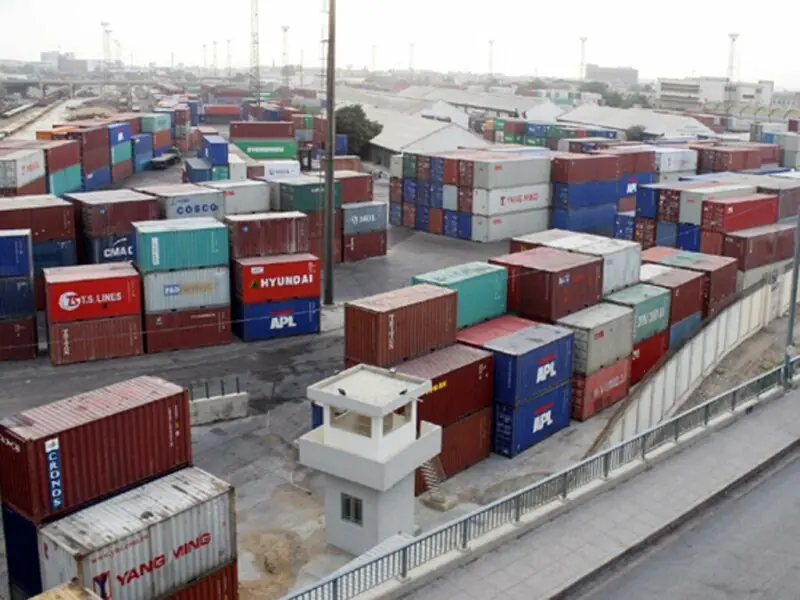

KARACHI: Traders are reportedly incurring substantial additional cost of approximately USD 750 million per month due to unsatisfactory port terminal services.
The issue was raised during the first meeting of the Joint Trade Facilitation Committee (JTFC) convened at the Custom House Karachi on Friday.
The meeting, chaired by Wajid Ali, Chief Collector Appraisement (South), brought together key stakeholders from Customs authorities, business chambers, and port terminal representatives to discuss critical challenges hindering trade facilitation.
Asif Sakhi, Vice President of the Federation of Pakistan Chambers of Commerce and Industry (FPCCI), and Muhammad Arshad Jamal, Former Vice President FPCCI, presented the business community’s agenda, highlighting several pressing issues requiring immediate attention.
Arshad Jamal informed the committee that traders are incurring substantial additional cost of approximately USD 750 million per month due to unsatisfactory port terminal services.
The FPCCI representatives called for minimizing unnecessary physical examinations of cargo through improved trader profiling based on performance history.
They also advocated for mandating container scanning as an alternative to physical examination wherever applicable, which would significantly reduce clearance time.
A major concern raised during the deliberations was the acute shortage of examiners and assessors relative to examination volumes, which has created substantial backlogs. The business community proposed increasing personnel numbers and constituting a dedicated task force to streamline examination processes and prevent delays in shipment clearance.
Representatives from the services sector, including Arshad Khursheed, Chairman of the Association of Pakistan Customs Agents (APCAA), Yayah Muhammad, President of Karachi Customs Agents Association (KCAA), and Sheikh Waqas Anjum, General Secretary KCAA, raised serious concerns about port terminal performance.
They specifically highlighted that Karachi International Container Terminal (KICT) and South Asia Pakistan Terminals (SAPT) are operating beyond capacity, lacking sufficient space, skilled labor, machinery, and technical expertise required for efficient cargo handling and examination arrangements.
Following extensive discussions with representatives from the Karachi Chamber of Commerce and Industry (KCCI), APCAA, KCAA, and port terminals, Wajid Ali emphasized the government’s commitment to facilitating trade and industry.
“The Joint Trade Facilitation Committee was constituted for this very purpose,” Wajid said, urging all stakeholders to collaborate in formulating comprehensive policies and laws aligned with international best practices to reduce dwell time and lower the cost of doing business.
The chief collector invited FPCCI to prepare and submit proposed Standard Operating Procedures (SOPs) and a policy framework for consideration at the next meeting. He assured the business community that Customs authorities remain committed to constructive engagement and resolving trade-related issues.
“Our doors remain open, and my team is fully committed to facilitating legitimate business activities in Pakistan,” Wajid added.
Copyright media, 2025






 American Dollar Exchange Rate