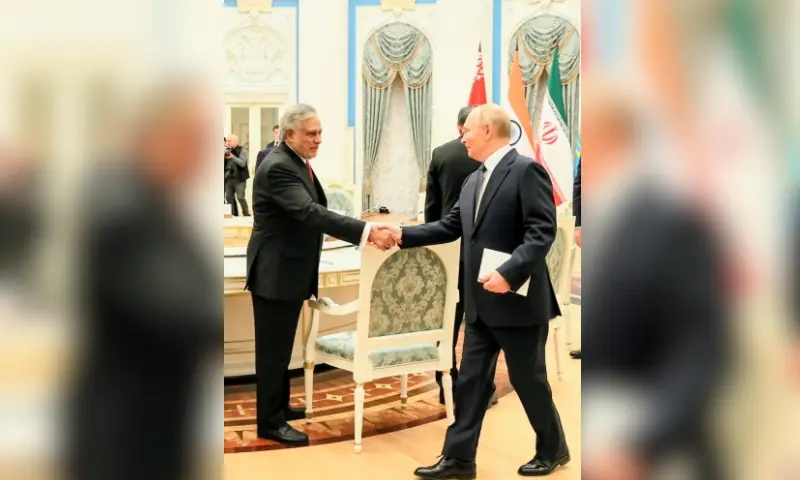
Deputy Prime Minister and Foreign Minister Ishaq Dar on Tuesday met with senior Russian and Chinese leadership at the Shanghai Cooperation Organisation (SCO) Council of Heads of Government summit, according to the Foreign Office (FO).

The SCO is holding its Council of Heads of Government summit in Moscow from November 17 to 18. Taking place under Russia’s rotating presidency, the high-level meeting follows the landmark Tianjin summit three months earlier and comes at a pivotal moment for Eurasian economic connectivity in a shifting global order.
At the heads of government gathering, Dar met Russian President Vladimir Putin, along with other SCO heads of state and senior officials. In a post on X, the FO said that Putin welcomed leaders to the summit in the Russian capital.
He also “emphasised the importance of strengthening regional economic cooperation under the SCO, highlighting its role as a key platform for connectivity, stability, and mutually beneficial development across the region”.
Dar also met Chinese Premier Li Qiang, where the pair “reaffirmed the ‘all-weather’ Pakistan-China strategic partnership, reviewed bilateral and multilateral cooperation — especially within the SCO — and praised the Shanghai Spirit principles guiding regional collaboration”.
The post added that the FMs exchanged views on global issues and agreed to “maintain real-time engagement moving forward.”
Dar also had a bilateral meeting with Russian Deputy PM Alexei Overchuk on the sidelines of the summit, the FO said in another social media post.
“The two leaders undertook a substantive review of the full gamut of Pakistan–Russia relations, with a focus on strengthening cooperation across political, economic, energy, connectivity, agricultural, industrial, educational and people-to-people areas through institutionalised mechanisms,” the FO wrote.
“DPM Overchuk recalled his recent visits and noted Pakistan’s potential as a regional hub for transit and connectivity,” the post added. “Both leaders also exchanged views on key regional & global developments and reaffirmed their commitment to enhanced cooperation at bilateral and multilateral fora, including the UN and SCO.”
Additionally, Dar met Russian FM Sergei Lavrov on the sidelines of the Moscow summit, with photographs showing the pair hugging each other upon meeting.
During his address earlier today, Dar said the SCO was “well-placed” to promote regional cooperation in the humanitarian field to deal with emergencies.
“Excellencies, the agenda before us, spanning trade, economy, culture and humanitarian cooperation, is the basis of a mature, future-oriented SCO,” FM Dar said during his speech in Moscow. “Pakistan views them as interconnected threads in a single, stronger fabric of regional partnership.”
He said that the Tianjin summit was a clear signal that “our organisation is evolving with the resolve to harness the full spectrum of our collective potential by focusing on economic integration through expanded trade collaboration, improved infrastructure connectivity, investment partnerships, advancement of cross-border trade corridors, and the promotion of digital economic development”.
The SCO, Dar highlighted, has established a foundation for sustainable economic progress throughout the SCO space.
“Pakistan has developed a technology-driven, proactive disaster management system,” the FM pointed out, adding that the country is “keen” to organise simulation exercises with SCO partners to bolster disaster preparedness across the region.
“Excellencies, our discussions at Tianjin underscored the need to modernise our outreach. The value of our observer and partner states is immense,” Dar said.
He added, “Let us move from a model of passive observation to one of real engagement. Let us invite them to participate not as guests on the periphery but as stakeholders in specific project-based initiatives that align with their expertise and our collective goals.
This way, Dar emphasised, “we can create a flexible, multi-tiered model of cooperation that would benefit all”.
“An important feature of the modernisation of the SCO is the introduction of English as a working language,” FM Dar pointed out. “Let us move forward from political declarations and establish a translation unit. The SCO can attract more partners and achieve wider goal influence with this only one step.”
“Excellencies, to translate the momentum of Tianjin into tangible progress, we suggest greater focus on practical, cross-cutting initiatives,” Dar said.
‘Youth empowerment of foremost importance’
Pakistan, according to Dar’s address, has two proposals: operationalise financial tools for the promotion of trade and economy, and build human capital.
“While our efforts continue to make available diversified financial tools such as the SCO Development Bank and development and investment funds for our economies and businesses, we must aggressively utilise the tools already at our disposal, like the SCO Interbank Consortium, to finance connectivity and technical collaboration projects,” he said.
With respect to building human capital, Dar said the ultimate resource of the SCO is “our people”.
“The empowerment of our youth is of foremost importance,” he stressed.
“We must invest in them directly. Pakistan, therefore, advocates for a significant expansion of the SCO university network into a consortium for applied knowledge,” the minister said.
He added that this would facilitate not just student exchanges but also joint research programmes in critical fields such as information technology, artificial intelligence, water resource management, agriculture, and telemedicine while addressing common challenges with shared intellect.
“Excellencies, Pakistan is committed to being a proactive and creative partner in the journey,” Dar highlighted. “Let us build an SCO that is a launchpad for shared success, where every connection made, commercial, cultural, or intellectual, strengthens the whole. Let us ensure that the legacy of our work is a region more innovative, more interconnected, and more integrated.”
A day earlier, FM Dar was received by the Russian Deputy FM Mikhail Galuzin, Deputy Director of State Protocol Aleksander Prusov, Deputy Director of the Second Asia Department of the Russian Foreign Ministry Alexei Surovtsev and Pakistan Embassy officers on his arrival to Moscow.
Earlier this year, the SCO Council of Heads of State summit was held in Tianjin, China from August 31 to September 1, where Prime Minister Shehbaz Sharif raised the Indus Waters Treaty issue.
He also announced in September that Pakistan would be hosting the next SCO summit, but did not provide a date for it. Pakistan last hosted the SCO in 2024 for the Council of Heads of Government summit.




 American Dollar Exchange Rate