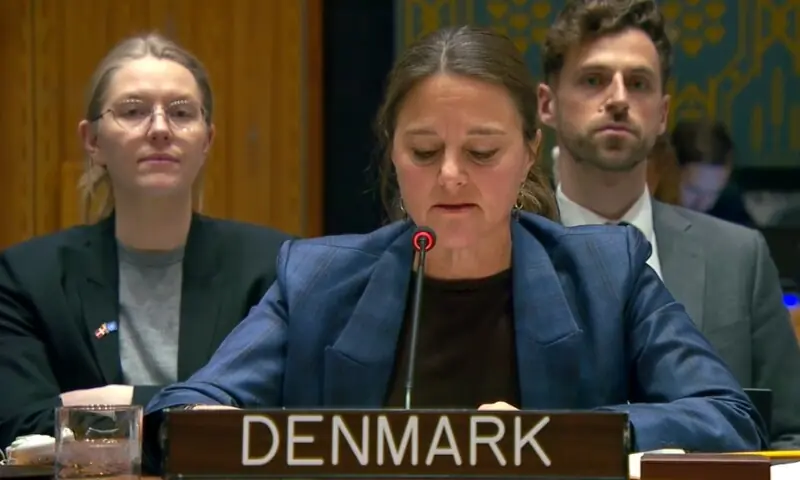
Denmark has pointed to the “serious threat” posed by the banned Tehreek-i-Taliban Pakistan (TTP) in Central and South Asia and says that the terror outfit has been receiving “logistical and substantial support from the de facto authorities”.
In the capacity of the chair of the Security Council ISIL (Daesh) and Al-Qaeda Sanctions Committee, Denmark raised these concerns while briefing a UNSC meeting held in New York on Wednesday.
The presence of TTP militants in Afghanistan has long been a point of contention between Islamabad and the Taliban administration. Since the Taliban’s return to power in Kabul in 2021, Pakistan has accused the group of sheltering thousands of TTP fighters, who have escalated attacks on Pakistani security forces, particularly in the Khyber Pakhtunkhwa and Balochistan provinces.
Denmark’s Deputy Permanent Representative to the United Nations Sandra Jensen Landi told the UNSC meeting that the TTP, “with its approximately 6,000 fighters, is another serious threat emanating from the region, receiving both logistical and substantial support from the de facto authorities”.
“The TTP has conducted numerous high-profile attacks in Pakistan from Afghan soil, some of which incurred mass casualties,” she added.
Landi also gave an overview of the evolving terrorist threat posed by Daesh, Al-Qaeda and their affiliates, drawing on the latest assessments of the Analytical Support and Sanctions Monitoring Team.
“The threat posed by ISIL (Daesh), Al-Qaeda and their affiliates remains dynamic and geographically diverse, with the highest intensity observed in Africa. ISIL, Al-Qaeda and their affiliates continue to step up their propaganda, exploiting social media platforms to glorify violence, recruit youth and raise funds. Their continued use of cryptocurrencies poses a growing challenge to sanctions implementation,” she said.
Landi further stated that after losses in the Middle East, Daesh had “pivoted towards Africa, where affiliates such as the Islamic State West Africa Province (ISWAP) have expanded activities and propaganda”.
“ISIL-Khorasan (ISIL-K) is one of the most serious threats in Central and South Asia, with at least 2,000 fighters under Sanaullah Ghafari. They continue to target Shia communities, de facto Afghan authorities and foreign nationals,” she said.
“Across regions, foreign terrorist fighter movements — particularly between Syria, Africa and Central Asia — remain a persistent concern for member states.”
Landi further said that Al-Qaeda’s central leadership remained weak and largely marginalised, while affiliates — including Jamaat Nasr al Islam wal Muslimin in the Sahel region of Africa – had “exploited local grievances to expand their reach and financing”.
Al-Qaeda in the Arabian Peninsula (AQAP) also continued to incite attacks and raise funds, she highlighted.
“Overall, ISIL and Al-Qaeda have proven resilient, adaptive and opportunistic, exploiting regional instability, weak governance and emerging technologies to sustain relevance and project influence. These developments underscore the need for continued vigilance and close multilateral cooperation under the 1267 sanctions regime.”
Following Landi’s briefing, Pakistan’s Deputy Permanent Representative to the UN Usman Jadoon was among those who addressed the meeting.
He highlighted that the global terrorism landscape continued to evolve, “adapting itself to a fast-changing world with new and emerging threats under the shadow of rapid technological advancement”.
“At the same time, the prevalence of prolonged unresolved conflicts, external interventions and root causes of terrorism, or euphemistically referred to as the ‘conditions conducive to terrorism’, remain unaddressed, giving continued life to the threat of terrorism.”
He said that as a frontline state in global efforts to counter terrorism, Pakistan had rendered invaluable sacrifices in its efforts to eradicate this menace, with over 80,000 casualties and billions of dollars in economic losses.
Al Qaeda was decimated largely due to Pakistan’s efforts, he said.
“Our valiant security forces and law enforcement agencies continue to counter the terrorism threat emanating from Afghanistan where entities like ISIL-K, TTP and its affiliates, BLA (Baloch Liberation Army) and the Majeed Brigade are thriving under the patronage of their hosts and backed by our principle adversary and net destabiliser in the region.”
Jadoon stressed that the 1267 sanctions regime — the UNSC framework for imposing sactions on Daesh and Al Qaeda — must reflect ground realities. “Its scope should be broadened to list individuals and entities, without any association with religion, nationality or ethnicity.”
He further said that it was necessary to deal with listing and delisting issues in a fair, transparent, judicious and impartial manner, and without political considerations.
“We must also ensure that the 1267 sanctions committee takes an objective view of all listing proposals that are brought before its consideration and not subject them to narrow political interests.”
Moreover, to adopt a zero-tolerance approach to terrorism, the UN’s counter-terrorism architecture “must also possess the necessary tools to designate violent, far-right, extreme right-wing, ultra-nationalist, xenophobic and Islamophobic groups around the world”, he said.
 American Dollar Exchange Rate