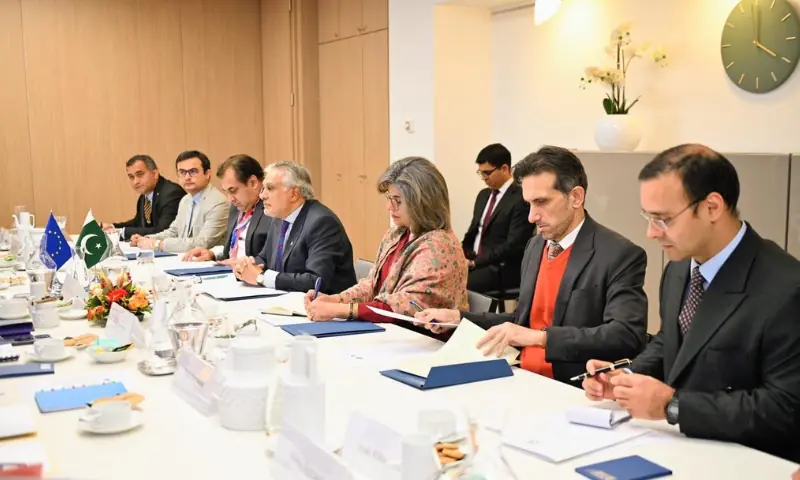
Pakistan and the European Union (EU) have underlined the importance of further deepening trade and investment ties, including through the EU’s GSP+ scheme, as a driver for sustainable growth, export diversification, job creation and mutually beneficial economic opportunity, the Foreign Office (FO) said on Saturday.
The development came as 7th Strategic Dialogue between Pakistan and the EU was convened in Brussels. The meeting was co-chaired by Deputy Prime Minister and Foreign Minister Ishaq Dar and EU’s chief diplomat Kaja Kallas.
The GSP+ status allows Pakistan to enjoy duty-free or minimum duty on European exports.
According to the FO, the meeting provided a “comprehensive review” of the full spectrum of Pakistan-EU relations, “building on the positive momentum of recent high-level engagements and sustained institutional interactions”.
Both sides reaffirmed their commitment to a “broad-based, multidimensional and forward-looking partnership anchored in shared values, the UN Charter, multilateralism, and the principles of mutual respect and cooperation” during the meeting, it said.
“The dialogue also offered an opportunity to exchange views on regional and global developments, including South Asia, Afghanistan, the Middle East, and broader geopolitical developments,” said FO.
“Both sides underlined the importance of coordinated approaches to peace, stability, sustainable development, and global challenges such as climate change and connectivity,” it added.
Moreover, Pakistan and the EU agreed to strengthen cooperation under the Strategic Engagement Plan, advance work on ongoing dialogues, and identify concrete avenues to expand collaboration in the years ahead, the FO said.
GSP+ status is a special incentive awarded to developing countries to “pursue sustainable development and good governance” in exchange for cutting import duties to zero on two-thirds of the tariff lines of its exports. Governments with this status need to implement 27 international conventions on human rights, labour rights, good governance and the environment.
Earlier this week, EU Ambassador to Pakistan Raimundas Karoblis said the country needed to “do more” in terms of fulfilling its commitments under the GSP+ scheme ahead of a review.
‘Maritime threats are both multidimensional and transnational’
The deputy premier also delivered a statement on critical maritime security, saying that “Today’s maritime threats are both multidimensional and transnational.
“We face threats ranging from piracy, terrorism and trafficking of arms and narcotics, to cyber vulnerabilities at port infrastructure, marine pollution, and the growing climate-induced risks to coastal zones.”
He said Pakistan was a littoral state, one sharing the coastline with a particular sea or ocean, with a geostrategic location at the crossroads of key international sea lanes and the Arabian Sea as its “fifth neighbour”.
Dar said the Arabian Sea remained central to Pakistan’s national security, connectivity, economic resilience, food and energy security.
“From Karachi to Gwadar, our ports are gateways linking the landlocked heart of Central Asia to the global trading system.
“Pakistan, therefore, views maritime security and economic development as mutually reinforcing.”
 American Dollar Exchange Rate