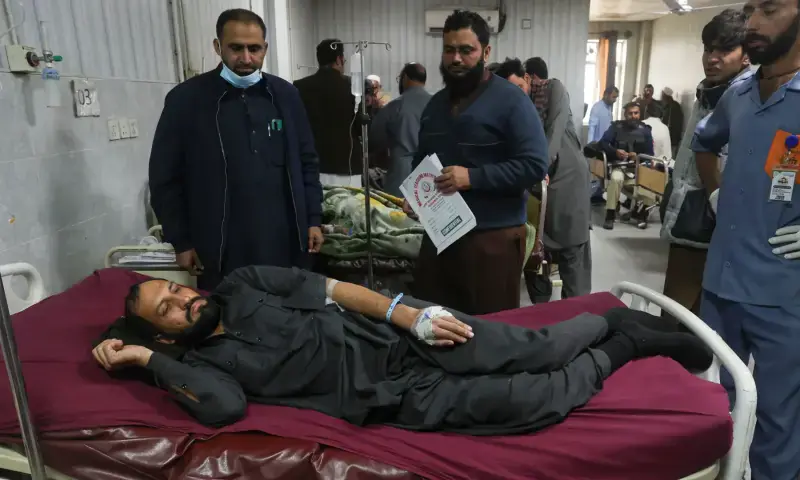

PESHAWAR: Frequent bombs and suicide attacks have compelled hospitals, especially the province’s biggest health facility Lady Reading Hospital, to upgrade mass emergency services. Given the vast experience of dealing with survivors of terror attacks, LRH recently organised training wherein healthcare professionals from Karachi, Lahore and other cities were imparted training in mass emergencies.
LRH, the 1,800-bed oldest hospital of the province, has the first-ever emergency specialist due to which the level of mortalities from the terror strikes is very low.
“During the last few years, we have handled 320 mass emergencies including suicide and bomb attacks. We treated affected persons with fractured bones, head and chest injuries and multiple wounds. The ratio of deaths remained extremely low because our staff has mastered the art of lifesaving procedures,” LRH spokesman Mohammad Asim told media.
According to him, more than 600 staffers, including doctors, nurses and paramedics have been deployed in addition to radiologists, pathologists and cardiologists and other consultants in accident and emergency department of the hospital to make it sure that people receive services during ‘golden hour’ –the critical 60-minute period after a traumatic injury when a patient’s chances of survival are the highest with prompt medical attention.
Spokesperson says 10 injured were treated effectively at the hospital after attack on FC headquarters
“So, our doctors are well-trained to make prompt decision in first hour about patients. LRH is the only hospital where basic life support and mass emergency preparedness, advanced cardiac life support and other trainings are happening on regular basis. Traditionally, our staff, even not on duty, rushes to the hospital to support lifesaving efforts,” said Mr Asim.
He said that emergency department of the hospital had consultants round the clock. “Recently, we started collaboration with American Heart Association and partnership with ICRC for scaling up emergency response as a regular feature,” he added.
He said that the hospital could manage 300 patients simultaneously. LRH is the first priority of patients as people are rushed to it not only from sites of terror attacks in Peshawar but from every nook and corner of the province.
“On Monday, we received 10 wounded persons from the suicide attack at Federal Constabulary’s headquarters in Peshawar. They were treated effectively,” he said.
Mr Asim said that more often people from manmade or natural disasters were brought to the hospital with multiple wounds. “They are given first aid in emergency and subsequently shifted to orthopaedic, neuro-surgery, general surgery and other wards for proper medication,” he said. He said that after every attack, most patients were sent home after their recovery with the advice for follow-ups while some remained for their surgeries and reconstruction procedures at general surgery and plastic surgery units of the hospital.
“None of the injured persons are referred outside because the hospital has all specialties with more than two-decade experience,” he said. He also appreciated the people, who donated blood on every occasion due to which the hospital had enough stock that was transfused to patients. Mr Asim said that senior doctors in LRH were getting invitations from organisers of international seminars and symposiums where they shared their experiences regarding management of trauma patients.
A doctor at the emergency department of the hospital said that first they carried out priority surgical procedures and stoppage of bleeding and later focused on other issues of blast victims.
He said emergency department was headed by trauma specialist where all the facilities including operation theatres, blood bank, pharmacy, CT scan, ultrasound and X-ray machines and pathology were available under one roof and patients received implants, blood and surgical disposable free of cost.
“The endless wave of terrorism in the province resulted in huge destruction and killing of security people but at the same time we have upgraded facilities and skills of health professionals to manage trauma incidents effectively,” he said.
Published in media, November 25th, 2025







 American Dollar Exchange Rate