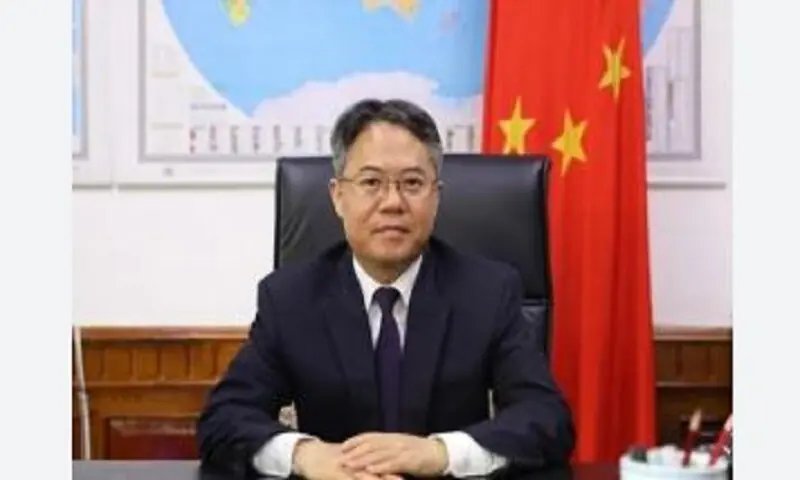

China is ready to work with Pakistan to organically integrate the country’s development plans and the action plan on building a closer China-Pakistan community with a shared future in the new era, Chinese Ambassador in Islamabad Jiang Zaidong said on Wednesday.
Pakistan and China share a longstanding strategic partnership with ties that span various sectors, including trade, energy, defence, and infrastructure.
Ambassador Jiang was speaking at the Policy Dialogue on “Redefining Regional Connectivity: Pakistan-China Friendship in the New Geo-Economic Paradigm.”
“Guided by the important consensus of our leaders, centered on building a closer China-Pakistan community with a shared future in the new era, using the advancement of CPEC 2.0 as a platform, and focusing on deepening cooperation in industry, agriculture, and mining, we will continuously consolidate, deepen, and expand our all-round partnership,” the Chinese envoy said while speaking via video link.
He said the approach will tangibly serve the modernisation drives of both countries and better benefit the two peoples.
“We will promote the inclusion of more Pakistani agricultural products under contract farming cooperation and facilitate the export of more high-quality agricultural products to China. Furthermore, we will continue to support industrial park cooperation, making new and greater contributions to Pakistan’s export expansion and foreign exchange earnings,” he said.
The day-long dialogue brought together senior policymakers, including the Chinese ambassador, alongside leading experts who discussed the transformative potential of the Belt and Road Initiative (BRI) and the China-Pakistan Economic Corridor (CPEC) in fostering regional stability, connectivity, and economic interdependence.
The Chinese envoy said his country will support the Chinese company Haier’s investment of US $400 million to establish a new home appliance industrial park in Pakistan, which is expected to achieve an annual production capacity of approximately 10 million units. “We will also support Chinese company Challenge Group’s investment of US $150 million to build a new textile industrial park, aiming to achieve an annual export value of US $400 million.”
“Looking to the future, CPEC will help Pakistan expand regional cooperation. Pakistan is a hub connecting South Asia, Central Asia, and the Middle East, possessing many unique advantages for development, one of which is its critical geographical location,” he said.
Ambassador Jiang said Beijing is also willing to accelerate the Karakoram Highway realignment, promote the modernisation of the Khunjerab-Sost Port, advance the comprehensive development of Gwadar Port, and transform it into a hub for regional connectivity.
“We are ready to actively and steadily advance third-party cooperation under CPEC, promoting its extension towards Central Asia and the Middle East to leverage Pakistan’s geographic advantages,” he added.
Jiang elaborated that CPEC has brought Pakistan a cumulative total of US $25.93 billion in direct investment, 510 kilometers of highways, over 8,000 megawatts of power generation, and 886 kilometers of core grid networks, significantly improving Pakistan’s infrastructure and industrial transformation.
“Taking the flagship Gwadar Port and its supporting projects as an example, the upgraded China-Pakistan Friendship Hospital has greatly enhanced the modernisation of local medical services, with cumulative patient visits exceeding 340,000.”
About the Gwadar seawater desalination plant, he said the plant is now officially operational with a daily output of over 2,000 tons, effectively alleviating local water supply shortages.
He also mentioned the Lahore Orange Line Metro train and said he has personally taken a ride during a tour and found it as smooth and comfortable as the urban rail transit in Beijing, adding that its cumulative passenger traffic has exceeded 270 million.
The envoy pointed out that CPEC has created a total of 261,000 jobs in Pakistan, improving the lives of countless families and building a solid foundation of public support for CPEC.
Talking about the Pakistani government’s policies, he said Pakistan’s economic indicators have significantly improved.
“In the last fiscal year, GDP grew by 3.04 percent, and per capita income increased from US $1,663 to US $1,824. Pakistan is also advancing its “Uraan Pakistan” five-year plan, prioritising digital transformation and technology empowerment, emphasising an export-oriented strategy, and aiming to achieve high-speed, sustainable growth in key industries through opening up, to become an upper-middle-income country by 2035,” said Jiang.
Pakistan’s former National Security Adviser, Moeed Yusuf, in his address highlighted regional connectivity with special reference to Afghanistan.
Yusuf, said, “things with Afghanistan are messy, but we need to expand and work on regional cooperation, and expand such partnerships to Central Asia”.
While endorsing Pakistan’s security concerns, he favoured the approach of separating economic issues from political matters and said others would find alternatives and “would not wait”. He also mentioned the idea of CPEC’s to Afghanistan and stated that China and Pakistan are interested in achieving this goal.







 American Dollar Exchange Rate