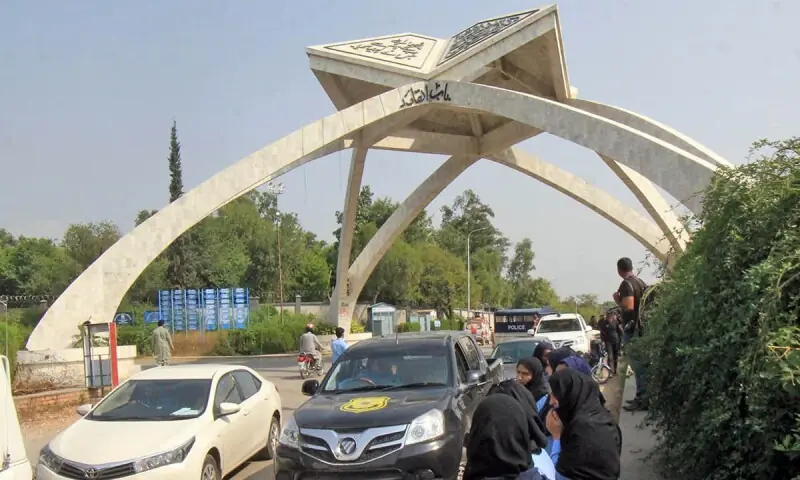
A protest and sit-in against the disappearance of a Baloch student entered its third day at Quaid-i-Azam University (QAU) on Wednesday, bringing all academic activities to a halt.
A protest camp was established by the Baloch Students Council (BSC) against the enforced disappearance of a sixth-semester student, Saeedullah Baloch.
The BSC students had earlier reached out to students from other councils and groups to join the camp.
However, fearing a larger protest campaign, the administration of QAU suspended all academic activities at the varsity.
The BSC students participating in the sit-in remained wary of certain consequences and declined to disclose their names to the media.
However, speakers at the protest camp said they had remained firm in their stance for the past three days and refused to remain silent. They added that these three days have shown that students cannot be intimidated when justice is denied.
Mohammad Azam, brother of missing Saeedullah, said that the protest camp has become more than a protest site; it is a symbol of collective resilience.
“With every hour that passes, our message grows louder, we will not accept enforced disappearances, we will not accept fear, and we will not walk away until our voices are heard,” he added.
There was no official reply from the QAU administration over the situation and the continued suspension of studies on campus.
However, a senior QAU official said the administration had reached out to the BSC, offering assistance and requesting that they not establish a protest camp over the enforced disappearance
“But they flatly refused because the (varsity) administration was not in a position to offer any help, secondly, the BSC maintained that the protest camp was not a political activity but a demand for the recovery of a student of the university,” the official added.
Saeedullah Baloch was a student of the Defence and Strategic Studies (DSS) department.
The speakers at the camp highlighted that Saeedullah was forcibly taken away by unknown men in civil dress on July 8, 2025, between 7 and 7.30pm, from the Islamabad toll plaza when he and his friend were travelling to Quetta on a public bus.
The protestors added that the abductors were accompanied by officials of law enforcement, and they offloaded the two from the bus.
While Saeedullah’s friend was allowed to proceed on the same bus, he was taken away.
The speakers, who preferred not to be named in the media, said that they were students, but they were also witnesses to illegal acts by the authorities.
In the first half of 2025, a total of 125 missing persons cases were submitted to the Commission of Inquiry on Enforced Disappearances. The total number of cases received up till June 2025 was 10,592, while 1,914 cases of them were disposed of and 6,786 were traced, the commission said.
In December 2024, the Constitutional Bench of the Supreme Court emphasised that only parliament held the authority to address and resolve the longstanding, yet unlawful, practice of enforced disappearances — a persistent issue that has plagued the nation for decades.
 American Dollar Exchange Rate