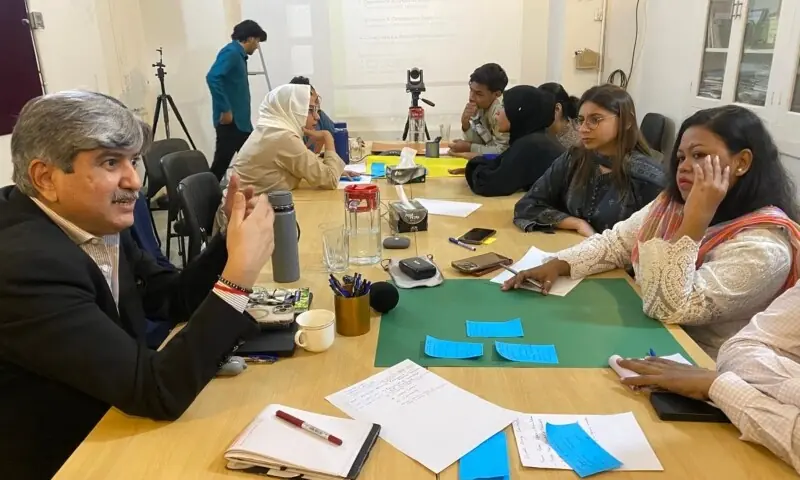

Various stakeholders in Karachi floated ideas and debated solutions in a collaborative, cross-sector dialogue on Saturday about how they could support one another to solve issues plaguing the city’s solid waste management infrastructure.
According to a waste audit conducted by the United Nations Human Settlements Programme (UN-Habitat), the average citizen of Karachi generates 0.49 kilogrammes of municipal solid waste (MSW) per day, amounting to 12,067 tonnes of MSW generated daily in the city.
Code for Pakistan — a non-profit building a non-partisan civic innovation ecosystem to improve the quality of life in the country — brought together individuals from government, academia, the private sector and non-governmental organisations (NGOs) to participate in the conversation at the Climate Action Centre about the issue at hand and solutions to improve coordination, efficiency and impact.
Ahmad Shabbar, CEO of GarbageCAN, a sustainable waste management company, emphasised focusing on the grassroots to bring change.
Shabbar suggested that the Sindh Solid Waste Management Board (SSWMB) should “regulate and push smaller companies” to clean waste from different areas by providing them with licences.
“I do not consider waste management a welfare effort. Waste management is a polluter’s pay, essential service”.
Farhan Lodhi, serving as a consultant for the SSWMB, stated that instead of focusing on subsidies, the board was “aggressively working towards sustainability”.
Shedding light on solutions to manage solid waste, Rahul Rai from the environmental organisation Trashit, spoke about responsibly recycling it in Sindh’s urban and non-urban areas, rather than burning it.
Maliha Najib from Imkaan, an NGO focused on working with marginalised and stateless communities, put forward a solution to irresponsible solid waste management: incorporating waste management practices into school curricula to raise awareness.
Aimah, an entrepreneur, however, suggested that “awareness alone is not enough. What I realised with behavioural experts is that you have to change habits, one-time awareness and keeping dustbins is not enough.
“Segregation at source is important; if that is not done, your recyclability is much lower.”






 American Dollar Exchange Rate