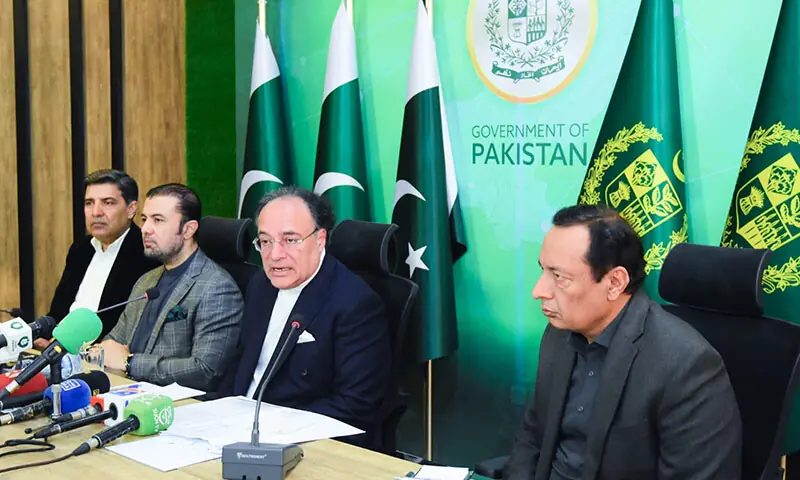
Finance Minister Muhammad Aurangzeb said on Sunday that the recent report by the International Monetary Fund (IMF) that highlighted financial irregularities in Pakistan was “not criticism” but a “catalyst for accelerating long-overdue reforms”.
The document’s publication, a precondition for the IMF’s approval for disbursing the next $1.2 billion loan tranche in December, found that institutional weaknesses, lack of transparency in state functions, preferential treatment for select businesses, and inefficiencies in public-sector transactions were major constraints to growth. It also called for a series of reforms spread across the next three to six months to help raise the growth rate to 5-6.5 per cent over the next five years.
The report led to criticism of the government, and opposition parties have called for a probe into the “worst financial scandal of Pakistan’s history”.
However, Aurangzeb said during a press conference in Islamabad today that the government itself had requested and facilitated the assessment to strengthen institutional reforms.
He maintained that the report acknowledged significant progress in sectors including taxation and governance, and that many of its priority recommendations were “already work in progress”.
The finance minister further said the government was committed to implementing the remaining recommendations as part of broader institutional reforms essential to sustaining Pakistan’s economic turnaround.
He said Pakistan’s structural challenges had built up over decades, and institutional reform was essential for sustaining economic stability.
The finance minister described the report “not as criticism, but as a catalyst for accelerating long-overdue reforms”.
Exports rise by 5pc
During the press conference, Aurangzeb outlined the government’s shift towards an “inclusive, private-sector-driven and export-led growth strategy”.
The finance minister highlighted the recent abolition of the Export Development Surcharge (EDS), a levy in place since 1991, as a “key demonstration of the government’s commitment to boosting export competitiveness”.
Aurangzeb noted that this, coupled with reforms to strengthen the governance of the Export Development Fund (EDF), “reflects a strong policy direction centred on empowering exporters, removing outdated distortions, and enabling the private sector to drive economic expansion”.
He said the decision had already been summarised for cabinet approval, after which its implementation would formally begin.
Aurangzeb highlighted that export performance had strengthened, with overall exports rising five per cent and IT services exports growing by over 20 per cent year-on-year.
“It is very important that we take this forward in a sustainable manner,” he said. “Exports are helping us.”
He stressed that the IT sector had recorded back-to-back monthly highs in September and October, establishing itself as a critical pillar of the “new economy,” alongside emerging sectors such as minerals and mining.
Aurangzeb noted that the $3.5bn Reko Diq-related syndication, now financially closed following the resolution of procedural delays, represented a transformational investment that would generate an estimated $2.8–$2.9bn in annual exports once production commenced.
He added that meanwhile, remittances remained a key strength of the economy.
“[Remittances] are moving from strength to strength. Last year, they were $38m, which was a big uptick from the year before that,” he said. “God willing, at a minimum, this year we will cross $41m, which will provide a sizeable buffer to the current account.”
He added that the government was managing imports carefully under a reformed tariff regime designed to support industrial competitiveness by prioritising raw materials and intermediate goods while “gradually phasing out long-standing protectionism”.
This transition, he emphasised, would be phased over four to five years to enable domestic industries to become internationally competitive.
He stressed that structural reforms remained central to the government’s agenda. The new tax policy office, now operational under the Finance Division, had conducted its first advisory board meeting and would henceforth be responsible for preparing tax policy and the national budget, he said.
The objective, he continued, was to bring consistency, analytical rigour, and private-sector input into the policy-making process while allowing the Federal Board of Revenue to focus on enforcement, compliance and technology-driven administration.
The finance minister further said that work on pension, debt, state-owned enterprises reform, the digital economy, taxation, energy, and rightsizing was proceeding as committed earlier.
On public finance, he said Pakistan’s domestic debt stock had stabilised for the first time in nine years, and debt servicing costs had begun to decline with the reduction in the policy rate.
He confirmed that Pakistan’s inaugural Panda Bond, supported by credit enhancement from the Asian Development Bank and Asian Infrastructure Investment Bank and approved by China’s central bank, would be “issued before December or, at the latest, before the Chinese New Year, helping diversify Pakistan’s funding base and reduce borrowing costs”.
NFC Award
The minister further said that the 11th National Finance Commission Award process would begin next week, with chief ministers and provincial finance teams joining deliberations.
Aurangzeb emphasised that revenue, expenditure and governance reforms required “constructive federal–provincial engagement” and expressed confidence that the meeting would be held in a spirit of “Pakistan first,” following the consensus approach demonstrated during the National Fiscal Pact.
The minister also addressed questions on taxation, energy costs, and competitiveness, acknowledging the concerns of the formal sector regarding high taxation and tariffs.
He said the government was committed to expanding the tax base, enhancing enforcement, reducing leakages, and ensuring fairness between formal and informal sectors.
The minister said that tax refunds had risen from Rs 200bn to Rs250bn over the five-month comparison period, reflecting responsiveness to industry needs. He highlighted the ongoing work in reducing circular debt and improving energy pricing, explaining that tangible progress had already been achieved on the financing and energy fronts.
Responding to questions about the sugar sector and commodity governance, the minister stated that durable reform required a full transition away from government involvement—from import and processing to trading and regulation. He emphasised that persistent distortions could not be eliminated without structural changes and that the government remained “committed to deregulation and transparency”.
Aurangzeb also drew attention to the “strong interest” of international firms in Pakistan across sectors, including energy, mining, IT, telecom, construction, logistics and EV manufacturing. He cited recent commitments from global companies such as Aramco, Wafi, Gunvor, Turkish Petroleum, Barrick Gold, Citizen Metals, Nova Minerals, BYD, Chery, NWTN Motors, Abu Dhabi Ports and Google.
He said that Pakistan had “turned a corner from the crisis of two years ago and is now pursuing a stable, export-driven, investment-focused growth model grounded in structural and institutional reforms”.
Moreover, he stressed that agriculture, large-scale manufacturing, the new economy, remittances and private investment would collectively contribute to a “more resilient and inclusive economic future” for Pakistan.
 American Dollar Exchange Rate