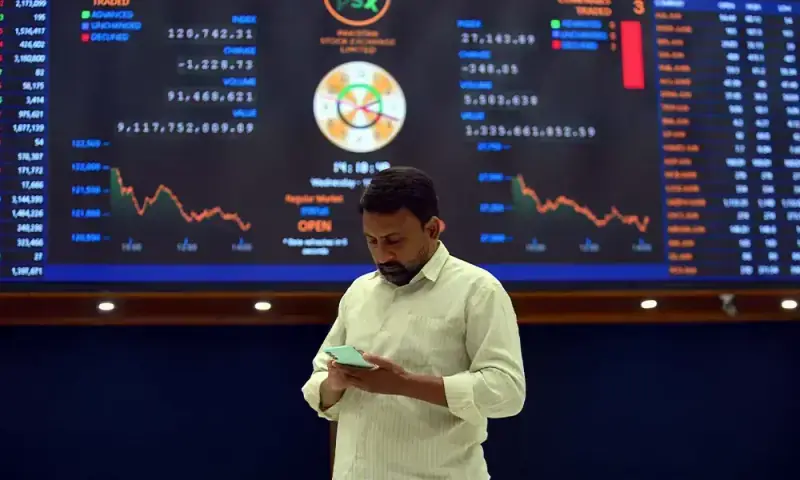

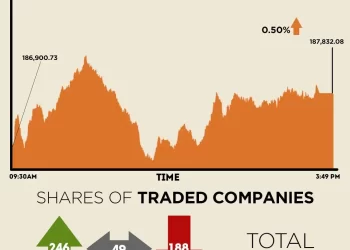
Bullish momentum was observed at the Pakistan Stock Exchange (PSX), with the benchmark KSE-100 Index gaining over 500 points during the second half of the trading session on Friday.
At 3:20pm, the benchmark index was hovering at 166,848.17, an increase of 564.62 points or 0.34%.
Across-the-board buying interest was observed in key sectors, including automobile assemblers, cement, fertiliser, commercial banks, oil and gas exploration companies, OMCs and power generation. Index-heavy stocks, including ARL, HUBCO, MARI, OGDC, POL, PPL, SSGC, NBP and UBL, traded in the green.
The positive sentiment came as the Saudi Fund for Development (SFD), on behalf of the Kingdom of Saudi Arabia, extended the term for the deposit of $3 billion maturing on December 8, 2025, for another year.
“The extension of the term of the deposit… will help in strengthening the foreign exchange reserves of Pakistan and contribute to the country’s economic growth and development,” the SBP said in a statement.
Moreover, President Asif Ali Zardari on Thursday approved Prime Minister Shehbaz Sharif’s summary appointing Chief of Army Staff Field Marshal Syed Asim Munir as the country’s first Chief of Defence Forces (CDF) for a five-year term, the Presidency said in a statement.
On Thursday, the PSX staged a steady recovery as renewed buying interest supported key indices, helping the market regain ground after a heavy spell of institutional selling a day earlier. The benchmark KSE-100 Index closed slightly higher at 166,283.55 points, gaining 138.20 points or 0.08%.
Globally, Japan’s Nikkei skidded on Friday, wiping out this week’s gains amid an otherwise subdued Asian session, after weaker-than-expected spending data underscored the scourge of inflation as bets grew that the Bank of Japan would hike interest rates.
The Nikkei 225 fell 1.5% and was on track to end the week mostly flat. MSCI’s broadest index of Asia-Pacific shares outside Japan was off 0.1% but was still set for a gain of 0.5% for the week.
Data showed household spending in Japan unexpectedly fell the fastest in nearly two years in October, as inflation ate into people’s spending power. The yield on 10-year Japanese government bonds hit 1.94% early in Asia, its highest since mid-2007.
This is an intra-day update



 American Dollar Exchange Rate