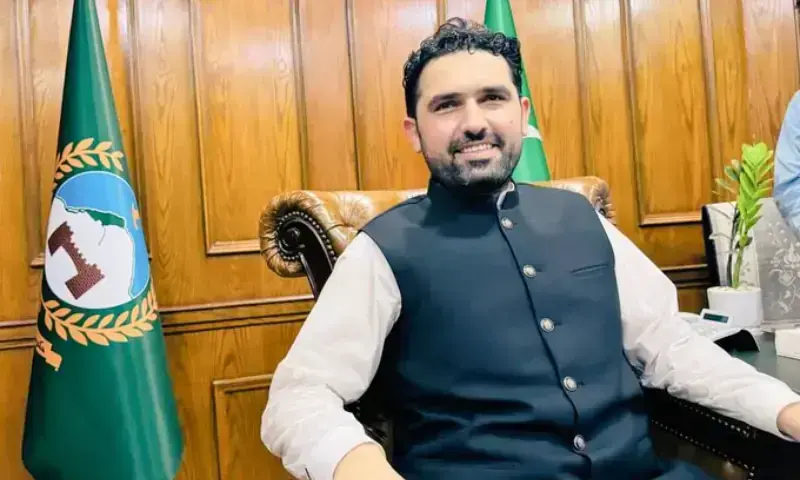
PESHAWAR: Khyber Pakhtunkhwa Chief Minister Sohail Afridi on Saturday said political instability, economic decline, inflation, falling industrial, agricultural output and unemployment had weakened the national economy, so there was a need for setting aside personal differences and political vendettas in the “larger national interest.”
“Our province faces challenges far greater than those of other provinces, but human development and public welfare remain our government’s top priorities. Despite limited resources, we are making sustained efforts to improve education, health, governance and public service delivery in line with the vision of PTI founder Imran Khan,” Mr Afridi told the annual parents’ day function at Girls Cadet College in Mardan, according to an official statement.
He noted that the Girls Cadet College enrolled students not only from KP but from other provinces and overseas Pakistani families, reflecting confidence in the institution’s high academic standards.
He said the provision of quality education to girls was a key priority of the provincial government and that further investment in the education sector would be ensured.
Says human development, public welfare his govt’s top priorities
Mr Afridi announced the establishment of a girls cadet college in Khyber tribal district and promised the provision of funds for the timely construction of the building of the Girls Cadet College.
He complained that KP was not receiving its constitutionally-mandated financial share in full and that the province’s dues to be cleared by the federal government had exceeded Rs4.5 trillion.
The chief minister said the amount to be paid included hydel power arrears, promised allocations for merged districts, net hydel profits and other financial liabilities, adding while the merged districts had been administratively integrated, their financial integration remained incomplete, which was a constitutional violation.
He maintained that the provision of the province’s due financial resources would enable greater investment in energy, education, health and social sectors, with benefits extending beyond the province.
“The country’s progress depends on constitutional supremacy, fair distribution of resources and political stability,” he said.
Also, Mr Afridi said the provincial government was working on emerging technologies in biomedicine and advanced materials.
“The objective of those projects is to promote value addition to natural resources through technology and to accelerate economic growth. The provincial government is committed to fostering innovation-driven development and self-reliance,” he said during the “Khyber Pakhtunkhwa Science Agenda, a High-Technology and Product Development Exhibition” at the Chief Minister’s House here.
High-tech projects initiated by the provincial government were showcased, according to an official statement.
The exhibition featured a range of innovative products, including artificial skin for burn care, locally developed PCR diagnostic kits for Hepatitis B and C, HIV and other diseases, an e-rickshaw project, the use of liquid oxygen in mining, e-surgical instruments and an e-study card system for students, it read.
During the exhibition, detailed briefings were given on the manufacturing process and key features of the showcased products.
It was informed that the development of artificial skin and tissues had been carried out with the collaboration of Pak-Austria Fachhochschule University, Haripur, Pakistan’s first artificial skin project and its local production would enable timely and affordable treatment for burn patients.
Similarly, it was briefed that the PCR diagnostic kits project had been assigned to Khyber Medical University, which was expected to reduce diagnostic costs by 30-40 per cent, while manufacturing time would be reduced from 90 days to just 15 days.
The project aimed to develop real-time PCR diagnostic kits for five deadly viruses, which would reduce reliance on imported kits, save foreign exchange and enable faster testing.
Moreover, the project would strengthen the country’s capacity to provide affordable, reliable and locally manufactured molecular diagnostic solutions.
Briefing on the e-rickshaw project, it was informed that a state-of-the-art electric rickshaw had been developed in line with the provincial government’s priorities. The project will help reduce dependence on fuel and lower repair and maintenance costs, the statement read adding that compared to conventional rickshaws, drivers would be able to earn up to twice as much income.
“Most importantly, electric rickshaws do not contribute to air pollution and will serve as a significant step forward in promoting green transportation,” the statement read.
It added that the use of liquid oxygen in mining would provide an alternative to explosive materials, while the e-study card would offer students access to e-books, advanced features and AI-based tutors.
Published in media, December 21st, 2025
 American Dollar Exchange Rate