Courtesy of Databricks; Lukas Schulze/Sportsfile for Web Summit via Getty Images
- Databricks and Glean CEOs say AI automation isn't as easy as many leaders thought.
- "It's not just you can just unleash the agents, and it just works," said Databricks CEO Ali Ghodsi.
- "It actually takes much longer than you know to actually generate success," said Glean CEO Arvind Jain.
Two CEOs running multi-billion-dollar AI companies say AI can't automate work as easily as many leaders had assumed.
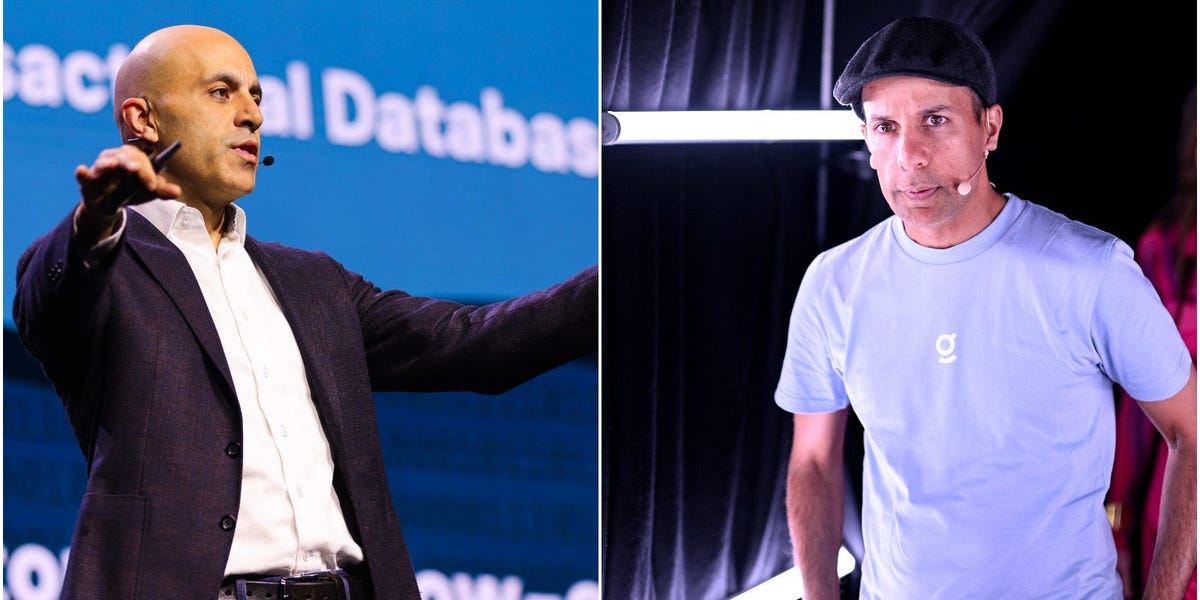
Glean CEO Arvind Jain and Databricks CEO Ali Ghodsi said on an episode of the "Bg2 Pod" published Tuesday that companies need to temper expectations about how quickly and easily AI can be deployed.
Jain said he had tried to automate internal workflows at Glean, including an effort to use AI to automatically identify employees' top priorities for the week and document them for leadership.
"It has all the context inside the company to make it happen," said Jain, adding that he thought AI would "magically" do the work. The idea seemed simple, but it hasn't worked.
Glean, an AI startup that helps employees search across internal tools and documents, said in September that it had raised $150 million at a $7.2 billion valuation.
Jain pointed to another bet that fell short: building and fine-tuning a custom model for a specific use case within Glean's product. That effort "didn't really pan out," ultimately pushing the company back toward existing foundation models that were easier to deploy, he said.
"It actually takes much longer than you know to actually generate success," he added.
Ghodsi, whose company sells a data and AI platform, said: "It's not just you can just unleash the agents, and it just works."
Making AI useful inside an organization is "an engineering art," requiring careful evaluation, production work, and strong teams to support it, he added.
Databricks last week announced that it had raised more than $4 billion in a funding round, valuing the company at $134 billion.
Both CEOs said failed AI projects are common — and not necessarily a sign that something has gone wrong.
"You hear these 95% of projects fail," Jain said. "That's actually what you want."
"When you're actually experimenting with new technology, if all of your projects are failing, that means you're not trying enough," he added.
Humans need to be in the loop
Ghodsi has previously said that human oversight will remain essential in AI systems, even as companies deploy more agents and AI automate more tasks.
"I think in a few years, yes, we'll have agents in many, many places, but there will be a human overseeing and approving every step, and you're on the hook when you approve, when you click, 'OK,'" he said in June at a conference in San Francisco. "We all become supervisors."
Other tech leaders have echoed that view.
Research scientist Yoshua Bengio, who is one of the "godfathers of AI," said human qualities will become more important as machines take over tasks.
"Work on the beautiful human being that you can become. I think that that part of ourselves will persist even if machines can do most of the jobs," Bengio said on an episode of "The Diary of a CEO" podcast published last week.
"The human touch is going to, I think, take more and more value, as the other skills become more and more automated," he added.
 American Dollar Exchange Rate