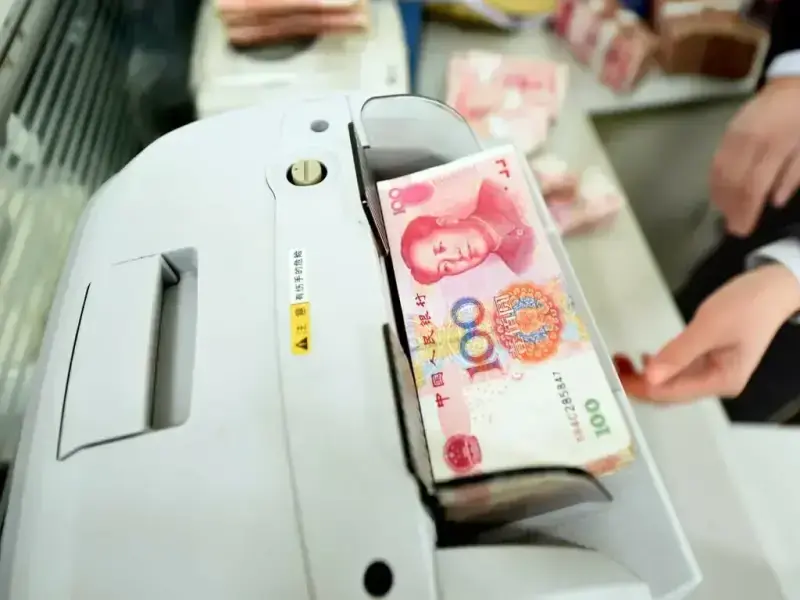
Federal Minister of Finance and Revenue, Senator Muhammad Aurangzeb, announced that Pakistan is hopeful of launching its first-ever Panda bond ahead of the Chinese New Year, calling it a landmark development in Pakistan’s external financing strategy.
Speaking in an interview with China Global Television Network (CGTN), the finance minister said the issuance would allow Pakistan to tap into the second-largest and second-deepest capital market in the world, helping diversify funding sources away from overreliance on the US dollar by complementing existing access to euro and sukuk markets, read a statement released by the Ministry of Finance on Tuesday.
He acknowledged that Pakistan had previously underutilised this opportunity and expressed optimism about investor interest in the Chinese market.
A Panda bond is a Renminbi (RMB)-denominated bond issued by a non-Chinese entity, like a foreign company or government, within mainland China’s domestic market, offering them access to China’s investor base and supporting RMB internationalisation.
Meanwhile, the Chinese New Year, also known as the Spring Festival, is falling on 17 February 2026.
Highlighting China’s position as Pakistan’s largest trading partner, with bilateral trade nearing $17 billion in the first eight months of the year, Aurangzeb underscored that the relationship between the two countries has consistently moved “from strength to strength” over the decades.
He noted that China has stood firmly with Pakistan at international fora and has played a pivotal role in Pakistan’s economic development, particularly through the China-Pakistan Economic Corridor (CPEC), which remains the flagship project of the Belt and Road Initiative.
The finance minister explained that while CPEC Phase-I focused on building critical infrastructure, including roads, ports, airports and energy projects, CPEC Phase-II has now been formally launched following high-level engagements with President Xi Jinping and Premier Li Qiang earlier this year.
He said the new phase is centred on monetising existing infrastructure and is increasingly driven by business-to-business (B2B) cooperation, reflecting a shift toward sustainable, private-sector-led growth.
Responding to questions on Pakistan’s economic priorities, Aurangzeb identified agriculture, minerals and mining, artificial intelligence and the digital economy as key areas attracting Chinese investment.
He emphasised that beyond capital flows, this phase of cooperation places strong emphasis on knowledge transfer and technical support.
Addressing the impact of global uncertainty, geopolitical tensions and rising protectionism, the finance minister said Pakistan’s approach remains anchored in strengthening its long-standing partnership with China.
He noted that China’s support has extended beyond trade and investment to include assistance during critical economic phases, including support linked to Pakistan’s IMF program and broader financing needs.
Looking ahead, the finance minister said that Pakistan and China now have a clear strategic and economic roadmap, developed through recent bilateral engagements at the leadership level, including meetings held on the sidelines of the Shanghai Cooperation Organisation summit in Tianjin.
He concluded that both countries are aligned not only on geopolitical priorities but also on a forward-looking economic agenda that will guide cooperation over the medium to long term.
 American Dollar Exchange Rate