Juan Barreto/AFP via Getty Images; Mateusz Slodkowski; Alyssa Powell/BI
It certainly looks like an insider may have cashed in big by betting on Venezuelan President Nicolás Maduro's American-orchestrated ouster. Is that allowed? Good question! Maybe not, but also, to some extent, that's the point, and nobody's doing anything about it, anyway.
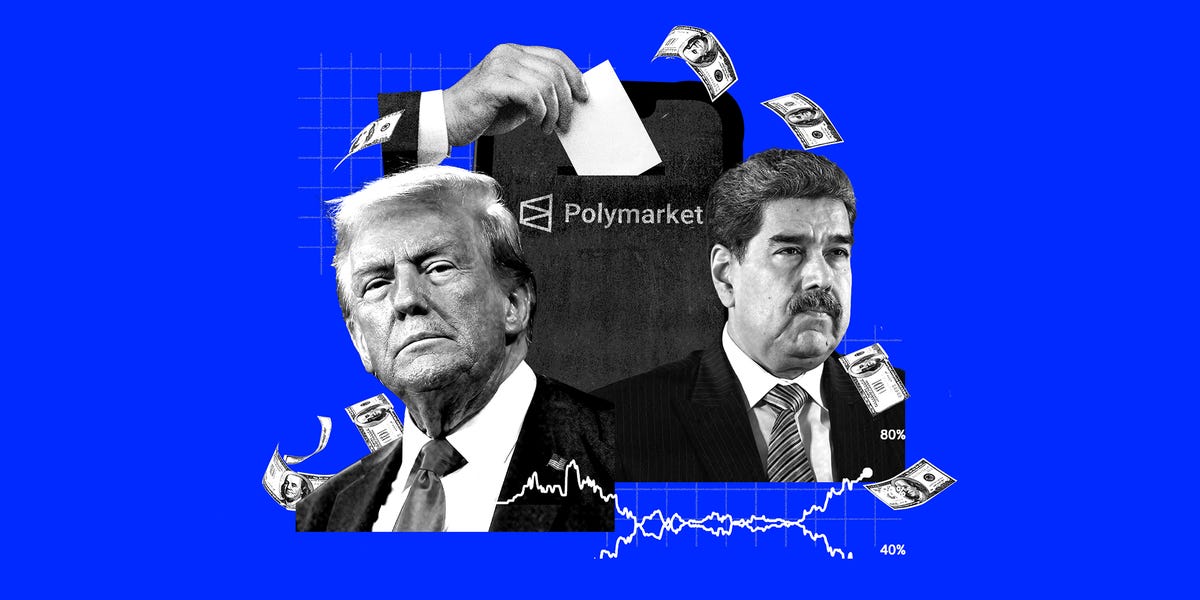
Just ahead of Maduro's capture over the first weekend of January, a newly created account on the prediction market Polymarket put $30,000 on his exit. It was a lucrative move: the bettor made over $400,000. It also raised some eyebrows. Was this a lucky bet, or did someone have inside information on the US government's plans? It's not the first time activity on prediction markets — which let people bet on the outcomes of events, from sports games to elections to wildfires — has prompted questions about people using private knowledge to hit it big. In December, someone on Polymarket made $1 million when they went 22 for 23 on guessing Google's most searched terms of the year.
This activity has some people setting their hair on fire, figuring this type of activity must be illegal. But for now, it's sort of open season for insider trading on some prediction markets. The CFTC, which oversees them, doesn't have a deep track record of going after that type of activity, unlike the SEC, which oversees the stock market. In fact, the main rule on the books about it that could apply is only 15 years old. Some platforms, such as Kalshi, explicitly ban insider trading, while others, like Polymarket, are more lenient on the practice. Heck, Manifold Markets, a smaller competitor, even encourages it (though it doesn't generally use real money). And regardless of the official rules, there's only so much anyone can do to track it.
"There's no general statutory standard for prediction markets. There's no general ban that says you can't trade on the basis of insider information. And what would insider information even be?" says Timothy Massad, a research fellow at Harvard's Kennedy School of Government and former CFTC chair.
The legality of prediction markets themselves in the US is a bit of a gray area, but they have the blessing of Trump's CFTC for now. There's not much appetite from that same CFTC to go after insider trading on prediction markets, either.
From a purist standpoint, traders using firsthand knowledge to put their money where their mouth is is the whole shebang. If the idea of prediction markets is information accuracy, who has more accurate information than someone on the inside? Questions of fairness aside, of course. Plus, part of the thrill of these markets is feeling like you're smarter than everyone in the virtual room.
When it comes to old-school securities markets like stocks and bonds, it's pretty well-established that trading on material non-public information is a no-no. If I work for Meta and know they're going to announce an awesome new product launch tomorrow, I can't buy up a bunch of stock or tell my brother-in-law to do it. With slightly less mainstream and sometimes more complex commodities, derivatives, and futures contracts, which are regulated under the CFTC, things are a little murkier. As part of the Dodd-Frank regulations implemented post-2008 crisis, the CFTC created a rule that mimics the SEC's rule on insider trading. It bans trading on the basis of private information "in breach of a pre-existing duty," or that's obtained by fraud or deception. Essentially, if I know I'm supposed to keep it secret and trade on it anyway, or if I engage in fraud or manipulation to move prices or gain an advantage, I'm in trouble.
Is what is technically allowed actually legal?
"If you have a fiduciary duty not to trade on something or not to reveal something, or if you're a tippee and you know that the tipper had a fiduciary duty not to, then it is a violation," says Aitan Goelman, a partner at Zuckerman Spaeder and former head of the enforcement division of the CFTC who previously represented Polymarket during a CFTC investigation.
But the rule is an awkward fit — in many circumstances, some level of insider knowledge is expected and encouraged in commodities trading. For example, if an airline knows they're adding new routes next quarter, they might buy oil futures to lock in current prices. If you're trying to hedge your risk, you're the one who best knows what your risk is. Moreover, the CFTC hasn't brought many cases under the rule, Goelman says, and the cases it has brought have been settled, not litigated in court, which would provide more clarity on how regulators view application and enforcement.
Yesha Yadav, a professor and associate dean at Vanderbilt University's law school, tells me that prediction markets represent a new frontier in the CFTC's handling of potential insider trading. "It's an evolving regulatory approach as to how to take the existing regime for the CFTC and to then modulate and apply it to the prediction market game," she says. "There's just a lack of clarity right now as to how this should move forward."
The CFTC likely could bring a case against an inside trader on a prediction market, but it would likely be an uphill battle. Gathering evidence would require a lot of resources that the agency doesn't have, and on some platforms, it's not easy to track who's even making bets. Moreover, given the CFTC's generally hands-off approach to prediction markets, there may not be much appetite for scrutiny.
Some of the idea behind prediction markets is they're supposed to encourage people who are in the know to play along, making them more accurate.
One former CFTC regulator, who spoke with me on the condition of anonymity to express their frank thoughts, says prediction markets are "ripe" for an insider trading case, though whether one comes to fruition is a separate question. "If the CFTC doesn't do anything, does that make it legal? Well, maybe not, but it certainly means it's not being prosecuted," the regulator says. "One of many interesting things for the regulators over these next few years is: Is what is technically allowed actually legal?"
The CFTC did not respond to a request for comment for this story.
The mental game of what is and isn't kosher, information-wise, on prediction markets gets messy fast. Hypothetically, if I were Barron Trump and I placed a bet on Polymarket based on information I received from my dad about whether the US is trying to take Greenland next, that could be a violation of insider trading rules, since I'd presumably know that information was supposed to be kept secret. If I work at a pizza place near the Pentagon and notice a surge in orders and place a bet, that's probably OK. If I'm Taylor Swift and I decide I need even more than my current $1.6 billion fortune, I may be able to put money on my wedding date (yes, this is a thing you can bet on), since I'm the one who chooses it. A lot of the potential situations where people could fall into legal jeopardy stem from employment agreements. For instance, if I'm the florist for the Swift-Kelce nuptials and am under NDA, it might be a problem. If I'm an athlete, insider trading is almost definitely not allowed, not because the CFTC is going to come after me, but because sports leagues have pretty strict rules about this stuff.
But also, again, some of the idea behind prediction markets is they're supposed to encourage people who are in the know to play along, making them more accurate. In an interview with Axios last year, Polymarket CEO Shayne Coplan said it's "cool" that his platform creates a financial incentive "for people to go and divulge the information to the market." In theory, that type of live information updating is a positive — the idea is to aggregate and spread new knowledge and data in real time.
Whether that's fair is a separate issue. Markets everywhere advantage traders and investors with more and faster information. And as much as prediction markets may embrace traders with an edge, they don't want to do so to the extent that everyone else feels like the entire thing is rigged. It's not good for Kalshi or Polymarket if people decide against putting money into them because they figure they're always going to lose.
"Polymarket, from its perspective, they don't want it to look like everything's gamed and unfair," Goelman says.
Polymarket didn't respond to a request for comment for this story. On Wednesday, Kalshi CEO Tarek Mansour responded to the uproar over potential insider trading on prediction markets in a LinkedIn post. "What non-American, unregulated platforms do has no relationship to what regulated, American platforms do," he wrote, taking a veiled shot at Polymarket, which was banned in the US in 2022 and is in the process of coming back online in the country. He wrote that Kalshi is supportive of a bill put forth by Rep. Ritchie Torres that would bar government officials from using nonpublic information to trade on prediction markets, but emphasized that the platform already does.
Yadav notes that some questions on prediction markets are so hyper-specific that it's virtually impossible for anyone but insiders to know. Only New York City Mayor Zohran Mamdani knows which words he'll say at his next press conference. The same goes for MrBeast in his next YouTube video and Fed Chair Jay Powell during his next press conference. (Seriously, these are all things you can bet on.) If they want to play along and make a quick buck, it seems like they could.
"If that question is set up in such a way that only a very small number of people can win and those people do in fact win, does that just result in a market that was set up to be potentially unfair, manipulative, fraudulent under the CFTC's definition of it?" she says. "Those are questions that have not been looked at."
At the end of the company's third-quarter earnings call last year, Coinbase CEO Brian Armstrong decided to have a "little bit of fun." There was a prediction market where people were betting on what he would say during the company's conference call with analysts, so he decided to end the call by rattling off a series of buzzwords. At the DealBook conference in December, he clarified that he had not traded on it. At the same conference, he reflected on the pros and cons of having insider trading in prediction markets. For the people using prediction markets to get a signal of what is going to happen, you actually want insider trading, he said. On the other hand, "if you want to preserve the integrity of those markets, maybe you don't want insider trading," he said. "It's not a clear-cut answer."
Overhanging whether insider trading is OK on prediction markets is whether prediction markets in the US are OK at all. The companies running them believe they are and say that they ought to be regulated by the CFTC. Critics, including the attorneys general of multiple states, think that what they're doing looks a lot like gambling, especially around sports, and should be regulated as such. The issue could eventually end up at the Supreme Court.
"To me, this is gaming, and we need to come up with a better regulatory system for it," Massad says.
It's another reason to think insider trading isn't exactly at the top of anyone's to-do list for prediction markets.
Ethically, trading on private knowledge is, at the very least, icky, but the entire enterprise sits in a bit of a moral fog. Turning everything, from when an autocrat will be dethroned to who will be arrested this year, into an opportunity to gamble is an idea that many people chafe at. And if someone loses some money because they incorrectly bet a war would happen against a general who knew it wasn't on the horizon, it's hard to feel too bad for them.
For the time being, prediction markets are here to stay — along with the question of whether insider trading is a feature or a flaw.
Emily Stewart is a senior correspondent at Business Insider, writing about business and the economy.
 American Dollar Exchange Rate