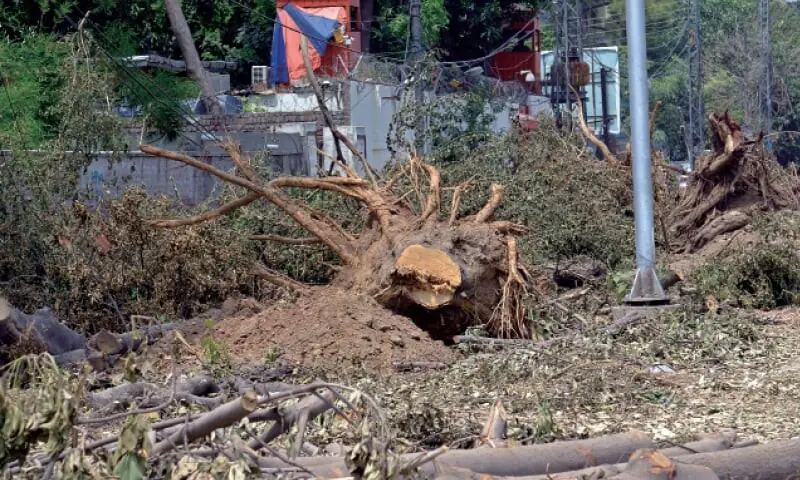
LAHORE: After taking disciplinary action against its four officers recently, the Parks & Horticulture Authority (PHA) on Monday imposed a complete ban on trimming/felling of trees in the Lahore city district and directed the officers concerned to ensure compliance of the orders.
The decision was made following remarks of the Lahore High Court on Friday wherein it warned of cases against the PHA officials responsible for cutting down trees reportedly on Canal Road last week. The court also expressed its displeasure at PHA for not imposing a ban on tree cutting.
According to a notification, the ban will be effective with immediate effect following orders of PHA Managing Director Raja Mansoor Ahmed.
The notification states that the unauthorised cutting down of any tree has been prohibited. It further states that even minor cutting of branches, trimming or pruning of trees shall not be carried out without prior written approval of the competent authority, regardless of whether the purpose is clearance of electric lines, safety measures or aesthetic maintenance. It directs all directors, project directors and in-charge officers of the PHA to exercise enhanced vigilance within their respective jurisdictions.
Move comes after LHC warned authority officers of cases
The notification further emphasises that the protection of trees is essential for environmental conservation and promotion of urban greenery.
“Any violation of these instructions will be dealt with in accordance with the relevant laws and regulations,” the notification warns.
On Friday last, the PHA withdrew the additional charge of Canal Project from the director and suspended three others for cutting a fully grown branch of a tree along the Canal Road near the Doctors` Hospital Underpass instead of trimming it, inviting public criticism. The action was taken following an inquiry report against the officers, including the director (horticulture).
It is pertinent to mention that Lahore had already witnessed loss of thousands of trees in the recent past due to various infrastructure development projects. The city lost over 2,100 trees due to three major projects – Rs2bn Signal-Free Corridor Project (from Liberty Roundabout to Shadman via Jail Road), over Rs160bn Lahore Orange Line Metro Train Project and about Rs1.5bn Canal Road Widening Project. Moreover, uprooting of about 1,300 trees was also carried out for the Canal Road widening project in the past. Additionally, 120 trees were cut down for the Link Canal Road from the Punjab University land to Kareem Block.
Lahore Canal Road (24km long stretch) is a major urban green corridor in the country having a huge number of grown trees. In July last year, the National Engineering Services Pakistan (Nespak) completed the first large-scale digital mapping of this urban green cover.
The geotagging survey of the Lahore Canal Road (from Jinnah Bus Terminal, Thokar, to Harbanspura underpass) had been completed on the orders of the Lahore High Court in connection with the proposed Yellow Line Metro project under which, nearly 1,400 mature trees are to be cut down to create space for the dedicated metro line.
At this, the court had warned that no tree felling could be conceived in the feasibility report since it was prohibited under a number of orders passed by the court. The court also ordered the Punjab’s Environment Protection Agency (EPA) not to consider the environment impact assessment (EIA) report of such projects unless it was prepared by an independent consultant having international repute.
During the survey, the geotagging of 27,950 trees was completed along the 24km long stretch of the Canal Road. Each tree’s species, height, girth, age and condition was recorded. Dead trees were also identified and marked.
A digital dashboard was also developed to visualise and track the data. Besides nearly 28,000 trees, 5,000 shrubs were also identified at this green corridor. The geotagging initiative involved precise identification of each tree using GPS-enabled surveying equipment.
This structured dataset enabled spatial analysis, monitoring, and provided a critical decision-making tool for authorities, urban foresters and environmental planners. Strategically located, the Lahore Canal green belt functions as one of the city’s primary ecological corridors — mitigating air pollution, regulating micro climate and enhancing urban biodiversity.
Published in media, January 13th, 2026
 American Dollar Exchange Rate