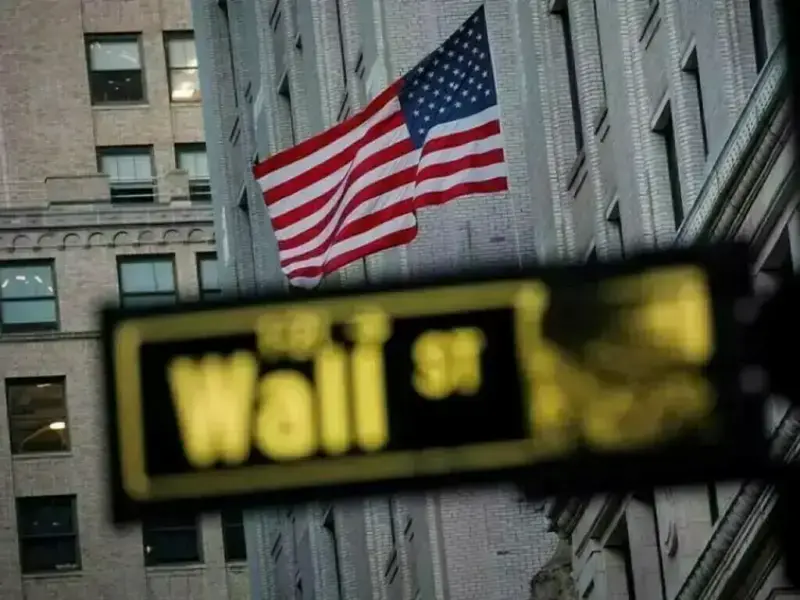
Wall Street’s main indexes were higher on Friday as chipmakers returned to the driver’s seat in a volatile week that also marked the start of the fourth-quarter earnings season.
Memory chipmakers led the gains, with Micron, Seagate Technology and SanDisk up between 2% and 7%, building on their searing rallies in 2025.
The iShares Semiconductor ETF gained 2.1% on Friday, lifting its near 12% rally so far this year that has handily beaten the Nasdaq 100’s 1.2% rise, underscoring investor faith in AI-riven chip demand.
U.S. stocks were limping toward modest weekly losses, even after the S&P 500 and the Dow punched out fresh record closes on Monday. The S&P now hovers just about 30 points shy of the 7,000 milestone – a mark that analysts have pegged as a potential pocket of technical resistance.
Worries over the fallout of a proposed one-year cap on credit card interest rates at 10% weighed on lenders’ shares and broader markets despite strong quarterly showings from big U.S. banks.
“Banks set up the week nicely to say the consumer is still spending and there’s nothing to worry about yet. We will see if that is being translated into more consumption,” said Jason Barsema, president of Halo Investing.
Markets will remain shut on Monday on account of Martin Luther King, Jr. Day, but the earnings season will gather steam next week with results due from the likes of Netflix, Johnson & Johnson and Intel.
At 9:35 a.m. ET, the Dow Jones Industrial Average rose 67.35 points, or 0.14%, to 49,509.79, the S&P 500 gained 18.67 points, or 0.27%, to 6,963.14 and the Nasdaq Composite gained 114.46 points, or 0.49%, to 23,644.48.
DEFENSIVE SECTORS LEAD WEEKLY GAINS
Consumer staples, real estate and utilities – largely considered defensive sectors – were on top of the leaderboard for weekly gains. At the same time, financials sank and were headed for their worst week since October.
That defensive rotation comes as uncertainty flared around the Federal Reserve’s independence, after Chair Jerome Powell said on Sunday that the Justice Department had opened a criminal investigation into him. White House adviser Kevin Hassett sought to tamp down the fallout, brushing off the probe and saying he expected there would be “nothing to see here.”
The week also saw money shifting out of some heavyweight tech names into more undervalued areas, with the S&P 600 mid-cap index and the Russell small-cap 2000 index set to gain about 2% each this week.
Meanwhile, a run of key economic data reinforced bets for a prolonged rate pause by the Fed.
Remarks from Fed governors Michelle Bowman and Philip Jefferson later in the day will offer clues on voting members’ thinking before the U.S. central bank enters its blackout period ahead of its January 27-28 policy meeting.
Among other stocks, State Street dipped 2.7% after reporting a fall in fourth-quarter profit.
Independent power producers dropped after a report said U.S. states seeing a rapid expansion in data center construction will sign an agreement with the Trump administration intended to curb rising electricity costs.
Talen Energy slumped 9.6%, while Constellation Energy and Vistra fell over 7% each.
Declining issues outnumbered advancers by a 1.44-to-1 ratio on the NYSE and by a 1.17-to-1 ratio on the Nasdaq.
The S&P 500 posted 23 new 52-week highs and six new lows, while the Nasdaq Composite recorded 46 new highs and 28 new lows.
 American Dollar Exchange Rate