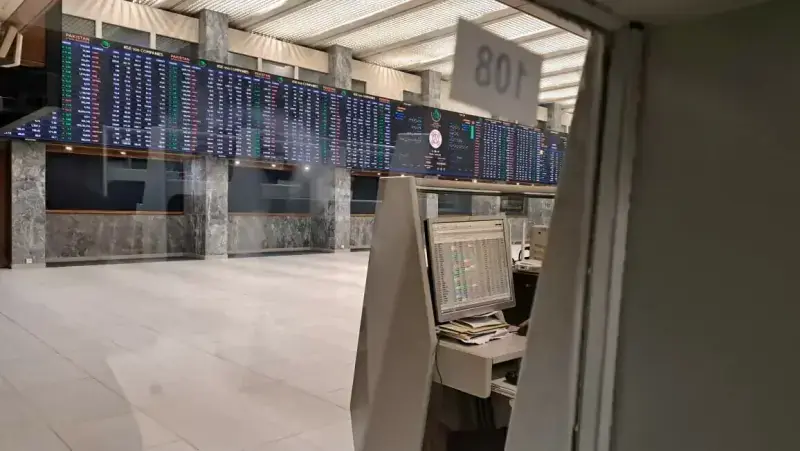
The Pakistan Stock Exchange (PSX) opened on a strong note, with the benchmark KSE-100 Index gaining nearly 1,700 points during the opening minutes of trading on Monday.
At 9:35am, the benchmark index was hovering at 186,786.74, an increase of 1,687.91 points or 0.91%.
Buying interest was observed in key sectors, including automobile assemblers, cement, commercial banks, fertiliser, oil and gas exploration companies, OMCs, power generation and refinery. Index-heavy stocks, including ARL, HUBCO, MARI, OGDC, POL, PPL, PSO, SNGPL, SSGC, MCB, MEBL and NBP, traded in the green.
Analysts attributed the buying rally to expectations of a policy rate cut in the upcoming Monetary Policy Committee (MPC) meeting, which is scheduled for 26 January 2026.
During the previous week, the PSX concluded the outgoing week on a firmer footing as a strong rebound in the final trading session helped the benchmark KSE-100 Index recover earlier losses triggered by elevated regional geopolitical tensions.
The index closed at 185,098.83 points, posting a week-on-week increase of 689.16 points or 0.4%, after opening the week at 184,409.67 points.
Internationally, stock markets slid in Asia on Monday after President Donald Trump threatened to slap extra tariffs on eight European nations until the US is allowed to buy Greenland, pushing the dollar down against the safe-haven yen and Swiss franc.
A holiday in the US equity and bond markets made for thin trading and likely contributed to a 0.8% drop in S&P 500 futures and a 1.1% fall in Nasdaq futures.
For Europe, EUROSTOXX 50 futures and DAX futures both shed 1.3%, while FTSE futures lost 0.6%. Japan’s Nikkei fell 1.4%, and MSCI’s broadest index of Asia-Pacific shares outside Japan dipped 0.3%.
Trump said he would impose additional 10% import levies from February 1 on goods from Denmark, Norway, Sweden, France, Germany, the Netherlands, Finland and Britain, rising to 25% on June 1 if no deal is reached.
Major European Union states decried the tariff threats over Greenland as blackmail, and France proposed responding with a range of previously untested economic countermeasures.
The EU’s options include a package of its own tariffs on 93 billion euros of US imports that was suspended for six months in early August and measures under an Anti-Coercion Instrument that could hit US services trade or investments.
Analysts at Deutsche Bank noted European countries owned $8 trillion of US bonds and equities, almost twice as much as the rest of the world combined, and might consider bringing some of that money back home.
This is an intra-day update
 American Dollar Exchange Rate