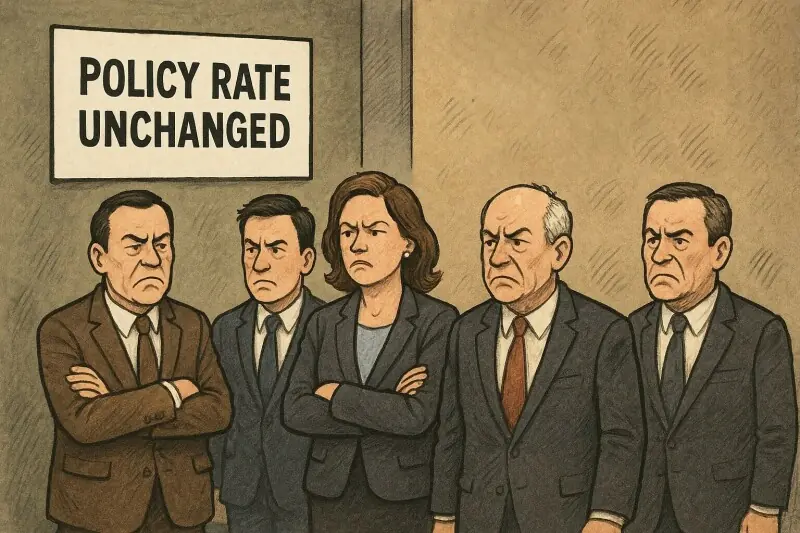

The business community expressed on Monday disappointment over the State Bank of Pakistan’s (SBP) decision to keep the policy rate unchanged at 10.5%, stating that single-digit interest rate was “essential for economic revival and restoring business confidence”.
In its first meeting of 2026, the SBP’s Monetary Policy Committee (MPC) decided to keep its benchmark policy interest rate unchanged at 10.5%. SBP Governor Jameel Ahmad announced the decision in a press conference.
The committee observed that headline inflation of 5.6% y/y in December 2025 was in line with its expectation.
“However, core inflation has steadied around a relatively higher level of 7.4% in recent months. Meanwhile, as reflected by the recent high frequency indicators (HFIs),” it said.
Reacting to the central bank announcement, business leaders asked for reducing interest rate in the larger interest of higher exports and industrial growth.
Saquib Fayyaz Magoon, Businessmen Panel Progressive (BMPP) Chairman and Senior Vice President of the Federation of Pakistan Chambers of Commerce and Industry (FPCCI) expressed disappointment over the MPC decision, which he said was contrary to the expectations of the FPCCI and the broader business community.
Calling for urgent action, he urged the central bank to reconsider its stance.
“A single-digit interest rate is not only possible but essential for economic revival and restoring business confidence,” Magoon emphasised.
“Inflation has gradually come down to 5.6%, leaving ample room for a reduction in the policy rate. The SBP could have easily brought interest rates into single digits, but failing to do so is discouraging for the business community.”
According to Magoon, interest rates are determined by adding a positive real rate of 2 to 4% to the prevailing inflation.
“If inflation is at 5.6%, the policy rate should ideally be between 7.6 and 9.6%. This is a level the State Bank could have adopted without difficulty.”
He stressed that businesses had anticipated a cut to at least 7–8%, which would have provided much-needed relief and boosted economic activity.
“The cost of financing is already unbearable, overall business expenses have surged, and energy tariffs remain exceptionally high. Elevated interest rates are further squeezing industrial and commercial operations,” Magoon said.
Meanwhile, Karachi Chamber of Commerce and Industry (KCCI) President Rehan Hanif said business people were calling for bringing down the rate to a single digit for a long time.
“Higher interest rate fuels high cost of doing business,” he lamented.
Babar Khan, Chairman of Pakistan Hosiery Manufacturers and Exporters Association (PHMEA), was of the view that the interest rate and utility costs were higher than that of regional countries such as India, Bangladesh, Vietnam and others.
He pleaded for reducing interest rate and utility costs for higher industrial growth and exports.
“The present interest at 10.5% will not help enhance exports and industrial growth and set up new industrial units. However, unemployment can be increased.”
Ahmed Azeem Alvi, President of the SITE Association of Industry(SAI), rejected the SBP move, saying it would further burden businesses and undermine exports.
“Even the State Bank governor himself has acknowledged that exports have declined while imports have risen. This clearly shows that keeping interest rates high has stalled economic progress,” he remarked.
Alvi added that timely decisions could benefit businesses, boost exports, and support overall economic growth. Expressing regret, he noted that Pakistan had “failed to learn from regional countries and had not capitalised on opportunities presented by global exhibitions”.
Commercial importers also rejected the SBP decision to maintain the policy rate, warning that the move would further strain businesses and delay economic recovery.
Pakistan Chemicals & Dyes Merchants Association (PCDMA) Chairman Salim Vali Muhammad said the decision was unacceptable under the current economic conditions, arguing that a single-digit interest rate was essential to revive economic activity.
He said the policy rate should ideally be brought down to 8–9%, stressing that Pakistan’s economy was already facing a slowdown, with weak business activity and growing financing challenges for traders and industrialists.




 American Dollar Exchange Rate