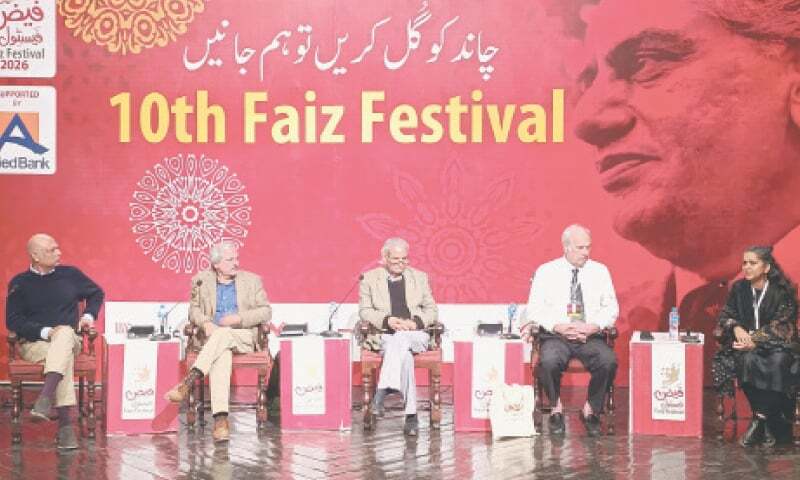
LAHORE: Faiz Ahmed Faiz is widely known for his poetry but his work as an editor at the Pakistan Times has been of fearless journalism, principles and editorial excellence.
Panelists at a session titled ‘Faiz, Pakistan Times and Imroze’ at the 10th Faiz Festival expressed these view while discussing his stint at the newspaper. The session was moderated by Human Rights Commission of Pakistan (HRCP) Secretary General Harris Khalique and the speakers included veteran journalist and author Majid Sheikh, senior journalists Mazhar Abbas and Nasir Zaidi, and HRCP Director Farah Zia.
Recalling his time working at the Pakistan Times, Mr Sheikh said that Faiz Ahmed Faiz, Mazhar Ali Khan and Hameed Sheikh were all very progressive and Mr Jinnah said that with such talent you should do wonders, and wonders Pakistan Times did. He said that the common belief was that the Progressive Papers was an offshoot of the Communist Party, but this was not true. Because of its progressive outlook and activism, the Progressive Papers was nationalised in 1951 and the journalists who suffered at that time were still suffering today.
He said, “When I was researching this, I found a very strange fact. The proposal to nationalise [the paper] given to Ayub Khan was written by Zulfiqar Ali Bhutto. People don’t know this and I was quite shocked by this too but Bhutto’s later actions proves this”.
Speaking about Faiz’s contribution to the journalistic community, Mr Abbas said those belonging to the Pakistan Times, including Faiz, did two great things for journalists. He said the first thing was getting Mian Iftikharuddin to agree to make the paper administration pay for journalists’ expenses for their travels for unions. Later, when CBA unions came into being, it was also included in their charters. The second thing was making the charter that later became the foundation of the press commission in Pakistan. All these things became the foundation of the Pakistan Federal Union of Journalists, he said.
He said Faiz was also the first journalist to get arrested in Pakistan in 1948. “It was because of a piece published in Imroze. The next day when Mahmood Ali Kasuri went to bail him out, he refused. Later, the government itself withdrew the case”.
He said Pakistan Times’ early editorials were important as it was the only newspaper being published in what is now Pakistan as media was published from Delhi and so was the Civil and Military Gazette. He said that these editorials clearly supported the Muslim League, and in fact, it was declared as the Muslim League’s paper. He said the editorials also reflected Faiz’s style in which he was happy for Pakistan coming into existence but at the same time, he was also sad for those Muslims who were left behind. He was also looking after other papers at the time and his command on the Urdu and English languages could be seen along with the commitment and conviction lacking today.
Ms Zia recalled reading the impression her generation had of the Pakistan Times and said that when she started journalism in the early 90s, Faiz was only known to that generation as a poet. She said that those who grew up during the Zia-era knew Pakistan Times as the most well-edited newspaper. She said, “This reputation preceded it even after being nationalised and IA Rehman, in his book, wrote that this was the strongest attempt to crush the civil society movement in the country.
Later papers were seen as pioneers of highlighting progressive causes, promoting democracy, talking about marginalised segments of the society but all this was done very early by Pakistan Times and Imroze”. She said that these newspapers were the foundation of such journalism, which was lost after its nationalisation. People were unaware of this glorious history, she added.
Mr Zaidi described how Pakistan Times and Imroze came into being and also how Faiz, among others, were chosen to lead it. He said that in the subcontinent during the Pakistan Movement, there were two poles, the Muslim League’s feudal leadership and Quaid-i-Azam and a few other people who wanted Pakistan to be egalitarian, progressive and secular. The other strongest grass-root movement in the subcontinent against the British was the Communist Party of India, he said.
Mr Zaidi said, “It must be understood that in this background, these progressive people wanted a media forum that helped in evolving the progressive and secular image of Pakistan. This was the foundation of the Progressive Papers Limited and the selection of the staff and leadership reflected it”.
Published in media, February 16th, 2026
 American Dollar Exchange Rate