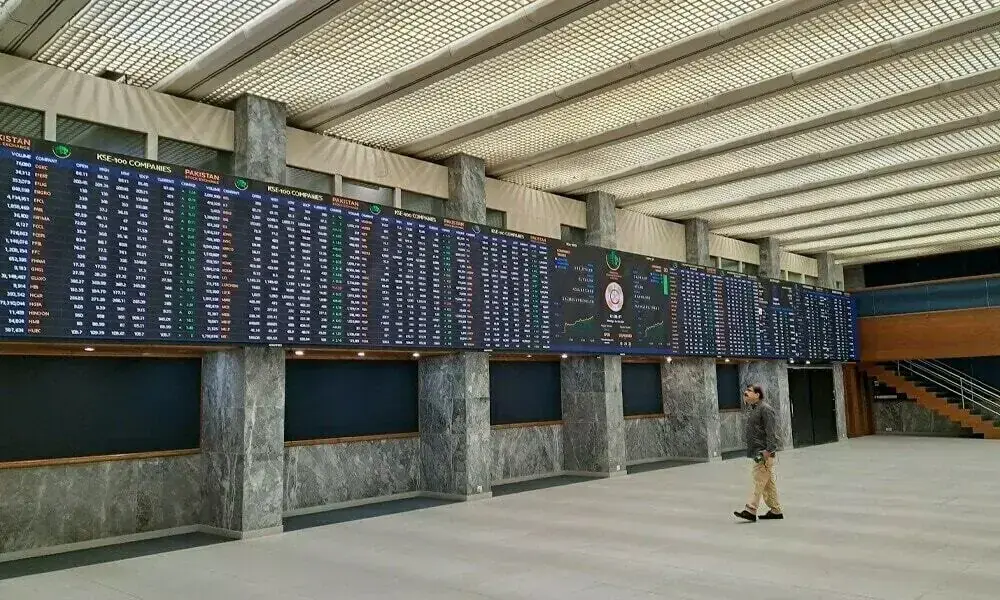
Selling pressure continued unabated at the Pakistan Stock Exchange (PSX), with the benchmark KSE-100 shedding nearly 1% on Tuesday.
The market opened on a positive note and briefly surged in early trade, but selling pressure quickly emerged, dragging the benchmark sharply lower by mid-morning, hitting an intraday low of 163,907.59.
Following the steep dip, the market staged a steady recovery through late morning and midday, with the index climbing back toward the 168,000 level. However, the rebound proved short-lived,* pushing the KSE-100 back into negative territory by the end.
At close, the benchmark index settled at 166,258.54, a decrease of 1,432.54 points or 0.85%.
“Even though some geopolitical tensions have eased, risk appetite remains fragile,” Waqas Ghani, Head of Research at JS Global, told media.
“Markets are still pricing uncertainty, as investors don’t wait for inflation prints, trade disruptions, or macro data to confirm the damage, they sell first on heightened geopolitical risk, uncertainty, and risk-off flows,” he added.
“Investor sentiment remained fragile as the benchmark index continued to grapple with the aftermath of an 11% decline from its recent peak, keeping participants cautious and highly selective,” said Topline Securities in a note on Tuesday.
The brokerage house noted that the see-saw movement observed during the day reflected nervous positioning, “as investors balanced emerging valuation comfort against lingering uncertainty and a lack of near-term positive triggers”.
Index-heavy constituents UBL, HBL, FFC, MARI, and HUBC remained the principal laggards, collectively dragging the benchmark down by 949 points. On the other hand, LUCK, POL, MCB, EFERT, and ATRL provided partial support, adding 439 points to the index, Topline added.
On Monday, PSX suffered another dramatic sell-off as panic-driven liquidation gripped the market, triggered by escalating geopolitical tensions, uncertainty surrounding the upcoming IMF review, and cautious expectations from the ongoing corporate earnings season. The benchmark KSE-100 Index closed at 167,691.08 points, shedding 5,478.63 points or 3.16%.
Internationally, Asian stock markets stuttered in early trade on Tuesday as a selloff on Wall Street overnight rattled investors, with sentiment hurt by heightened uncertainty over US President Donald Trump’s tariff policy and rising geopolitical tensions.
MSCI’s broadest index of Asia-Pacific shares outside Japan flipped from gains to losses following a six-day rally, and was last down 0.2%, led by declines in South Korea.
The Nikkei 225 advanced 0.7% as Japanese markets returned after a holiday.
S&P 500 e-mini futures were up 0.1%.
On Monday, Trump warned countries against backing away from recently negotiated trade deals with the U.S. after the Supreme Court struck down his emergency tariffs, saying that he would hit them with much higher duties under different trade laws.
The new tariffs are based on Section 122 of the Trade Act of 1974, causing further confusion in markets trying to come to grips with U.S. protectionist policies.
Meanwhile, the Pakistani rupee registered a marginal gain, appreciating 0.01% against the US dollar in the inter-bank market on Tuesday. At close, the local currency settled at 279.52, a gain of Re0.03 against the greenback.
Volume on the all-share index improved to 687.96 million from 461.26 million recorded in the previous close.
The value of shares increased to Rs38.46 billion from Rs24.93 billion in the previous session.
K-Electric Ltd was the volume leader with 64.85 million shares, followed by B.O.Punjab with 49.14 million shares, and WorldCall Telecom with 45.98 million shares.
Shares of 487 companies were traded on Tuesday, of which 139 registered an increase, 292 recorded a fall, and 56 remained unchanged.
 American Dollar Exchange Rate