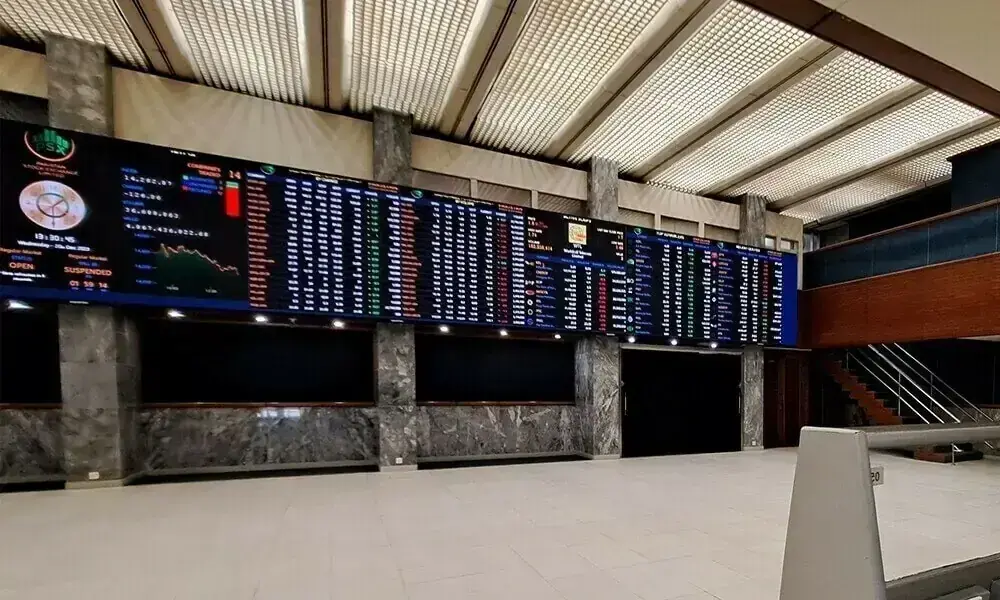
After observing buying momentum in the opening hours, selling pressure returned to the Pakistan Stock Exchange (PSX), with the benchmark KSE-100 Index shedding over 1,600 points during intraday trading on Friday.
At 11:05am, the benchmark index was hovering at 152,796.87, down by 1,624.56 points or 1.05%.
Selling pressure was observed in key sectors, including automobile assemblers, cement, chemical, commercial banks, fertiliser, and oil and gas exploration companies traded in the red. Index-heavy stocks, including HBL, MCB, MEBL, NBP, MARI, OGDC, POL, PPL, PSO, SNGPL and SSGC, traded in the red.
On Thursday, PSX extended its volatile streak as investor sentiment remained fragile amid persistent geopolitical tensions in the Middle East and uncertainty in global energy markets, prompting cautious trading across most sectors.
The KSE-100 Index closed in negative territory at 154,421.43 points, down 1,437.05 points or 0.92%.
Internationally, Asian stocks slumped on Friday, poised for a second straight weekly decline as fast-dwindling hopes of a resolution to the US and Israel’s war with Iran kept oil prices aloft, casting a shadow over global markets and spurring inflation fears.
The US dollar has become the safe-haven of choice during the tumult, putting most other currencies under pressure.
The dollar was set for a second consecutive week of gains and is up 2% since the war broke out at the end of February.
Oil prices remained close to the closely watched $100 per barrel level, although they eased a bit in early trading on Friday after US issued a 30-day license for countries to buy Russian oil and petroleum products currently stranded at sea.
Brent futures were last at $99.85 a barrel, while West Texas Intermediate crude was at $95.05 a barrel.
In Asia, MSCI’s broadest index of Asia-Pacific shares eased 0.5%, on course for a 1.5% decline for the week.
Japan’s Nikkei fell 1.3%, while tech-heavy South Korean stocks slid nearly 2% and Taiwan equities fell 1%.
With Iran stepping up attacks across the Middle East as its new Supreme Leader, Mojtaba Khamenei, vowed to keep the Strait of Hormuz shipping lane closed, investors are bracing for a prolonged conflict and higher oil prices.
The spectre of rising inflation has led markets to rapidly reprice what they expect from central banks this year, with traders now anticipating just 20 basis points of easing from the Federal Reserve compared to 50 bps of cuts priced last month.
This is an intra-day update

After observing buying momentum in the opening hours, selling pressure returned to the Pakistan Stock Exchange (PSX), with the benchmark KSE-100 Index shedding over 1,600 points during intraday trading on Friday.
At 11:05am, the benchmark index was hovering at 152,796.87, down by 1,624.56 points or 1.05%.
Selling pressure was observed in key sectors, including automobile assemblers, cement, chemical, commercial banks, fertiliser, and oil and gas exploration companies traded in the red. Index-heavy stocks, including HBL, MCB, MEBL, NBP, MARI, OGDC, POL, PPL, PSO, SNGPL and SSGC, traded in the red.
On Thursday, PSX extended its volatile streak as investor sentiment remained fragile amid persistent geopolitical tensions in the Middle East and uncertainty in global energy markets, prompting cautious trading across most sectors.
The KSE-100 Index closed in negative territory at 154,421.43 points, down 1,437.05 points or 0.92%.
Internationally, Asian stocks slumped on Friday, poised for a second straight weekly decline as fast-dwindling hopes of a resolution to the US and Israel’s war with Iran kept oil prices aloft, casting a shadow over global markets and spurring inflation fears.
The US dollar has become the safe-haven of choice during the tumult, putting most other currencies under pressure.
The dollar was set for a second consecutive week of gains and is up 2% since the war broke out at the end of February.
Oil prices remained close to the closely watched $100 per barrel level, although they eased a bit in early trading on Friday after US issued a 30-day license for countries to buy Russian oil and petroleum products currently stranded at sea.
Brent futures were last at $99.85 a barrel, while West Texas Intermediate crude was at $95.05 a barrel.
In Asia, MSCI’s broadest index of Asia-Pacific shares eased 0.5%, on course for a 1.5% decline for the week.
Japan’s Nikkei fell 1.3%, while tech-heavy South Korean stocks slid nearly 2% and Taiwan equities fell 1%.
With Iran stepping up attacks across the Middle East as its new Supreme Leader, Mojtaba Khamenei, vowed to keep the Strait of Hormuz shipping lane closed, investors are bracing for a prolonged conflict and higher oil prices.
The spectre of rising inflation has led markets to rapidly reprice what they expect from central banks this year, with traders now anticipating just 20 basis points of easing from the Federal Reserve compared to 50 bps of cuts priced last month.
This is an intra-day update



 American Dollar Exchange Rate