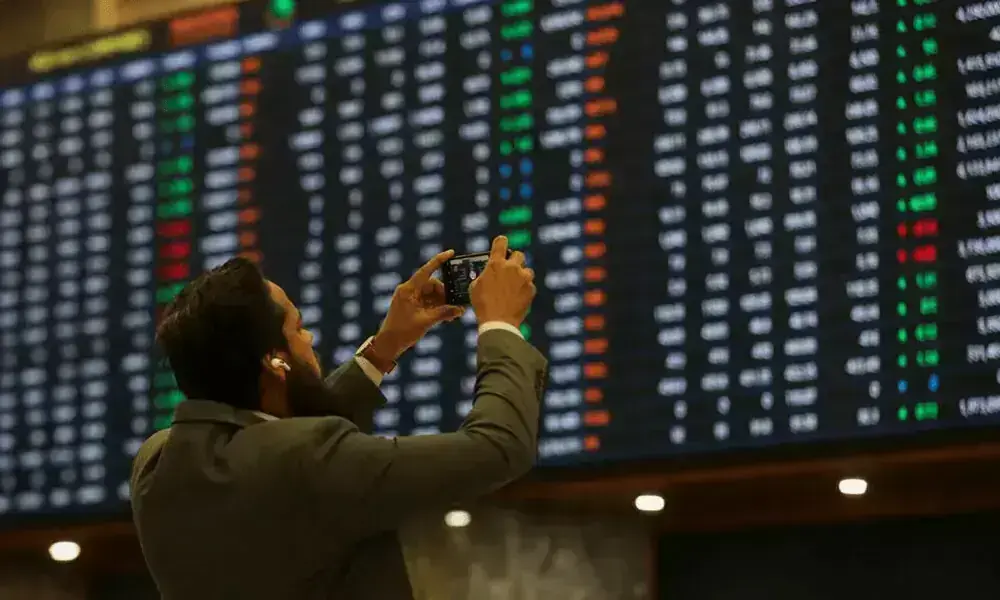
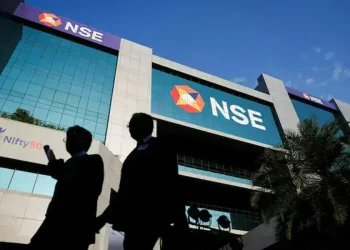
A volatile session was observed at the Pakistan Stock Exchange (PSX), with the benchmark KSE-100 Index swinging both ways during trading on Monday.

The index opened on a negative note, with the benchmark index dropping to an intra-day low of 147,771.35. However, buying interest returned during the second half of the trading session, pushing the index to an intra-day high of 151,875.01.
At close, the benchmark index settles at 151,207.81, up by 809.10 points or 0.54%.
“Early pressure reflected heightened geopolitical concerns; however, sentiment took a decisive turn as optimism around a potential ceasefire and the anticipated reopening of the Strait of Hormuz triggered a strong late-session recovery,” said Topline Securities.
“The rebound was led by aggressive value hunting and short covering, allowing bulls to regain control by the close,” it added.
On the index front, key laggards, including UBL, BAFL, ATRL, POL, and NESTLE, collectively shaved off 716 points. Conversely, ENGROH, PPL, LUCK, HUBC, OGDC, and MCB lent support, adding 666 points to the index.
With a US deadline approaching, the United States and Iran received the framework of a plan to end their five-week-old conflict on Monday.
The Pakistani-brokered plan emerged from intense overnight contacts and proposes an immediate ceasefire, followed by negotiations on a broader settlement to be concluded within 15 to 20 days, a source aware of the proposals told Reuters.
Pakistan’s army chief, Field Marshal Asim Munir, was in contact “all night long” with U.S. Vice President JD Vance, special envoy Steve Witkoff and Iranian Foreign Minister Abbas Araqchi, the source said.
During the last week, Pakistan’s stock market remained under pressure amid escalating geopolitical tensions and persistently high global oil prices. The KSE-100 Index continued to exhibit volatility, declining by 1,309 points or 0.9% on a week-on-week basis to close at 150,398.70 points.
Internationally, oil prices rose, bonds fell, and stocks were mixed at the start of trading in Asia on Monday as US President Donald Trump vowed “hell” if Tehran does not meet his deadline to reopen the Strait of Hormuz.
Trump’s repeated threats to destroy civilian infrastructure, including power plants and bridges, if the vital waterway is not open by Tuesday, have put traders on edge for reciprocal attacks by Iran on targets in the Gulf states.
With liquidity thin, as many countries around the region observed holidays on Monday, S&P 500 e-mini futures sank 0.2%, while MSCI’s broadest index of Asia-Pacific shares outside Japan was up 0.5%.
The Nikkei 225 rose 1.2%, as South Korea’s Kospi advanced 2%.
Brent crude futures opened higher, rising 1.4% to $110.58 a barrel after members of the OPEC+ agreed on Sunday to raise its oil output quotas by 206,000 barrels per day for May.
However, the increase will exist only on paper for several major producing countries behind the Strait of Hormuz that have sustained damage to oil production facilities and transport infrastructure since the war started.
Meanwhile, the Pakistani rupee registered marginal gain, appreciating 0.01% against the US dollar in the inter-bank market on Monday. At close, the local currency settled at 279.07, a gain of Re0.03, against the greenback.
Volume on the all-share index decreased to 457.21 million from 471.94 million recorded in the previous close.
The value of shares increased to Rs30.88 billion from Rs24.64 billion in the previous session.
Cnergyico PK was the volume leader with 57.96 million shares, followed by WorldCall Telecom with 30.55 million shares, and Pak Refinery with 28.35 million shares.
Shares of 483 companies were traded on Monday, of which 261 registered an increase, 153 recorded a fall, and 69 remained unchanged.



 American Dollar Exchange Rate