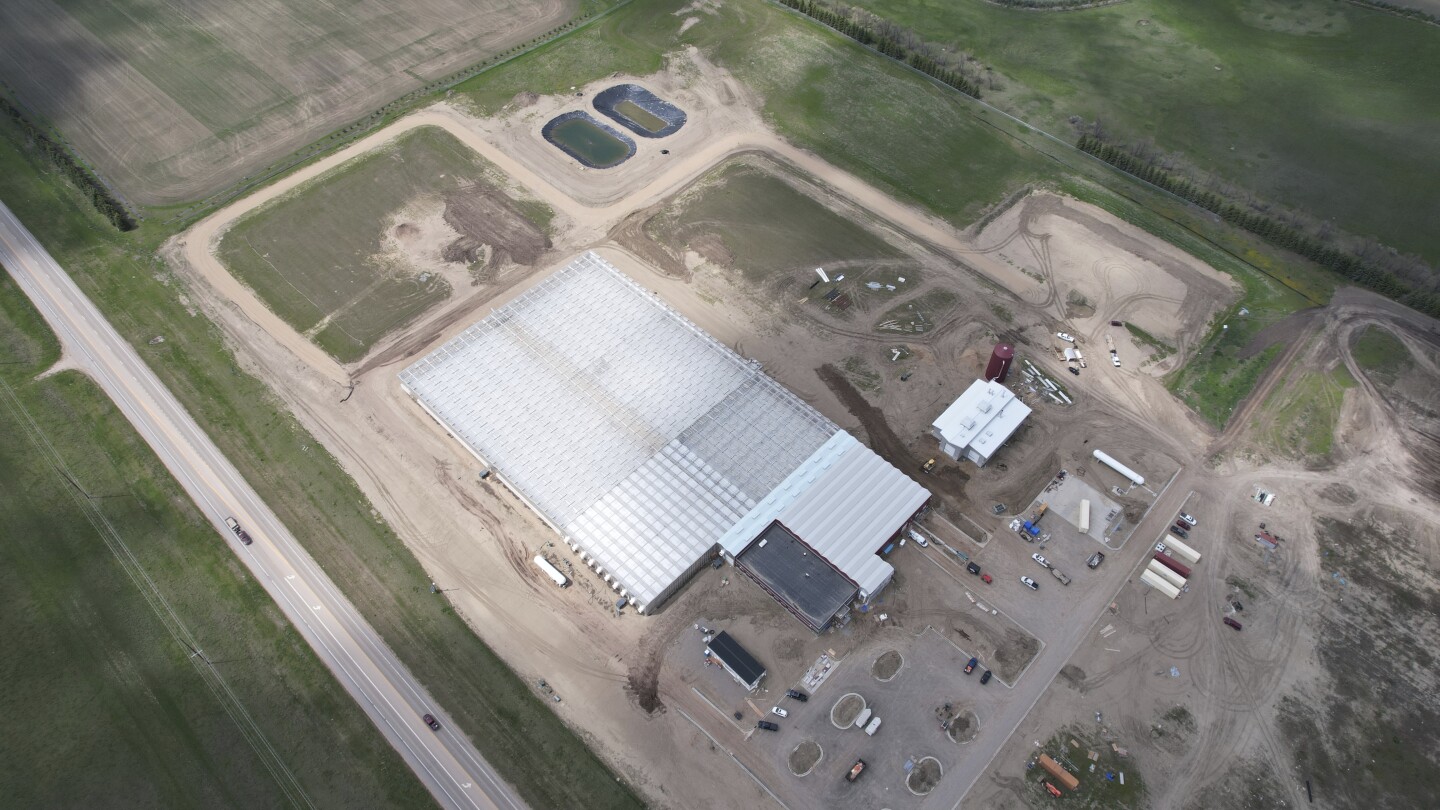
BISMARCK, N.D. (news agencies) — A Native American tribe in North Dakota will soon grow lettuce in a giant greenhouse complex that when fully completed will be among the country’s largest, enabling the tribe to grow much of its own food decades after a federal dam flooded the land where they had cultivated corn, beans and other crops for millennia.

Work is ongoing on the Mandan, Hidatsa and Arikara Nation’s 3.3-acre (1.3-hectare) greenhouse that will make up most of the Native Green Grow operation’s initial phase. However, enough of the structure will be completed this summer to start growing leafy greens and other crops such as tomatoes and strawberries.
“We’re the first farmers of this land,” Tribal Chairman Mark Fox said. “We once were part of an aboriginal trade center for thousands and thousands of years because we grew crops — corn, beans, squash, watermelons — all these things at massive levels, so all the tribes depended on us greatly as part of the aboriginal trade system.”
The tribe will spend roughly $76 million on the initial phase, which also will includes a warehouse and other facilities near the tiny town of Parshall. It plans to add to the growing space in the coming years, eventually totaling about 14.5 acres (5.9 hectares), which officials say would make it one of the world’s largest facilities of its type.
The initial greenhouse will have enough glass to cover the equivalent of seven football fields.
The tribe’s fertile land along the Missouri River was inundated in the mid-1950s when the U.S. Army Corps of Engineers built the Garrison Dam, which created Lake Sakakawea.
Getting fresh produce has long been a challenge in the area of western North Dakota where the tribe is based, on the Fort Berthold Indian Reservation. The rolling, rugged landscape — split by Lake Sakakawea — is a long drive from the state’s biggest cities, Bismarck and Fargo.
That isolation makes the greenhouses all the more important, as they will enable the tribe to provide food to the roughly 8,300 people on the Fort Berthold reservation and to reservations elsewhere. The tribe also hopes to stock food banks that serve isolated and impoverished areas in the region, and plans to export its produce.
Initially, the MHA Nation expects to grow nearly 2 million pounds (907,000 kilograms) of food a year and for that to eventually increase to 12 to 15 million pounds (5.4 million to 6.4 million kilograms) annually. Fox said the operation’s first phase will create 30 to 35 jobs.
The effort coincides with a national move to increase food sovereignty among tribes.
Supply chain disruptions during the COVID-19 pandemic led tribes nationwide to use federal coronavirus aid to invest in food systems, including underground greenhouses in South Dakota to feed the local community, said Heather Dawn Thompson, director of the U.S. Department of Agriculture’s Office of Tribal Relations. In Oklahoma, multiple tribes are running or building their own meat processing plant, she said.
The USDA promotes its Indigenous Food Sovereignty Initiative, which “really challenges us to think about food and the way we do business at USDA from an indigenous, tribal lens,” Thompson said. Examples include indigenous seed hubs, foraging videos and guides, cooking videos and a meat processing program for indigenous animals.
“We have always been a very independent, sovereign people that have been able to hunt, gather, grow and feed ourselves, and forces have intervened over the last century that have disrupted those independent food resources, and it made it very challenging. But the desire and goal has always been there,” said Thompson, whose tribal affiliation is Cheyenne River Sioux.
The MHA Nation’s greenhouse plans are possible in large part because of access to potable water and natural gas resources.
The natural gas released in North Dakota’s Bakken oil field has long been seen by critics as a waste and environmental concern, but Fox said the tribal nation intends to capture and compress that gas to heat and power the greenhouse and process into fertilizer.
Flaring, in which natural gas is burned off from pipes that emerge from the ground, has been a longtime issue in the No. 3 oil-producing state.
North Dakota Pipeline Authority Director Justin Kringstad said that key to capturing the gas is building needed infrastructure, as the MHA Nation intends to do.
“With those operators that are trying to get to that level of zero, it’s certainly going to take more infrastructure, more buildout of pipes, processing plants, all of the above to stay on top of this issue,” he said.
The Fort Berthold Reservation had nearly 3,000 active wells in April, when oil production totaled 203,000 barrels a day on the reservation. Oil production has helped the MHA Nation build schools, roads, housing and medical facilities, Fox said.





 American Dollar Exchange Rate