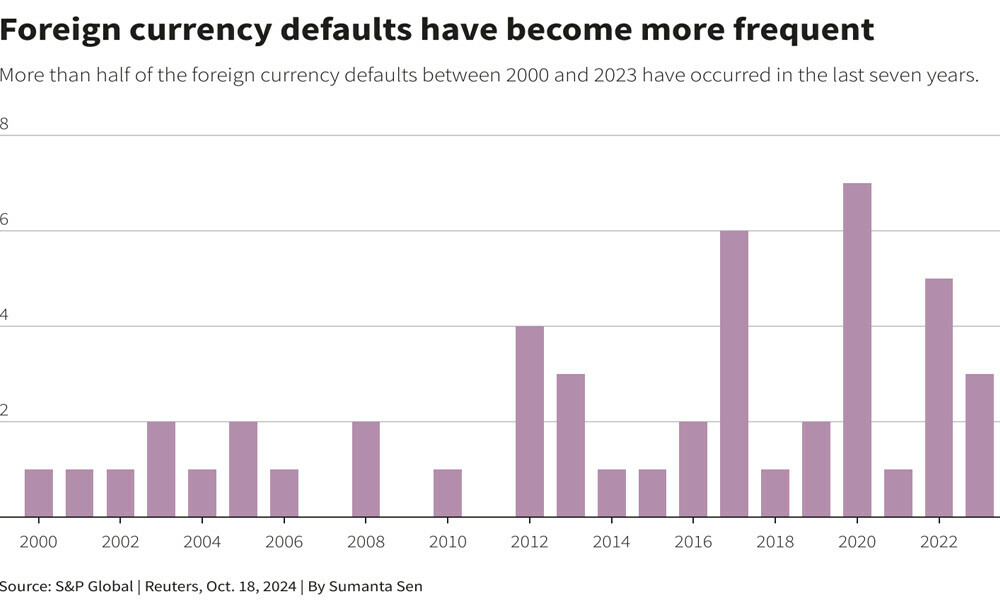
LONDON: The punishing post-COVID wave of sovereign defaults has finally crested, with the likes of Ghana, Sri Lanka and Zambia concluding years of painful debt reworks.
But the International Monetary Fund and others worry that a dangerous liquidity shortfall could take its place in many emerging economies – setting back development, stunting climate change mitigation and fuelling distrust in governments and Western institutions.
Zambia’s debt-rework battle scars mar its Common Framework success
The issue, and what to do about it when western countries are increasingly loath to send money overseas, is a key topic at the IMF World Bank autumn meetings taking place in Washington, D.C. this week.
“It’s a challenge in the sense that for many, debt service has grown, borrowing has become more expensive, and external sources (have become) less certain,” said Christian Libralato, portfolio manager with RBC BlueBay.
The US Treasury’s top economic diplomat has called for new ways to provide short-term liquidity support to low- and middle-income countries to head off debt crises.
The Global Sovereign Debt Roundtable – an initiative bringing together representatives from countries, private lenders, the World Bank and the G20 – has also tried to tackle the issue, and it will be on the agenda when they meet in Washington on Wednesday.
But with constrained budgets and crises around every corner, Vera Songwe, chair of the Liquidity and Sustainability Facility – a group that aims to lower debt costs for Africa – said current fixes lack the scale and the speed needed.
“Countries are avoiding education, health and infrastructure expenditures to service their debt,” Songwe said. “Even in the advanced economies…there are stresses in the system.”
Question of capital
Data from non-profit advocacy group ONE Campaign shows that in 2022, 26 countries – including Angola, Brazil, Nigeria and Pakistan – paid more to service external debts than they received in new external finance.
Many first gained access to bond borrowing roughly a decade prior, meaning big payments came due just as global interest rates rose, putting affordable refinancing out of reach.
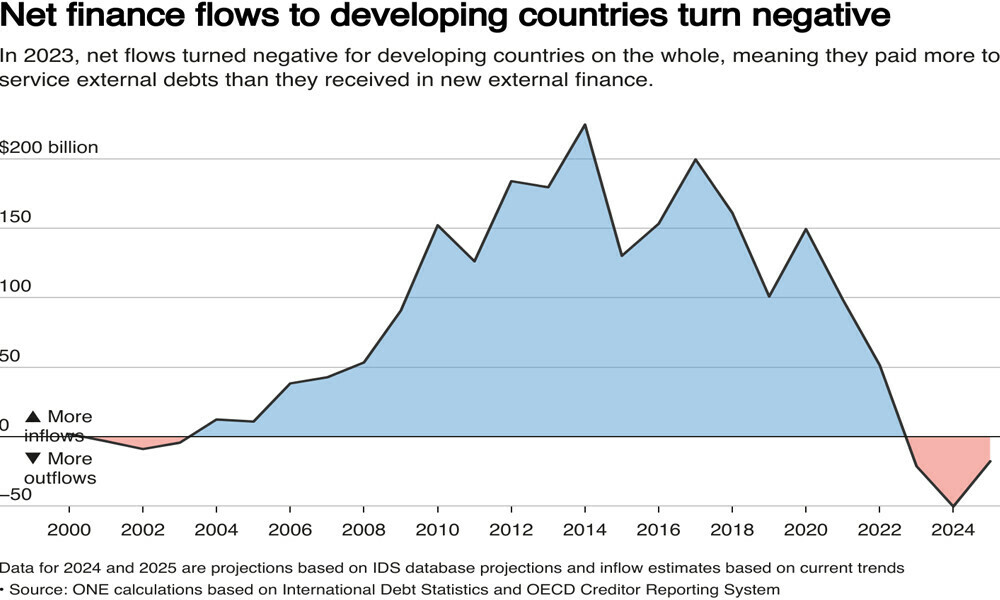
ONE estimates those flows turned net negative for developing countries on the whole in 2023, estimates backed by experts at the Finance for Development Lab.
“The IMF-led global social global financial safety net is simply not deep enough anymore,” Ishak Diwan, research director at the Finance for Development Lab told Reuters.
Sri Lanka’s inflation at -0.2% in September
Diwan, who spent two decades at the World Bank, said that while full official figures are not yet available, net negative transfers for 2023 and 2024 are likely worse. Fresh funding from the IMF, the World Bank and other multilaterals failed to compensate for the rising costs, he said.
World Bank and IMF officials seem to agree. The World Bank aims to boost lending capacity by $30 billion over 10 years. The IMF cut surcharges, lowering the cost for the most overstretched borrowers by $1.2 billion annually.
Tide turning?
Bankers say many of the countries are now able to tap markets again, alleviating cash flow worries. “I don’t think there’s a limitation on access,” said Stefan Weiler, head of CEEMEA debt at JPMorgan.
“The market is really wide open.”
Weiler expects bond issuance in Europe, the Middle East and Africa to reach a record $275-$300 billion this year – with more countries, even Nigeria and Angola, possibly issuing bonds next year. But the cost remains high.
Kenya, scrambling to repay a maturing dollar-bond, borrowed at above 10%, a threshold seen widely as unsustainable. Finance minister John Mbadi said Kenya cannot fund infrastructure investments through the budget.
“Kenyans keep on complaining about ‘we don’t have money in our pockets.’ That in a sense is just saying that we have challenges with liquidity in the economy,” Mbadi said during a news conference.
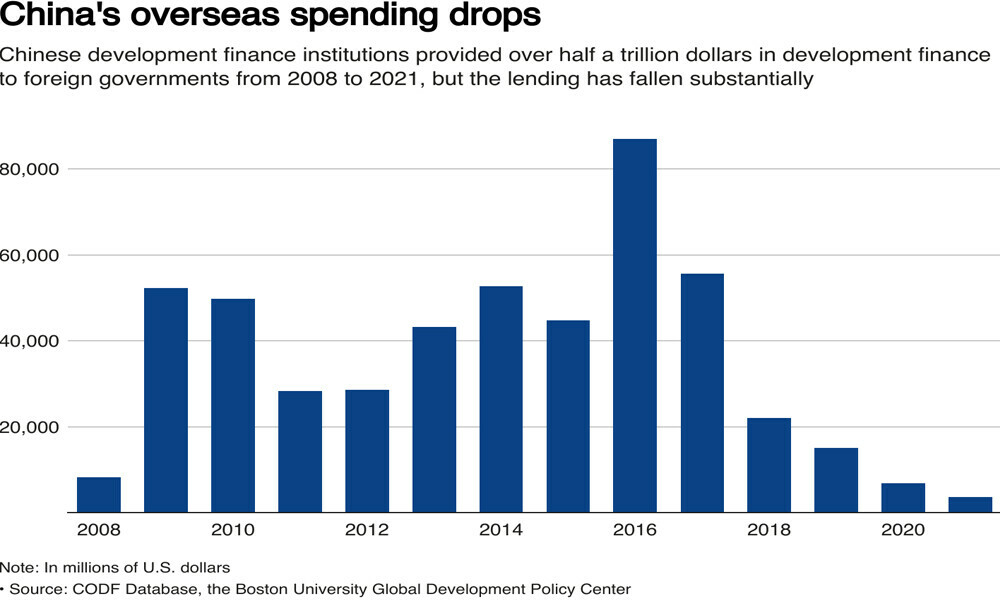
China’s pull-back in lending has also hit emerging countries hard, turning what had become a large source of incoming cash into a net negative flow for those repaying old debts.
So what?
Development banks are already scrambling to work together to maximise lending; the Inter-American Development Bank and the Africa Development Bank are in the midst of a global campaign to get countries to donate their IMF reserve assets, so-called “special drawing rights”, which they say could turn every $1 donated into $8 in lending.
But the World Bank and others are still fighting to convince western countries to cough up more cash to supercharge their lending; debt-laden France plans to cut 1.3 billion euros of foreign aid, following cuts by the previous government in Britain.
Sri Lanka records first deflation in 29 years
A strong dollar means key donor Japan would have to significantly boost its contributions to keep at the same level.
The mix is toxic for developing nations. “We see protests from Kenya to Nigeria to elsewhere. It’s a very dangerous situation,” Diwan said.
“We’re losing the whole global south at this stage.”
 American Dollar Exchange Rate