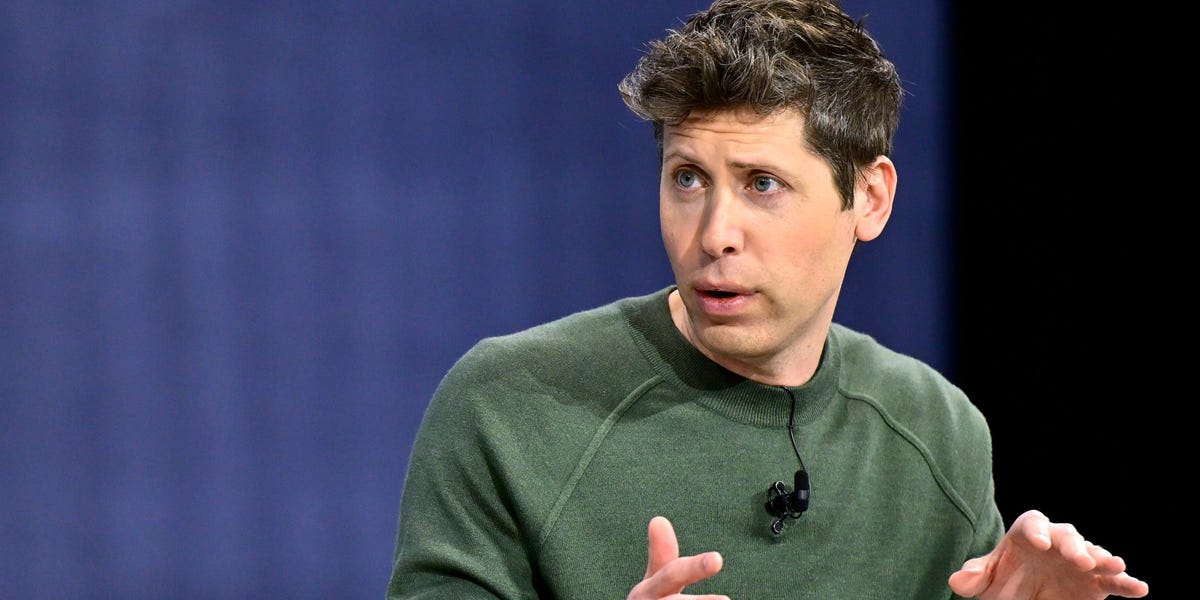
- As the CEO of OpenAI, Sam Altman is frequently asked for his predictions about how AI will change our world.
- He has thoughts on where we’re headed on AGI, superintelligence, agentic AI, and more.
- Here are some of his predictions about the future of AI.
Sam Altman’s latest blog post is full of predictions about how the world will change over the next decade.
Over the years, the OpenAI CEO has shared predictions about where he thinks we’re headed on artificial general intelligence, superintelligence, agentic AI, and more — and when we might get there.
There are some common themes.
He’s typically bullish on these technologies: He thinks AGI — which ChatGPT maker OpenAI defines as “AI systems that are generally smarter than humans” — will enhance productivity by taking care of menial tasks to free up people for more abstract work and decision-making.
He also believes it’ll create “shared intelligence,” he said in a May 2024 interview at Harvard Business School, and that it’ll usher in “massive prosperity,” he forecast in a 2024 blog post.
One day, everyone will have “a personal AI team, full of virtual experts in different areas, working together to create almost anything we can imagine,” Altman wrote in his 2024 blog.
“AI models will soon serve as autonomous personal assistants who carry out specific tasks on our behalf like coordinating medical care on your behalf. At some point further down the road, AI systems are going to get so good that they help us make better next-generation systems and make scientific progress across the board,” he added.
As far as timelines go, Altman wrote in a January 2025 blog post that he thinks this year “we may see the first AI agents ‘join the workforce’ and materially change the output of companies.”
He said in December at The New York Times’ DealBook Summit he thinks we’ll achieve AGI “sooner than most people in the world think and it will matter much less.”
“We are now confident we know how to build AGI as we have traditionally understood it,” he added in his January post.
Beyond AGI, the company is also turning its attention to superintelligence, which it defines as “future AI systems dramatically more capable than even AGI.”
“Superintelligent tools could massively accelerate scientific discovery and innovation well beyond what we are capable of doing on our own, and in turn massively increase abundance and prosperity,” he wrote in his blog post earlier this year.
Altman talked about AI funding in a February 2025 blog post.
He said the cost of using a given AI drops by roughly 10 times every year and that there’s “no reason for exponentially increasing investment to stop in the near future” since, as he puts it, “the socioeconomic value of linearly increasing intelligence is super-exponential.”
“If we don’t build enough infrastructure, AI will be a very limited resource that wars get fought over and that becomes mostly a tool for rich people,” he wrote last year. He cited the need to drive down the cost of compute, as well as the massive demand for enough chips and energy to power AI.
While Altman thinks AI will drive down the price of many goods in the future, he believes “the price of luxury goods and a few inherently limited resources like land may rise even more dramatically,” he wrote in February.
Then there’s the potential repercussions for people’s jobs.
“Most jobs will change more slowly than most people think, and I have no fear that we’ll run out of things to do (even if they don’t look like “real jobs” to us today),” he wrote in his 2024 blog post.
At the same time, he acknowledged in 2023 that many people will lose their jobs in the process.
“A lot of people working on AI pretend that it’s only going to be good, it’s only going to be a supplement, no one is ever going to be replaced,” he said. “Jobs are definitely going to go away, full stop.”
While he believes “trending more towards individual empowerment” with AGI is important, he noted in his February blog post that “the other likely path we can see is AI being used by authoritarian governments to control their population through mass surveillance and loss of autonomy.”
And his bleakest statement on AI yet: That the worst-case scenario is “lights out for all of us,” he said in a 2023 interview.
To that end, Altman has spoken about the need for guardrails to ensure responsible AI development.
“I think it’s like impossible to overstate the importance of AI safety and alignment work. I would like to see much, much more happening,” he said in the 2023 interview.
“The world will not change all at once; it never does,” he wrote in his February blog post. “But the future will be coming at us in a way that is impossible to ignore, and the long-term changes to our society and economy will be huge. We will find new things to do, new ways to be useful to each other, and new ways to compete, but they may not look very much like the jobs of today.”

- As the CEO of OpenAI, Sam Altman is frequently asked for his predictions about how AI will change our world.
- He has thoughts on where we’re headed on AGI, superintelligence, agentic AI, and more.
- Here are some of his predictions about the future of AI.
Sam Altman’s latest blog post is full of predictions about how the world will change over the next decade.
Over the years, the OpenAI CEO has shared predictions about where he thinks we’re headed on artificial general intelligence, superintelligence, agentic AI, and more — and when we might get there.
There are some common themes.
He’s typically bullish on these technologies: He thinks AGI — which ChatGPT maker OpenAI defines as “AI systems that are generally smarter than humans” — will enhance productivity by taking care of menial tasks to free up people for more abstract work and decision-making.
He also believes it’ll create “shared intelligence,” he said in a May 2024 interview at Harvard Business School, and that it’ll usher in “massive prosperity,” he forecast in a 2024 blog post.
One day, everyone will have “a personal AI team, full of virtual experts in different areas, working together to create almost anything we can imagine,” Altman wrote in his 2024 blog.
“AI models will soon serve as autonomous personal assistants who carry out specific tasks on our behalf like coordinating medical care on your behalf. At some point further down the road, AI systems are going to get so good that they help us make better next-generation systems and make scientific progress across the board,” he added.
As far as timelines go, Altman wrote in a January 2025 blog post that he thinks this year “we may see the first AI agents ‘join the workforce’ and materially change the output of companies.”
He said in December at The New York Times’ DealBook Summit he thinks we’ll achieve AGI “sooner than most people in the world think and it will matter much less.”
“We are now confident we know how to build AGI as we have traditionally understood it,” he added in his January post.
Beyond AGI, the company is also turning its attention to superintelligence, which it defines as “future AI systems dramatically more capable than even AGI.”
“Superintelligent tools could massively accelerate scientific discovery and innovation well beyond what we are capable of doing on our own, and in turn massively increase abundance and prosperity,” he wrote in his blog post earlier this year.
Altman talked about AI funding in a February 2025 blog post.
He said the cost of using a given AI drops by roughly 10 times every year and that there’s “no reason for exponentially increasing investment to stop in the near future” since, as he puts it, “the socioeconomic value of linearly increasing intelligence is super-exponential.”
“If we don’t build enough infrastructure, AI will be a very limited resource that wars get fought over and that becomes mostly a tool for rich people,” he wrote last year. He cited the need to drive down the cost of compute, as well as the massive demand for enough chips and energy to power AI.
While Altman thinks AI will drive down the price of many goods in the future, he believes “the price of luxury goods and a few inherently limited resources like land may rise even more dramatically,” he wrote in February.
Then there’s the potential repercussions for people’s jobs.
“Most jobs will change more slowly than most people think, and I have no fear that we’ll run out of things to do (even if they don’t look like “real jobs” to us today),” he wrote in his 2024 blog post.
At the same time, he acknowledged in 2023 that many people will lose their jobs in the process.
“A lot of people working on AI pretend that it’s only going to be good, it’s only going to be a supplement, no one is ever going to be replaced,” he said. “Jobs are definitely going to go away, full stop.”
While he believes “trending more towards individual empowerment” with AGI is important, he noted in his February blog post that “the other likely path we can see is AI being used by authoritarian governments to control their population through mass surveillance and loss of autonomy.”
And his bleakest statement on AI yet: That the worst-case scenario is “lights out for all of us,” he said in a 2023 interview.
To that end, Altman has spoken about the need for guardrails to ensure responsible AI development.
“I think it’s like impossible to overstate the importance of AI safety and alignment work. I would like to see much, much more happening,” he said in the 2023 interview.
“The world will not change all at once; it never does,” he wrote in his February blog post. “But the future will be coming at us in a way that is impossible to ignore, and the long-term changes to our society and economy will be huge. We will find new things to do, new ways to be useful to each other, and new ways to compete, but they may not look very much like the jobs of today.”








 American Dollar Exchange Rate