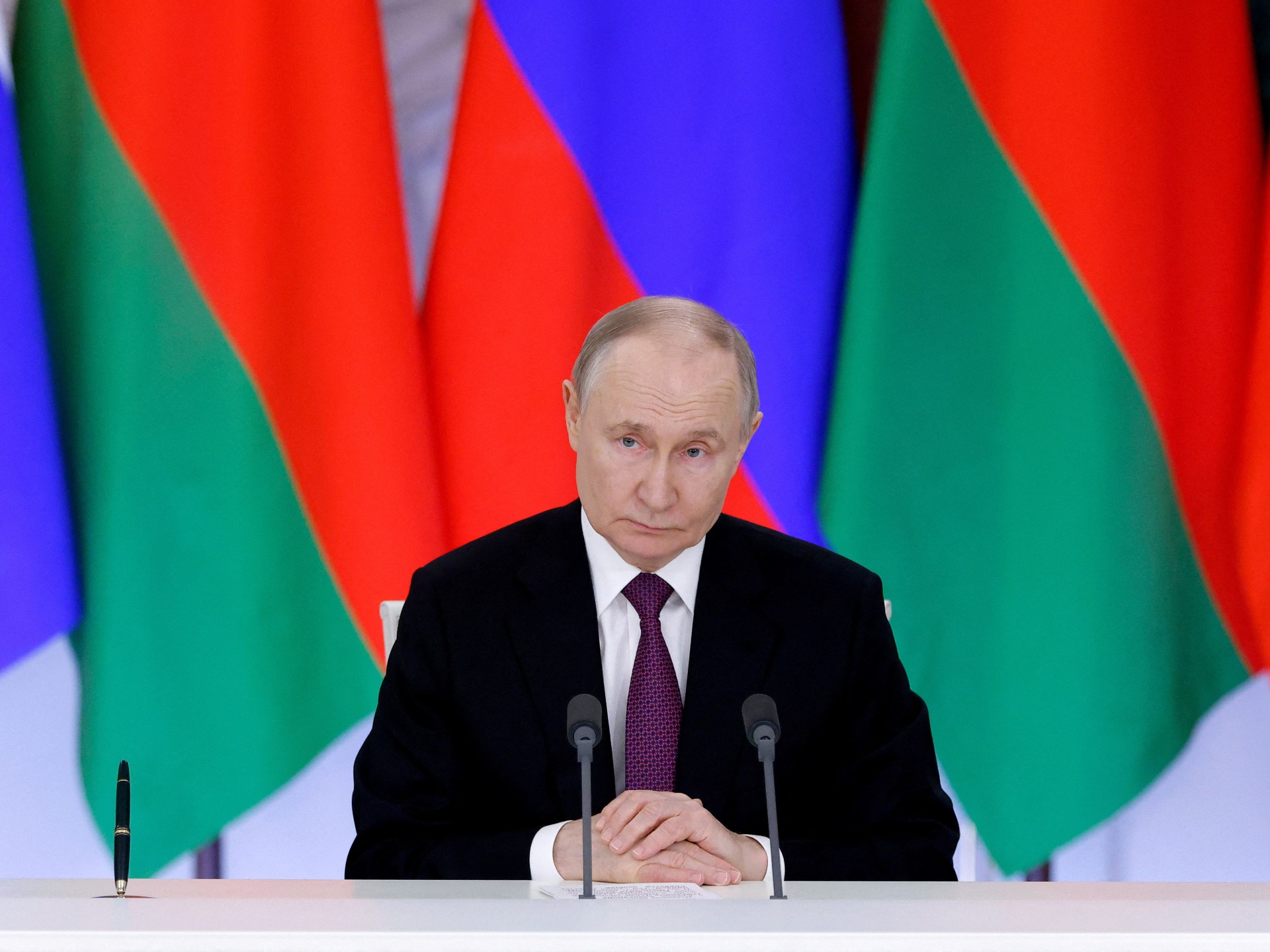
As Zelenskyy accused Putin of preparing to reject the ceasefire, Trump deemed Putin’s words ‘promising but incomplete’.

Russian President Vladimir Putin said on Thursday that Moscow was in favour of the principle of a ceasefire in the war against Ukraine, as proposed by the Donald Trump administration in the United States, but raised questions he said the Kremlin needed answers to before it could commit to a truce.
He said Russia needed to discuss these questions and the terms of a peace proposal with the US.
His comments, the first on the proposed ceasefire, drew criticism from Ukraine and a muted response from Trump, who has oscillated between expressing confidence in Putin’s commitment to a peace deal and threatening Russia with new sanctions if it does not agree to a ceasefire.
Here is what Putin said, the conditions he laid out for Moscow to back a ceasefire, and how the US and Ukraine have reacted to his recent statement:
On Tuesday, teams representing Washington and Kyiv met in Saudi Arabia’s Jeddah to negotiate terms for peace in Ukraine.
After this meeting, the two countries released a joint statement, proposing an “immediate, interim” 30-day ceasefire on the war front.
The statement placed emphasis on “the exchange of prisoners of war, the release of civilian detainees, and the return of forcibly transferred Ukrainian children” during the ceasefire period.
The document did not mention sanctions on Russia or security guarantees for Ukraine, but it did mention that Ukraine’s European allies would be “involved in the peace process”.
Then, on Thursday, at a news conference alongside Belarusian President Alexander Lukashenko, Putin responded to the ceasefire proposal.
He said the idea of a ceasefire was “correct” and Russia supported it, in principle. “We agree with the proposals to cease hostilities,” he told reporters in Moscow.
But, he added, “there are issues that we need to discuss, and I think that we need to talk about it with our American colleagues and partners, and, perhaps, have a call with President Trump and discuss it with him.”
The Russian president outlined three questions and suggested that resolving them in a manner satisfactory to Moscow would be preconditions for the Kremlin to accept a ceasefire.
The first question Putin posed pertains to Ukrainian troops in the Russian region of Kursk.
What is the US-Ukraine ceasefire deal?
In August last year, the Ukrainian army launched a surprise incursion into Kursk, seizing territory.
While the Russian army has now reclaimed 1,100 square km (425 square miles) of Kursk – almost the whole area that Ukrainian forces had grabbed – Kyiv’s troops are still present.
During the news conference, Putin said “Russian troops are advancing in almost all areas of the front… So how will these 30 days be used? For forced mobilisation to continue in Ukraine, for weapons to be delivered there, for the newly-mobilised units to be trained? … How can we and how will we be guaranteed that nothing like that will happen? How will control be organised?”
Yuri Ushakov, Putin’s foreign policy adviser, also said on Thursday that the 30-day pause in fighting would only help Ukrainian troops regroup, deeming the ceasefire a “temporary respite” for the Ukrainian army.
In recent months, Ukraine has suffered manpower shortages. In January, Ukrainian troops retreated from Kurakhove, a town in Ukraine’s Donetsk region, when Russian troops claimed control.
Putin also questioned how the ceasefire would be monitored and who would ensure that both parties are following the agreement.
“We proceed from the fact that this cessation should be such that it would lead to long-term peace and eliminate the original causes of this crisis,” he said.
“Who will give orders to stop hostilities? … Who will determine where and who has violated a possible ceasefire agreement for 2,000 kilometres (1,243 miles)?”
Putin’s comments came shortly after US President Donald Trump’s special envoy Steve Witkoff arrived in Russia to meet with Putin and other Russian officials. Although Witkoff is officially Trump’s Middle East envoy, he has also been involved in Russia relations.
Last month, he became the first high-level US official to travel to Russia since its 2022 invasion of Ukraine. During this visit, he secured the release of Marc Fogel, an imprisoned American, in exchange for the US releasing imprisoned Russian Alexander Vinnik. Witkoff was also part of the US team during negotiations with Russian officials in Saudi Arabia.
On Thursday, at the beginning of a meeting with NATO Secretary-General Mark Rutte, Trump said that Putin had released “a very promising statement, but it wasn’t complete”.
“Now we’re going to see whether or not Russia’s there. And if they’re not, it’ll be a very disappointing moment for the world.”
Also on Thursday, US Treasury Secretary Scott Bessent told CNBC that Trump is “willing to apply maximum pressure on both sides”, including sanctions on Russia.






 American Dollar Exchange Rate