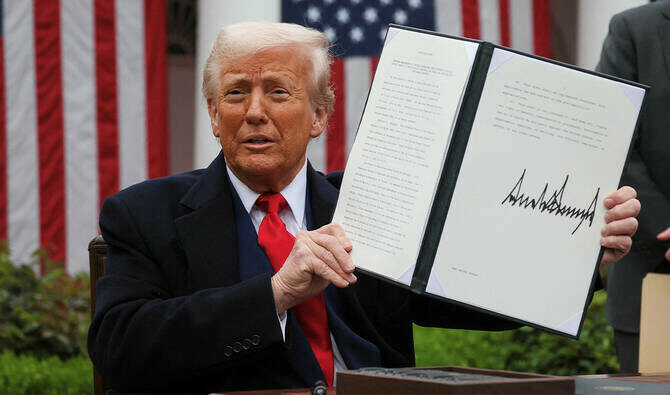
US President Donald Trump on Wednesday kick-started a global trade war as he announced sweeping reciprocal tariffs on over 180 countries, with significant implications for countries like Pakistan.

“For decades, our country has been looted, pillaged, raped and plundered by nations near and far, both friend and foe alike,” Trump said while speaking in the White House Rose Garden.
The announcement sent shockwaves around the world, as many countries – both allies and competitors – condemned Trump’s announcement, with some pledging counter-measures.
Among the most notable targets were US rival China (34%), the European Union (20%), and South Asian nations, including Pakistan, which now faces a 29% tariff on its exports to the US.
According to a US government website, reciprocal tariffs are calculated as the tariff rate necessary to balance bilateral trade deficits between the US and each of its trading partners.
“This calculation assumes that persistent trade deficits are due to a combination of tariff and non-tariff factors that prevent trade from balancing. Tariffs work through direct reductions of imports,” the website stated.
Eroding Pakistan’s competitiveness
While the US remains one of Pakistan’s largest trading partners, experts noted that these new tariffs could erode the competitiveness of Pakistani products in the American market.
Analysts noted that these new tariffs could disrupt Pakistan’s trade by slowing down its exports in the US market.
Mustafa Pasha, Executive Director and Chief Investment Officer at Lakson Investments Limited, explained that the imposition of tariffs is basically a tax on American consumers, reducing their purchasing power and lowering demand for imports.
“If the demand for Pakistani goods falls, it will be a negative for the country,” Pasha told media.
“Trump wants to reset world trade, thus, he has imposed tariffs globally. Pakistan now needs to assess its position relative to its competing countries,” he said.
“We can capture market share from China, Vietnam and Bangladesh,” said Pasha, which will depend on Pakistan’s ability to negotiate and its exporter’s adaptability.
“If the government reduces energy cost, it will give more margin to our exporters.”
“This presents an opportunity,” he said. “Since our imports from the US are negligible, we could offer concessions to negotiate better terms.”
Textile could be worst-hit
The US is among Pakistan’s largest trading partners, and experts noted that Pakistan’s exports are largely dominated by textiles, which could be among the most affected areas.
During the first seven months of FY2025, exports to the US totalled $3.6 billion, accounting for 19% of Pakistan’s total exports. Of this, 79% ($2.8 billion) consisted of textile and apparel products.
Musadaq Zulqarnain, CEO of Interloop Textiles, one of Pakistan’s largest textile manufacturers, said that the imposition of reciprocal tariffs on US trading partners worldwide is Trump’s “biggest assault yet on a global economic system he has long bemoaned as unfair”.
On a post on social media, he noted that “Pakistan will hold a cost advantage over Vietnam (17%), Indonesia (3%), Cambodia (20%), China (25%) and Bangladesh (8%)”.
“Conversely, Pakistan will face a competitive disadvantage of 3% compared to India, 19% when compared with Turkey, and 6% compared to Jordan Egypt and most Central American countries,” he added.
Trump has imposed a 29% reciprocal tariff on Pakistan, while its archrival India faces a tariff of 26%. Other countries being impacted include Indonesia (32%), Bangladesh (37%), Turkey (10%), Egypt (10%) and Jordan (20%).
Some of the nations worst hit were in Southeast Asia, including 49% for Cambodia, 47% for Vietnam and 44% for Myanmar, which was recently hit by a devastating earthquake.
“However, the final outcome will depend on how each of these countries negotiates their terms,” said Zulqarnain.
“Regardless of circumstances, sales in the US are expected to decline,” he said.


 American Dollar Exchange Rate