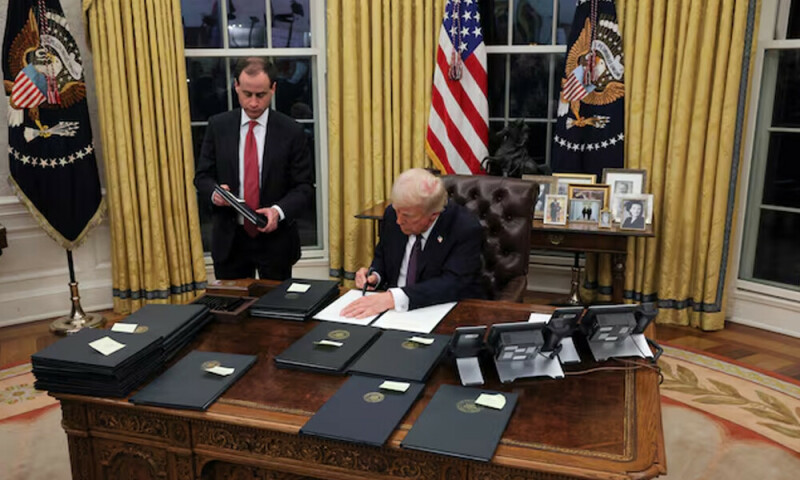
DHAKA/COLOMBO/MUMBAI: Bangladeshi garment exporter Shahidullah Azim woke up on Thursday to the shock of U.S. President Donald Trump slapping a 37% tariff on his country’s exports, endangering an apparel hub already reeling from domestic political upheaval.
“We knew something was coming, but we never expected it to be this drastic … This is terrible for our business and for thousands of workers,” said Azim, whose clients include North American and European retailers.
Suppliers in Bangladesh’s garment industry, which counts Gap Inc and Vans parent VF Corp as clients, told Reuters they began seeking government support hours after Trump’s lightning bolt.
Some companies in the impoverished South Asian country are pressing government officials to negotiate further on tariffs with the U.S. to prevent foreign buyers bolting to save costs.
The readymade garments industry is of existential importance to Bangladesh’s economy, accounting for more than 80% of total export earnings, employing 4 million people and contributing roughly 10% to its annual GDP.
Trump’s tariffs stoke global trade war as China, EU hit back
Trump’s global tariff barrage deals the latest and heaviest blow to the industry.
Last year, garment production was disrupted by violent protests that ousted Prime Minister Sheikh Hasina in August, casting doubt on the long-term potential of a market much sought after by Western fashion brands.
Azim said his company, which employs 3,200 factory workers, was bracing for order cancellations as rising costs for buyers could spell the end of Bangladesh’s competitive edge.
A representative of the Bangladesh Knitwear Manufacturers and Exporters Association, which supports more than 2,500 factories, told Reuters that it approached the government on Thursday seeking support against the tariff blow, and officials said the issue was being considered seriously.
Shafiqul Alam, the interim government’s press secretary, said in a statement that the United States was a “close friend” and Bangladesh’s largest export destination. He said Dhaka has been working with Washington on trade matters, and expects those discussions will “help address the tariff issue”.
Advantage for India?
Bangladesh’s loss is neighbour India’s gain in some ways.
Anwar-ul-Alam Chowdhury of garment maker Evince fears India, which had been getting more queries from U.S. suppliers since last year’s political crisis in Bangladesh, will now benefit even more as it faces a lower Trump tariff of 27%.
US tariffs will hurt Pakistani products’ competitiveness, experts warn
The Evince Group website says it has Tommy Hilfiger and Levi Strauss & Co as clients, and deals in woven shirts, denim and yarns.
“Bangladesh will be among the hardest hit,” said Chowdhury.
While India contributes only 6-7% of U.S. garment imports, far behind Bangladesh and Vietnam, the top 30 U.S. apparel brands indicated a shift in preference towards India from Bangladesh due to the latter’s political crisis last year, a survey by the United States Fashion Industry Association showed.
Another major South Asian casualty of Trump’s “reciprocal tariff” move is Sri Lanka, which now faces a 44% tariff.
Around 40% of Sri Lanka’s apparel exports are to the United States, which helped the island nation earn $1.9 billion last year. Apparel is also Sri Lanka’s second largest foreign exchange earner; the sector employs 300,000 people.
Sri Lankan President Anura Kumara Dissanayake’s office said in a statement that a panel of government officials and apparel companies has been formed to study “potential issues” that could arise from the new tariffs.
“Sri Lanka could very quickly see its share of U.S. business move to countries with lower tariffs,” said Yohan Lawrence, Secretary General of Sri Lanka’s Joint Apparel Association Forum. “This situation is serious, and it must be addressed as a matter of national urgency.”

DHAKA/COLOMBO/MUMBAI: Bangladeshi garment exporter Shahidullah Azim woke up on Thursday to the shock of U.S. President Donald Trump slapping a 37% tariff on his country’s exports, endangering an apparel hub already reeling from domestic political upheaval.
“We knew something was coming, but we never expected it to be this drastic … This is terrible for our business and for thousands of workers,” said Azim, whose clients include North American and European retailers.
Suppliers in Bangladesh’s garment industry, which counts Gap Inc and Vans parent VF Corp as clients, told Reuters they began seeking government support hours after Trump’s lightning bolt.
Some companies in the impoverished South Asian country are pressing government officials to negotiate further on tariffs with the U.S. to prevent foreign buyers bolting to save costs.
The readymade garments industry is of existential importance to Bangladesh’s economy, accounting for more than 80% of total export earnings, employing 4 million people and contributing roughly 10% to its annual GDP.
Trump’s tariffs stoke global trade war as China, EU hit back
Trump’s global tariff barrage deals the latest and heaviest blow to the industry.
Last year, garment production was disrupted by violent protests that ousted Prime Minister Sheikh Hasina in August, casting doubt on the long-term potential of a market much sought after by Western fashion brands.
Azim said his company, which employs 3,200 factory workers, was bracing for order cancellations as rising costs for buyers could spell the end of Bangladesh’s competitive edge.
A representative of the Bangladesh Knitwear Manufacturers and Exporters Association, which supports more than 2,500 factories, told Reuters that it approached the government on Thursday seeking support against the tariff blow, and officials said the issue was being considered seriously.
Shafiqul Alam, the interim government’s press secretary, said in a statement that the United States was a “close friend” and Bangladesh’s largest export destination. He said Dhaka has been working with Washington on trade matters, and expects those discussions will “help address the tariff issue”.
Advantage for India?
Bangladesh’s loss is neighbour India’s gain in some ways.
Anwar-ul-Alam Chowdhury of garment maker Evince fears India, which had been getting more queries from U.S. suppliers since last year’s political crisis in Bangladesh, will now benefit even more as it faces a lower Trump tariff of 27%.
US tariffs will hurt Pakistani products’ competitiveness, experts warn
The Evince Group website says it has Tommy Hilfiger and Levi Strauss & Co as clients, and deals in woven shirts, denim and yarns.
“Bangladesh will be among the hardest hit,” said Chowdhury.
While India contributes only 6-7% of U.S. garment imports, far behind Bangladesh and Vietnam, the top 30 U.S. apparel brands indicated a shift in preference towards India from Bangladesh due to the latter’s political crisis last year, a survey by the United States Fashion Industry Association showed.
Another major South Asian casualty of Trump’s “reciprocal tariff” move is Sri Lanka, which now faces a 44% tariff.
Around 40% of Sri Lanka’s apparel exports are to the United States, which helped the island nation earn $1.9 billion last year. Apparel is also Sri Lanka’s second largest foreign exchange earner; the sector employs 300,000 people.
Sri Lankan President Anura Kumara Dissanayake’s office said in a statement that a panel of government officials and apparel companies has been formed to study “potential issues” that could arise from the new tariffs.
“Sri Lanka could very quickly see its share of U.S. business move to countries with lower tariffs,” said Yohan Lawrence, Secretary General of Sri Lanka’s Joint Apparel Association Forum. “This situation is serious, and it must be addressed as a matter of national urgency.”





 American Dollar Exchange Rate