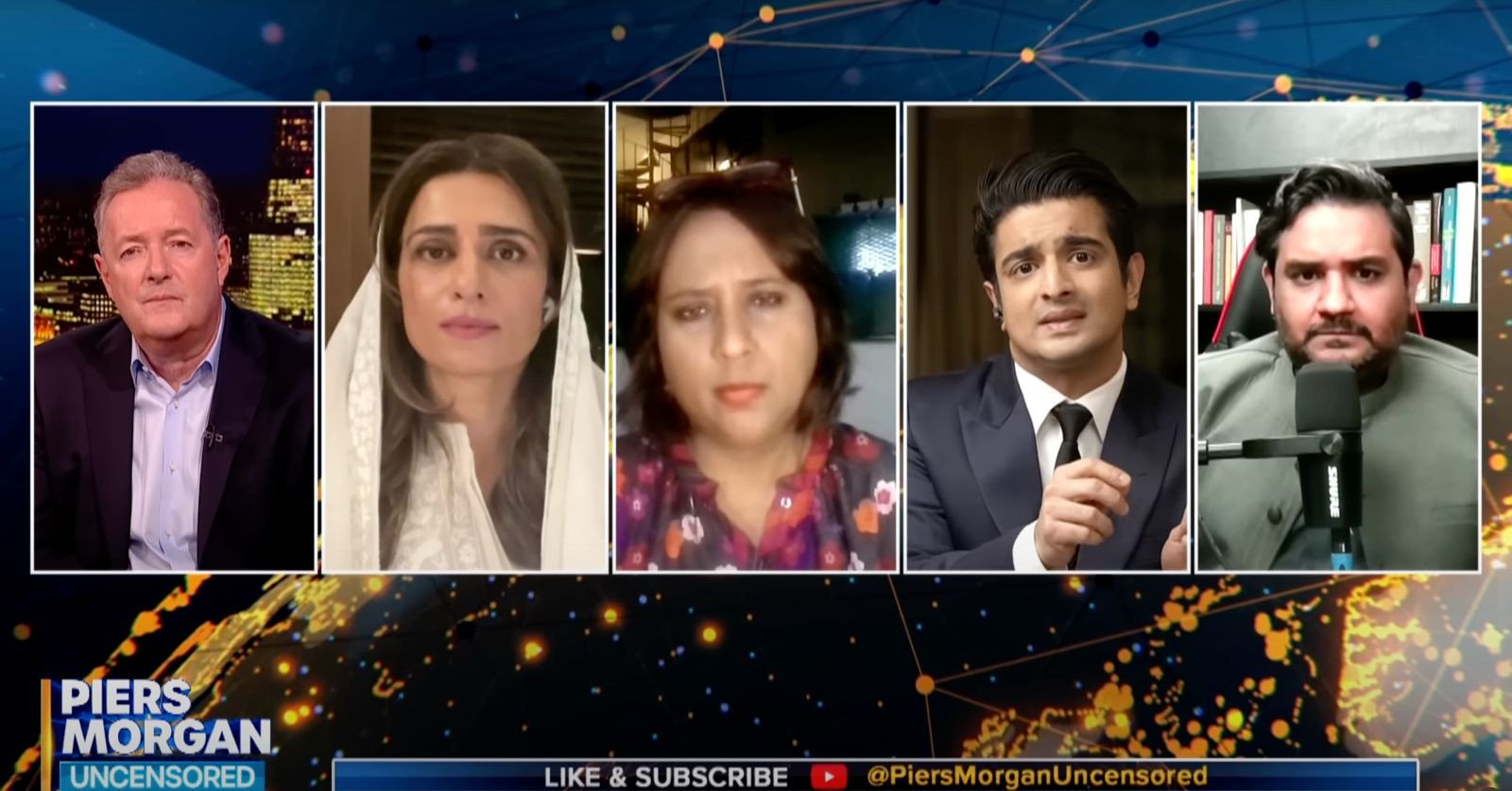
In this multiverse of madness, Pakistan’s ex-FM, Hina Rabbani Khar, is joined by two podcasters and Barkha Dutt
By all accounts, the recent Piers Morgan Uncensored episode on India-Pakistan relations should not have been watched, let alone dissected. And yet, here we are, post-morteming a panel discussion featuring former Pakistani foreign minister Hina Rabbani Khar, Indian journalist Barkha Dutt, and — why not — two podcasters: Pakistan’s Shehzad Ghias Shaikh and India’s Ranveer Allahbadia, better known to his following as BeerBiceps. Piers, who introduced the latter two as “young influencers,” offered no further justification for their presence beyond the implicit logic of online virality: if they have a platform, surely they have something to say.
In the case of podcasters, they are often brands first, people second. It’s a curious question in these times of crisis, where every industry, from news to entertainment, is coming to terms with social media personalities. Can the ones beholden to the algorithm speak the truth when the time comes?
Neither Shehzad nor Ranveer has much international appeal, which means they’re doubly bound to their domestic echo chambers. After the whole India’s Got Latent debacle, Piers should know better than to expect Ranveer to challenge the official line, especially when the very state he represents has cracked down brutally on stand-up comedians for a joke about incest, a trope that basically fuels half of Western prestige TV (see: Game of Thrones).
While Shehzad isn’t strictly an entertainment podcaster, Ranveer very much is. And Piers seems perfectly aware of this. His promotion tactics rely on zingers engineered for the comment section brain — soundbites that rot your cortex but boost your CTR. Take, for instance, the clip he shared of Shehzad quipping, “I’ve now figured out why he’s called BeerBiceps, because what he said sounds like the most drunk sh*t I’ve heard in my life.” It’s funny. But also, is that really the takeaway you want to amplify from a televised debate between representatives of two nuclear-armed states? A comedy roast?
“Pakistan has become the terror hub,” declares Ranveer, an odd line coming from someone who doesn’t even look old enough to remember when that phrase was doing the rounds in Western media with any real conviction. He’s about a decade too late to be handing out Islamophobia lollipops to the West. And honestly, are we really expected to take political analysis from a guy who believes that masturbation shortens your penis? Maybe all those years of “no fap” are finally culminating in one long, saffron release.
Shehzad, for his part, fares better — if only because he appears less eager to please. Still, his analysis is hemmed in by a certain neoliberal decorum, a kind of progressive coyness that refuses to name Indian-backed proxies in Balochistan lest it appear to “disown” Baloch resistance. But even when Shehzad rightfully calls out RSS’s involvement in the Samjhauta Express attack and the 2002 Gujarat riots, the screen practically starts vibrating with Barkha and Ranveer aggressively shaking their heads, as if trying to physically repel the facts.
Multiverse of madness
From the outset, Piers begins the circus with a straight-faced absurdity that he cooks up with General Wesley Clark, a retired US Army officer. “There are a lot more important issues in the world than fighting about Kashmir,” says Clark in a panel of South Asians, in a segment ostensibly about Kashmir. His follow-up, “Pakistan and India both crave Kashmir — it’s an attractive vacation spot,” is the sort of blithe statement that would be laughable if it weren’t so hauntingly reflective of the trivialisation at play. That the region in question is one of the most militarised zones in the world, where grave human rights abuses have been reported for decades, is apparently less compelling than its tourism potential and strategic promise. Never mind asking a Kashmiri — none were invited.
It’s hard to justify Barkha’s inclusion in the lineup when her X post falsely claiming that the Indian Navy had attacked Karachi Port is still unapologetically up. Her subsequent lamentations feel not only dated but hollow — “stop both-siding jihadi terrorism” and “a Pakistani killed Daniel Pearl” — lines that once might’ve felt incisive but now read like they’re aimed at a white audience that just wants a reason to keep hating the “Muslim.”
The rest of her speech is a nuance-starved summary even Grok could churn out, minus the dramatics. Why bother watching her recite warmed-over talking points when you could glean the same sentiments from ten minutes of doomscrolling on X? If this is the extent of Barkha’s analysis, maybe it’s time to pivot to a profession that demands a little less credibility, fact-checking, and absolutely no spine.
And yet, sitting beside her, Hina manages to hold the kind of composure that should be the bare minimum in any serious exchange. You don’t have to be a fan of her to acknowledge the quiet discipline with which she listens — calm, neutral, unflinching. In contrast, Barkha resorts to odd little gestures of protest, repeatedly raising her hand like a sulking backbencher desperate to be called on.
When Piers asks how India should have responded to Pahalgam, Hina shoots back with the obvious counterpoint: “Why are you not asking me how Pakistan should have responded to the Jaffar Express in Balochistan?”
Piers, in his signature condescension, scolds her: “I don’t like it when guests start to play whataboutery a little too early in the debate. I brought you guys together to debate what’s happened in the last two weeks, not the whole history.”
But of course, he has no issue when Barkha delivers her own Grok-style recap of Pakistan’s “terror legacy.” Historical context, it seems, is only off-limits when it’s inconvenient.
History who?
 American Dollar Exchange Rate