Self-taught filmmaker’s ‘Karmash’ will have its world premiere on May 22
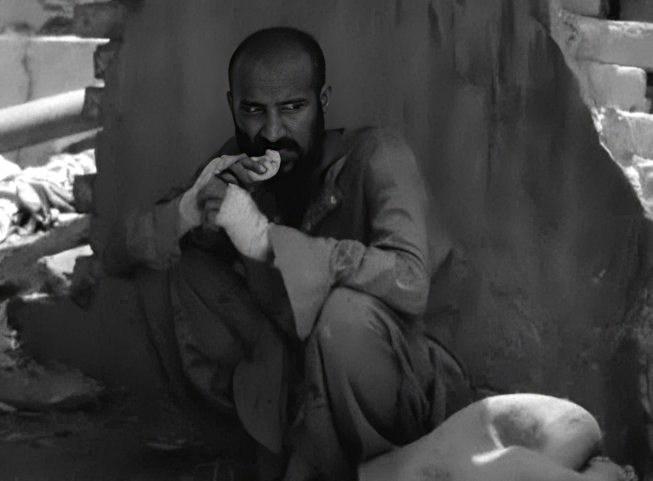
The sound of Japanese Taiko drums echoes in a rhythm during the opening credits. The madness of the rhythm builds up not unlike that of a pre-war buildup as we see a Kurosawa-esque montage of a broken city — damaged walls, doors, empty alleyways – until we come to what looks like a homeless man waking up amidst the dark ruins.
This is how filmmaker Aleem Bukhari opens his latest short film Karmash. The film premiered as part of the Director’s Fortnight at Cannes Film Festival on May 22, and is the first ever Pakistani short film to have earned the honour.
Going guerrilla
Karmash, Bukhari says, is his third short film, and is about the last survivor of a fictional Karmash tribe, who recalls the fragmented memories of his long-dead ancestral traditions. The 15-minute, black-and-white film plays out like an essay rather than a conventional linear narrative. And its structure and absence of information become its biggest strengths.
Bukhari is a visual artist and a self-taught filmmaker, who has been working independently since 2016. A number of short films and music videos later, Karmash has now become his breakthrough project with its inclusion in Cannes.
“It was surreal,” says Bukhari of the moment he found out Karmash was going to Cannes. “Very overwhelming.”
The Hyderabad-based filmmaker started the project last year, shot it in August and finished it early this year, just in time for Cannes’ submission. Besides the film’s haunting beauty, perhaps the most fascinating aspect of the project is how it was made.
Six friends – Irfan Noor K, Ebad Talpur, Shahzain Ali Detho, Muhammad Ali Shaikh, Qadir Abbas and Bukhari – created Karmash on a shoestring budget, minimal resources and borrowed equipment. The film is a collaboration between Bukhari’s Sleepbyte Films and Noor’s Braanz Films.
“I’m the writer, director, and cinematographer of the film,” says the filmmaker. “Irfan Noor K is the actor and producer. Shahzain Ali Detho is the assistant director, co-editor and co-sound designer. Muhammad Ali Shaikh served as the location sound recordist and mixer. Ebad Talpur is the script supervisor and second AD. Qadir Abbas is the line producer.”
He continues, “Basically, the six of us made the film ourselves. We have done everything ourselves, just the six of us who share this passion for cinema. And under Sleepbyte Films, it was our aim to produce artistic, auteur-driven, unconventional cinema. Now we wouldn’t need approval of bigger producers or companies so we can continue to make the kind of films we love. These six people are the reason why Karmash is at Cannes right now.”
He also credited Salman Israr for coming onboard as the co-producer.
Bukhair quips that the film is so low budget that the festival submission budget was higher than the production cost.
“The production was difficult since we worked with a very low budget and bare minimum resources. No proper cars, only our bikes and equipment. You can imagine the summer heat in Hyderabad. We just survived, I don’t know how. Most of the budget was spent on fuel and food. Other than that, we went completely guerrilla the way we produced it.”
The film, shot on Sony A6400 with a 35mm lens (which works as an approximately 52mm lens on the A6400’s crop sensor), looks tightly framed. But rather than a limitation, it works as a deliberate creative choice and helps Bukhari create this strange, decaying world. The filmmaker also utilised mostly natural light, except a small LED panel for a couple of sequences.
Experimental storytelling
 American Dollar Exchange Rate