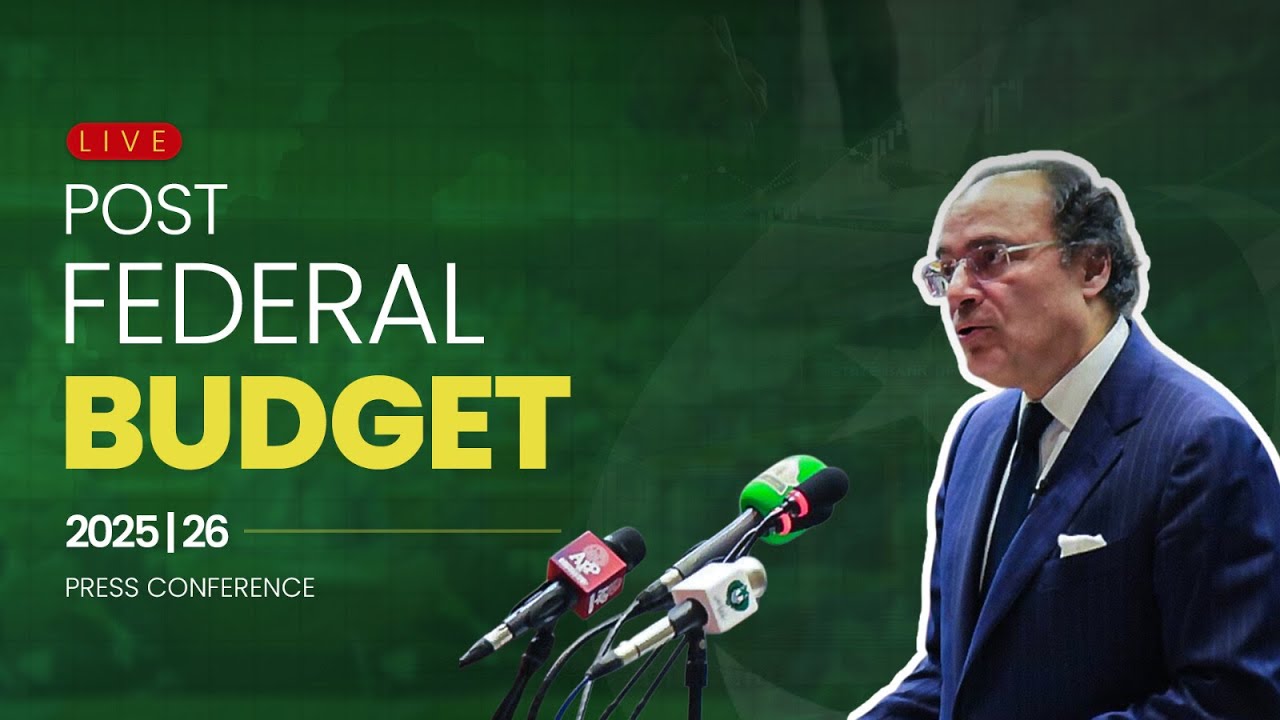
Federal Minister for Finance and Revenue Muhammad Aurangzeb on Wednesday addressed the concerns of stakeholders regarding the budget for fiscal year 2025-26 presented before the National Assembly (NA) a day ago.
Addressing the media persons, Aurangzeb maintained that the income tax levy for the salaried persons earning between Rs600,000 and Rs1.2 million annually is 2.5%.
“Because every number is locked, so we have to get money from somewhere to provide relief somewhere,” he said. “This is a work in progress.”
During the budget speech, Aurangzeb proposed halving the income tax rate to 2.5% for the salaried persons earning between Rs600,000 and Rs1.2 million annually.
However, it is important to note that there was a discrepancy between the rate announced during the speech and the rate stated in the Finance Bill — the latter sets the tax at an even lower 1% for this income bracket.
The finance minister reiterated that the government remains committed to issuing the inaugural Panda bond during this calendar year.
“We do want to access the euro and US dollar market, we anticipate entering these markets in 2026, certainly not during this calendar year, as we need to achieve a certain rating,” he said.
Aurangzeb said that the tariff reform mentioned during the budget speech “is very significant” for the country and will enhance the country’s exports.
“Out of a total of 7,000 tariff lines, the government has decided to eliminate additional customs duty on 4,000 of them,” he said.
Fiscal space limited
Aurangzeb said that the government wanted to provide maximum relief to the salaried class, but added, “The reality is that we can only offer as much relief as our fiscal space permits.”
The country’s tax-to-GDP ratio has reached 10.3% in the current fiscal year. “In FY26 we intend to increase it to 10.9%,” he said.
“We need enabling amendments and legislation to plug leakages in the system, so the government doesn’t have to resort to additional taxation measures of around Rs400-500 billion,” Aurangzeb said.
The finance minister noted that the government expenditure has increased by 1.9% this fiscal year.
“We have not imposed any additional tax on the agriculture sector,” he said. The government will provide soft-term loans to small farmers.
The finance minister noted that the government expenditure has increased by 1.9%. Meanwhile, Finance Secretary Imdadullah Bosal clarified that the increase is limited to critical needs.
Surcharge on Electricity Bills
On reports regarding the imposition of a 10% surcharge on electricity bills, Chairman FBR, Rashid Mehmood Langrial, clarified that no additional surcharge has been imposed.
Responding to a query on how the federal government could delink population from the National Finance Commission (NFC) award, Auranzgeb maintained, “Everything will be done in consultation with provinces.”
Responding to a query on why the government maintained the minimum wage at Rs37,000, Aurangzeb said the decision was made in consideration of industrial growth.
On the imposition of 18% tax on solar panels, Langrial explained that the GST of around 16-18% was imposed on less assembled solar panels, whereas there was no GST on imported fully assembled solar panels.
“The local manufacturing was at a disadvantage. We want to create an enabling environment for the local sector,” the FBR chief said.
Responding to a query, Imdadullah Bosal informed that the budget figures are “locked with the International Monetary Fund (IMF)”.
Govt salary increase
Bosal stated that the budgeted increase in government salaries—from 6% to 10%—would have a fiscal impact of approximately Rs28–30 billion.
He informed that the Ministry of Finance will hold consultations with the defence ministry regarding the introduction of a contributory pension scheme.
Earlier, reporters staged a boycott of the press conference after the government failed to hold a scheduled technical briefing on the Finance Bill, but returned after Information Minister Attaullah Tarar intervened.
Prime Minister Shehbaz Sharif-led coalition government’s Finance Minister Muhammad Aurangzeb on Tuesday presented the federal budget 2025-26 to the parliament, with a total outlay of Rs17.573 trillion, targeting a GDP growth target of 4.2% against 2.7% in the outgoing year.
Aurangzeb termed the budget the start of a strategy to create a competitive economy and economic productivity to increase exports and fundamentally change the economy’s DNA.
The government has set an inflation target of 7.5% for the next fiscal year. Regarding the fiscal deficit, the government projected a target of 3.9% of the GDP — or Rs5,037 billion — from the outgoing fiscal year’s target of 5.9%.
The primary surplus is targeted at 2.4% of the GDP against the budgeted 2% in the current fiscal year, which has been revised to 2.2%.
More to follow
 American Dollar Exchange Rate