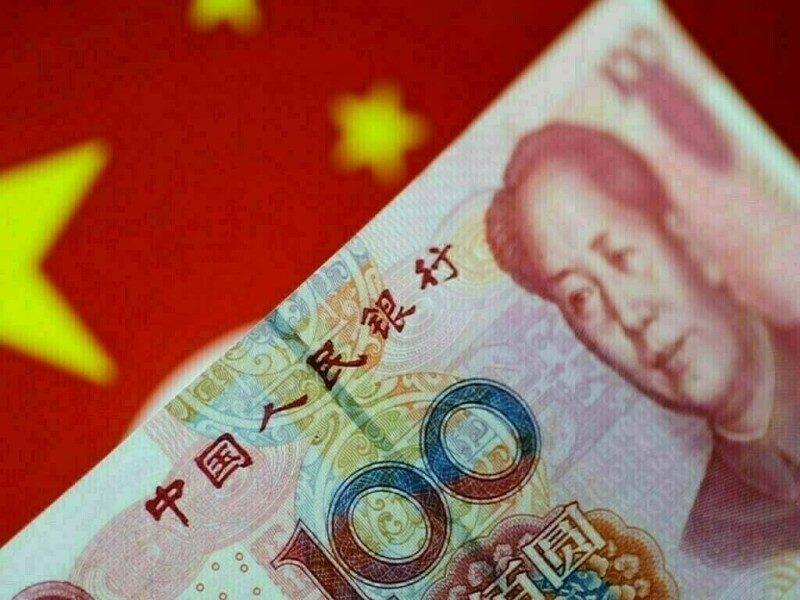
SHANGHAI: China’s yuan slipped to a three-week low against the dollar on Monday as investors rushed to perceived safe haven assets and awaited Iran’s response to US attacks on its nuclear sites that dramatically exacerbated Middle East tensions.
The yuan’s weakness mirrored other emerging market currencies, which fell across the board to reflect the dollar’s strength. But the losses were limited by the central bank’s firmer-than-expected official midpoint guidance fix.
Meanwhile, the Hong Kong dollar, which is pegged to the greenback, again hit the weaker end of its trading band again, with markets cautiously watching to see if the Hong Kong Monetary Authority would step in to defend the local currency.
The onshore yuan fell to a trough of 7.1950 per dollar, the weakest level since June 3, before changing hands at 7.1877 as of 0350 GMT.
Its offshore counterpart was down about 0.13% in Asian trade to 7.1880 per dollar.
The dollar/yuan pair “seems to have formed a rounding bottom, potentially rising on the back of broad dollar gains,” Maybank analysts said in a note.
“The Israel-Iran-US conflict are keeping investors nervous but (an) upmove of the USD/CNH seems to be limited still. China has thus far condemned the attacks on Iran but did not indicate any sign of direct support or involvement.”
China’s yuan rises on stronger fixing, weaker dollar outlook
Prior to the market opening, the People’s Bank of China (PBOC) set the midpoint rate at 7.1710 per dollar and 204 pips firmer than a Reuters’ estimate of 7.1914.
The spot yuan is allowed to trade 2% either side of the fixed midpoint each day.
Market participants closely watch the central bank’s daily guidance for any clues on changes to FX policy.
“The daily PBOC fixing continued to signal a preference for stability, even as external risks rise,” said Marco Sun, chief financial markets analyst at MUFG Bank (China).
Apart from Middle East tensions, some market watchers also expect the yuan to weaken in the second half of this year due largely to uncertainty in trade relations between the world’s two largest economies.
“We see a moderate yuan depreciation in the second half on potential export pressure and material rate differentials,” economists at Standard Chartered said in a note.
“China’s authorities have started to relax outbound investment since June, likely leading to more capital outflows. Sharp devaluation remains unlikely as the yuan is already highly competitive at its current valuation.”
 American Dollar Exchange Rate