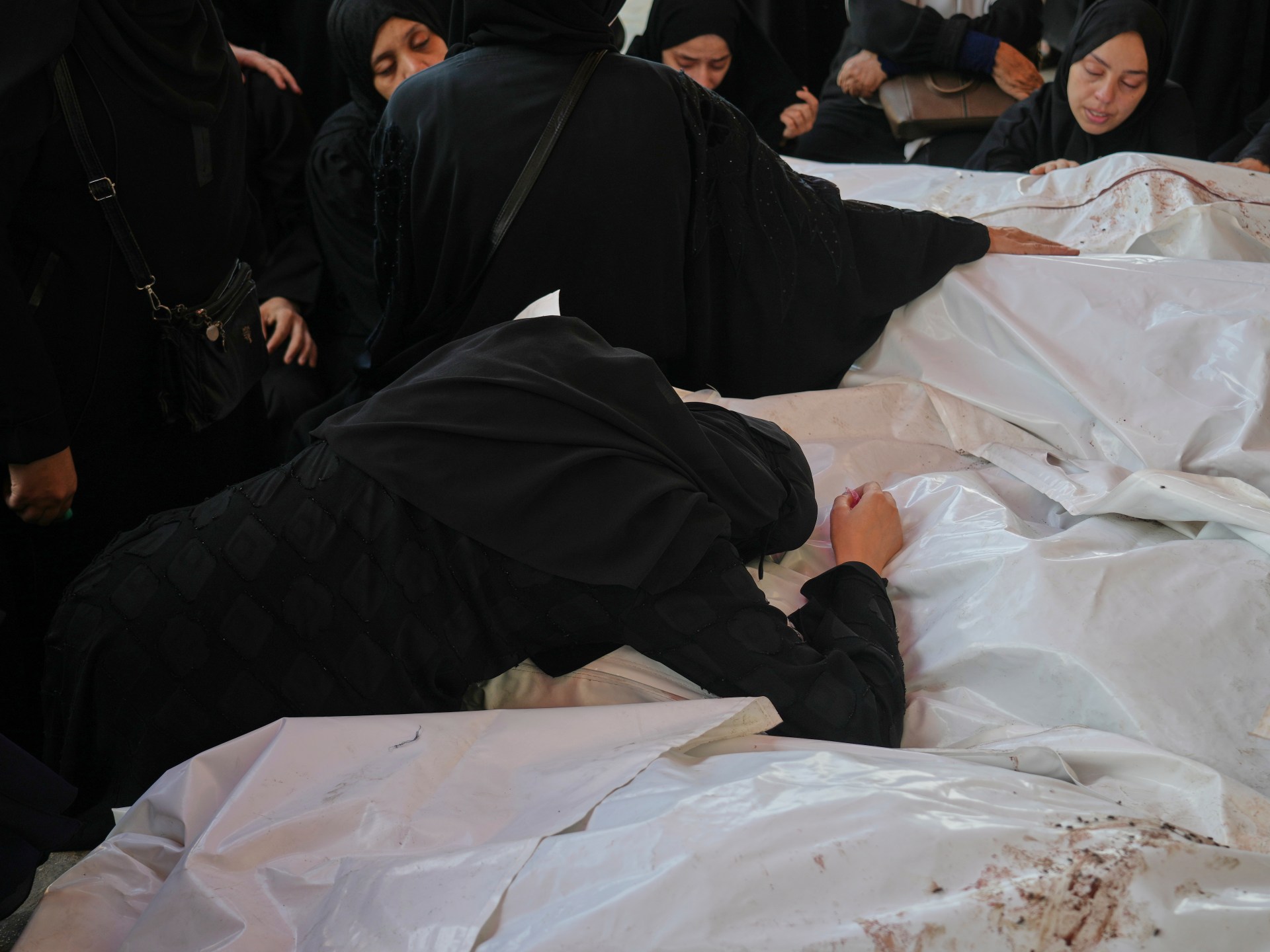
Witnesses say Israeli forces opened fire without warning on Palestinians at a GHF site in Rafah, killing at least 34 people.
Israeli forces have killed at least 110 Palestinians in attacks across Gaza on Saturday, according to medical sources, including 34 people waiting for food rations at the United States-backed Gaza Humanitarian Foundation (GHF) in southern Rafah.
The killings on Saturday came as progress in ceasefire talks in Qatar stalled and condemnation grew of the Israeli plan to forcibly displace the enclave’s entire population.
In Rafah, survivors and witnesses said Israeli forces fired directly at Palestinians in the al-Shakoush area, in front of one of the GHF sites, which the United Nations and rights groups have slammed as “human slaughterhouses” and “death traps”.
Samir Shaat, who survived the attack, described “pools of blood” at the GHF site, and said the victims were being shrouded in the bags they had hoped to collect food in.
“The bag meant to be filled with food turned into shrouds. I swear to God it is nothing but a death trap,” he said, sitting next to the body of his friend at the Nasser Hospital in Khan Younis. “They opened gunfire on people in a completely frenzied manner. As I carried my friend over my shoulder, I walked among martyrs.”
Mohammad Barbakh, a Palestinian father who also survived the attack, said the victims were killed by Israeli sniper fire.
“They deceive us, letting us come to receive aid. They let us carry the bags, then started shooting at us as if we were ducks being hunted,” he told the AFP news agency.
media’s Tareq Abu Azzoum, reporting from Deir el-Balah in central Gaza, said Israeli soldiers at the GHF site opened fire without warning.
“The latest attack on aid seekers underscores how no place in Gaza is safe and no act of survival is spared from Israeli strikes.”
According to doctors in Gaza, more than 800 Palestinians have been killed and 5,000 others wounded at GHF sites since the group began its operations in late May.
“The vast majority were shot in the head and legs,” said Khalil al-Degran, a spokesperson for Al-Aqsa Hospital. “We are struggling to cope with the overwhelming number of casualties amid a devastating shortage of medical supplies.”
‘Extremely cruel’
Other Israeli attacks on Saturday included bombings that killed 14 Palestinians in Gaza City, four of them in a residence on Jaffa Street in the Tuffah area. That assault also wounded 10 others.
Israeli forces also hit two residential buildings in Jabalia in northern Gaza, killing 15 people, according to medical sources. Israeli strikes on the Shati refugee camp, west of Gaza City, killed seven more people.
The Government Media Office in Gaza said on Saturday that 67 children have now died due to malnutrition. It said 650,000 children under the age of five were also at “real and immediate risk of acute malnutrition in the coming weeks”.
“Over the past three days, we have recorded dozens of deaths due to shortages of food and essential medical supplies, in an extremely cruel humanitarian situation,” the statement read.
“This shocking reality reflects the scale of the unprecedented humanitarian tragedy in Gaza.”
Progress in negotiations between Hamas and Israel to end the war have, meanwhile, stalled, the Reuters and AFP news agencies reported, with the sides disagreeing over the extent of Israeli forces’ withdrawal from Gaza.
A Palestinian source told Reuters that Hamas has objected to the withdrawal maps proposed by Israel, as they would leave about 40 percent of the territory under Israeli occupation, including all of Rafah and other territories in northern and eastern Gaza.
Two Israeli sources told Reuters that Hamas wanted Israel to retreat to lines it held in a previous ceasefire before it renewed its offensive in March.
A Palestinian source also told the AFP that the Israeli plan would force hundreds of thousands of displaced Palestinians into a small area near the city of Rafah, on the border with Egypt.
“Hamas’s delegation will not accept the Israeli maps… as they essentially legitimise the reoccupation of approximately half of the Gaza Strip and turn Gaza into isolated zones with no crossings or freedom of movement,” they said.
The agencies also reported that the two sides were divided on the entry of humanitarian aid into Gaza, and guarantees on ending the war. One Palestinian source told Reuters the crisis could be solved with more intervention from the US.
 American Dollar Exchange Rate