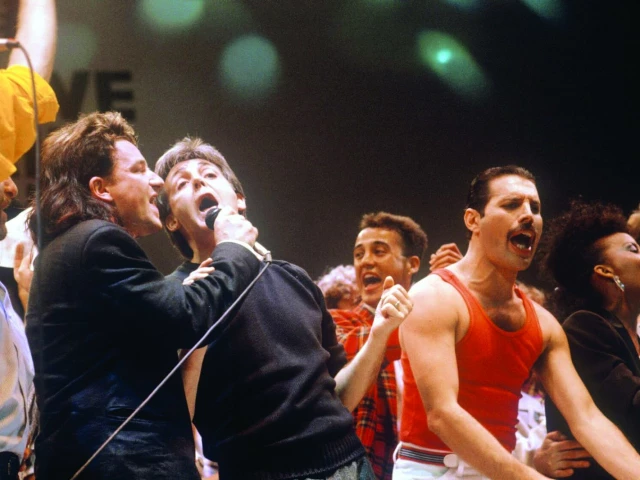
Global concert raised millions and questions of representation

“It’s 12 noon in London, 7AM in Philadelphia, and around the world it’s time for Live Aid.”
This television announcement on July 13, 1985, heralded over 16 hours of music broadcast from Wembley Stadium in London and John F Kennedy Stadium in Philadelphia that united close to 2 billion people across more than 100 countries, reports DW.
Live Aid was no ordinary gig. With the primary aim of raising funds for famine relief in then drought-stricken Ethiopia, it was the largest satellite link-up and television broadcast of its time.
It featured an unprecedented lineup of music’s biggest names across diverse genres, featuring luminaries — some since departed, including Freddie Mercury, David Bowie and Tina Turner — who performed for free.
People around the world watched agog as Mercury cued Wembley’s 72,000 fans with those iconic overhead claps during the chorus of Queen’s 1984 hit Radio Ga Ga, as U2’s Bono jumped off the stage and danced with a teenage fan, as Bob Geldof urged viewers to donate money.
And to set the record straight about the oft-repeated Live Aid lore: Sir Bob never said, “Give us your f***ing money.” He was misquoted.
Outreach via rock ‘n’ roll
Conceived and executed by Irish musician Geldof and Ultravox’s Midge Ure, Live Aid was put together at astonishing speed, the momentum having come from the 1984 Band Aid single Do They Know It’s Christmas? — a now-contentious song that the artists co-wrote.
Ure later recalled to The Guardian how much of the Live Aid planning unfolded on instinct and goodwill rather than strategy or budget. Consequently, it set a template that was later emulated by events such as Farm Aid (1985), Live 8 (2005) and Live Earth (2007).
Speaking in 2004, when a DVD box set of the event was released, Geldof said: “We took an issue that was nowhere on the political agenda and, through the lingua franca of the planet — which is not English, but rock ‘n’ roll — we were able to address the intellectual absurdity and the moral repulsion of people dying of want in a world of surplus.”
‘For Africa,’ without Africans
Though many boomers and Gen Xers may recall Live Aid fondly as a unique moment of global unity before social media, in retrospect it wasn’t without its flaws. Especially when viewed through the lens of diversity and representation.
Despite being a benefit for Africa, no African performers were featured on stage in 1985. Ditto female representation, where aside from Sade, Tina Turner, Madonna and Patti LaBelle, the line-up was overwhelmingly white and male.
Geldof defended the choices, saying the artists were selected based on their pull to maximise donations.
In 2005, Geldof organised Live 8 — a series of concerts that coincided with the G8 summit, which aimed to get leaders of the eight major industrialised countries to “Make Poverty History” — but it again wasn’t representative. The original lineup featured only Senegalese singer Youssou N’Dour, with Geldof trotting out the star bankability trope again.




 American Dollar Exchange Rate