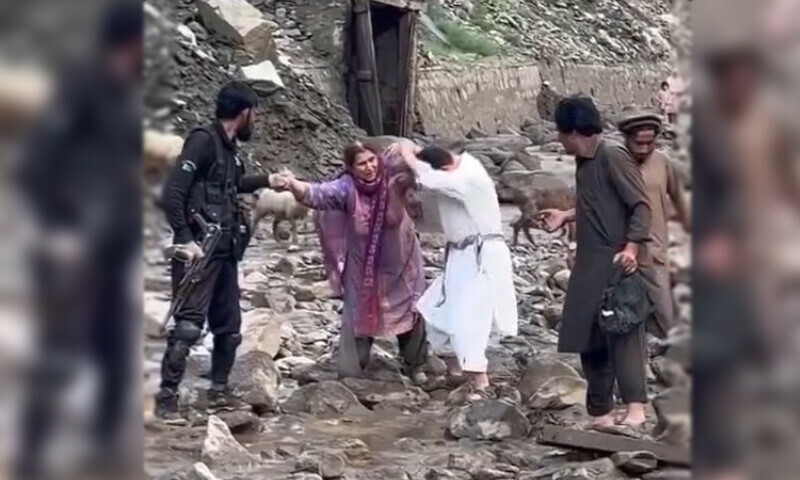
Over 200 trapped tourists have been rescued in Gilgit-Baltistan’s Diamer district after flash floods triggered by heavy rain swept through the city and damaged infrastructure, the provincial government spokesperson said on Tuesday.
A day ago, at least four tourists were killed, two others injured, and 15 went missing due to the floods in GB’s Babusar area in Diamer district. The devastating impacts of climate change have become more visible in GB as cloudburst-induced floods wreaked havoc across the region.
The provincial government spokesperson, Faizullah Faraq, said in a statement, “More than 200 rescued tourists have been shifted to Chilas and provided shelter in hotels and guest houses.”
He added that the tourists were now able to contact their families after being stranded for hours.
Faraq detailed that rescue operations were still underway to look for missing tourists, while the deceased ones have been identified.
“The military is participating in the rescue operation, and helicopters will be brought in for rescue, if necessary,” he said in the statement.
On Monday, Senior Superintendent of Police (SSP) Abdul Hameed told media that 20 to 30 tourists from different parts of the country might be missing.
According to rescue authorities in Skardu’s WhatsApp channel, three people were injured due to the flood in Sadpara, while the deluge has also hit the Kharmang district.
“The rescue operation was launched again at 6am today,” AFP reported the spokesperson as saying.
width=”100%” frameborder=”0″ scrolling=”no” style=”height:250px;position:relative”
src=”
sandbox=”allow-same-origin allow-scripts allow-popups allow-modals allow-forms”>
Meanwhile, spokesperson for the Baltistan Division Police Department Ghulam Muhammad said in a statement that “In Deosai, 413 tourist vehicles were stranded on the road connecting Sapara and Deosai, after it was closed at ten different points due to the floods.”
According to his statement, the stranded people have been rescued by the police and shifted to Skardu.
“The flood water entered homes and caused severe damage to public infrastructure and crops,” he added.
Outlining the damage, the GB govt spokesperson said that “more than 50 houses have been damaged in the flood since yesterday.”
In Babusar, a wheat depot, a girls’ school, a police checkpoint, a tourism police shelter, and four bridges have been washed away, while two mosques and a windmill have also been damaged.“
A local social worker, Muhammad Ali, told media.com that, “Thirty vehicles were swept away by the floods, and most people have been rescued by the locals.”
Faraq shared that construction has begun on the restoration of highways and connecting roads, after the floods damaged a portion of the Karakoram Highway (KKH), leaving thousands of tourists and passengers stranded on both sides.
NDMA issues landslide alert amid heavy rains
The National Disaster Management Authority (NDMA) on Tuesday issued a landslide alert amid floods triggered by heavy rains.
According to the advisory, the following areas may potentially face landsliding: Gilgit, Skardu, Hunza, Astore, Diamer, Ghanche in GB, Muzaffarabad, Neelum, Haveli, Bagh, Poonch in Azad Jammu and Kashmir and Chitral, Dir, and Kohistan in Khyber Pakhtunkhwa.
The NDMA advised citizens to avoid travelling to mountainous areas and directed authorities to remain alert in case of an emergency.
On June 26, the GB Disaster Management Authority issued a warning of increased risk of glacial lake outburst floods (Glof) and flash floods. The public and tourists were advised to avoid going near rivers, streams and other waterways, and avoid bathing or washing clothes in streams since the water flow can reach dangerous levels.
Rain-related death toll rises to 221
According to the NDMA, 221 people have been killed and more than 500 others injured in incidents linked to nearly a month of heavy monsoon rains, AFP reported on Tuesday.
“Since June 26 up to July 21, 221 people have lost their lives, including 104 children and 40 women,” a spokesperson from the national disaster management agency told AFP.
In June, at least 13 tourists were swept to their deaths in Swat while sheltering from flash floods on a raised river bank.
Monsoon rains, which fall across the region from June to September every year, continue to lash many parts of the country.
 American Dollar Exchange Rate