Getty Images; Tyler Le/BI
Deborah has fast become one of Nicole Ramirez's favorite colleagues. She's quick to deliver compliments, sharp-witted, and hyper-efficient. Perhaps best of all, there's no internal competition with Deborah at the health marketing agency they work for, because she isn't on the payroll. She isn't even human.

Ramirez, a 34-year-old who lives in the Pittsburgh area, says she randomly chose the name Deborah as a way to refer to the generative AI app ChatGPT, which she began using about a year ago to help her with basic tasks like drafting emails. As time went on, she asked Deborah to do more complex work, such as market research and analysis, and found herself typing "thank you" after the results came back. Eventually the relationship got to the point where the app became akin to a coworker who's always willing to give feedback — or listen to her gripes about real-life clients and colleagues. And so the bot became a bud.
"Those are things that you would usually turn to your work bestie over lunch about when you can go to ChatGPT — or Deborah, in my case," says Ramirez.
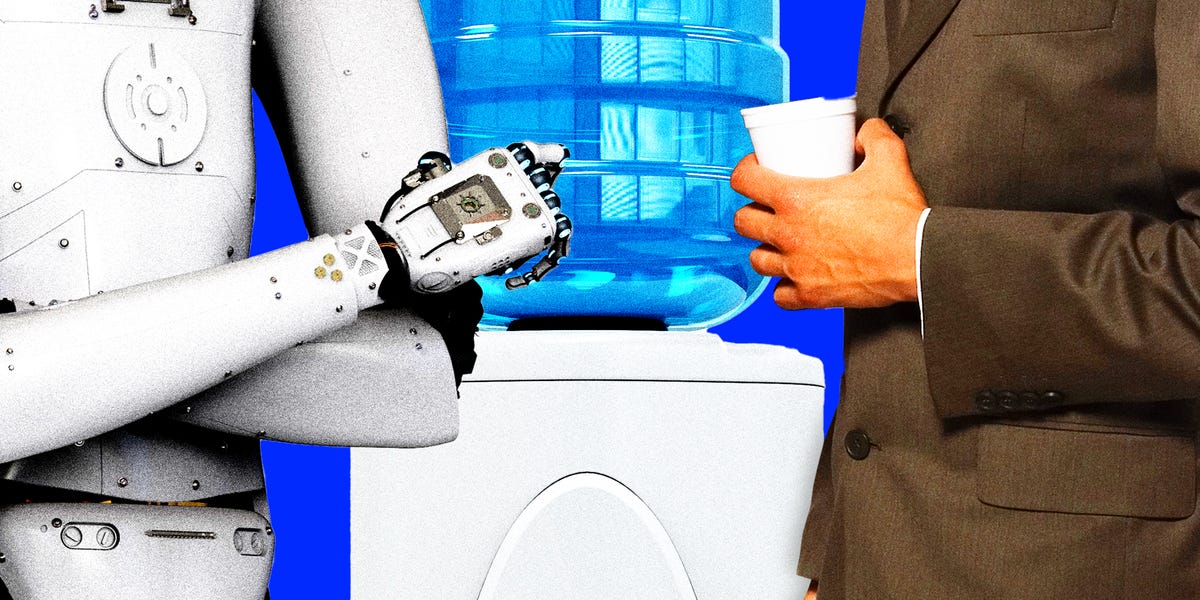
People are treating AI chatbots as more than just 24/7 therapists and loyal companions. With the tools becoming ubiquitous in the workplace, some are regarding them as model colleagues, too.
Unlike teammates with a pulse, chatbots are never snotty, grumpy, or off the clock. They don't eat leftover salmon at their desks or give you the stink eye. They don't go on a tangent about their kids or talk politics when you ask to schedule a meeting. And they won't be insulted if you reject their suggestions.
For many, tapping AI chatbots in lieu of their human colleagues has deep appeal. Consider that nearly one-third of US workers would rather clean a toilet than ask a colleague for help, according to a recent survey from the Center for Generational Kinetics, a thought-leadership firm, and commissioned by workplace-leadership strategist Henna Pryor. Experts warn, though, that too much bot bonding could dull social and critical-thinking skills, hurting careers and company performance.
In the past two years, the portion of US employees who say they have used Gen AI in their role a few times a year or more nearly doubled to 40% from 21%, according to a Gallup report released in June. Part of what accounts for that rapid ascendance is how much Gen AI reflects our humanity, as Stanford University lecturer Martin Gonzalez concluded in a 2024 research paper. "Instead of a science-fiction-like ball of pulsing light, we encounter human quirks: poems recited in a pirate's voice, the cringeworthy humor of dad jokes," wrote Gonzalez, who's now an executive at Google's AI research lab DeepMind.
One sign that people see AI agents as lifelike is in how they politely communicate with the tools by using phrases like "please" or "thank you," says Connie Noonan Hadley, an organizational psychologist and professor at Boston University's Questrom School of Business.
Like junk food, it's efficient when you need it, but too much over time can give you relational diabetes.Laura Greve, clinical health psychologist
"So far, people are keeping up with basic social niceties," she says. "AI tends to give you compliments, too, so there are some social skills still being maintained."
Human colleagues, on the other hand, aren't always as well-mannered.
Monica Park, a graphic designer for a jeweler in New York, used to dread showing early mock-ups of her work to colleagues. She recalls the heartache she felt after a coworker at a previous employer angrily responded to a draft of a design she'd drawn with an F-bomb.
"You never know if it's a good time to ask for feedback," Park, 32, tells me. "So much of it has to do with the mood of the person looking at it."
Last year she became a regular ChatGPT user and says that while the app will also dish out criticism, it's only the constructive kind. "It's not saying it in a malicious or judgmental way," Park says. "ChatGPT doesn't have any skin in the game."
Aaron Ansari, an information-security consultant, counts Anthropic's AI chatbot Claude among his top peers. The 46-year-old Orlando-area resident likes that he can ask it to revise a document as many times as he wants without being expected to give anything in return. By contrast, a colleague at a previous job would pressure him to buy Girl Scout cookies from her kids whenever he stopped by her desk.
"It became her reputation," Ansari says. "You can't go to 'Susie' without money."
Now a managing partner at a different consulting firm, he finds himself opening Claude before pinging colleagues for support. This way, he can avoid ruffling any feathers, like when he once attempted to reach a colleague in a different time zone at what turned out to be an inconvenient hour.
"You call and catch them in the kitchen," says Ansari. "I have interrupted their lunch unintentionally, but they certainly let me know."
AI's appeal can be so strong that workers are at risk of developing unhealthy attachments to chatbots, research shows. "Your Brain on ChatGPT," a study published in June from researchers at the Massachusetts Institute of Technology, found that the convenience that AI agents provide can weaken people's critical-thinking skills and foster procrastination and laziness.
"Like junk food, it's efficient when you need it, but too much over time can give you relational diabetes," says Laura Greve, a clinical health psychologist in Boston. "You're starved of the nutrients you need, the real human connection."
And if workers at large overindulge in AI, we could all end up becoming "emotionally unintelligent oafs," she warns. "We're accidentally training an entire generation to be workplace hermits."
In turn, Hadley adds, businesses that rely on collaboration could suffer. "The more workers turn to AI instead of other people, the greater the chance the social fabric that weaves us together will weaken," she says.
Karen Loftis, a senior product manager in a Milwaukee suburb, recently left a job at a large tech company that's gone all-in on AI. She said before ChatGPT showed up, sales reps would call her daily for guidance on how to plug the company's latest products. That's when they'd learn about her passion for seeing musicians like Peter Frampton in concert.
But when she saw the singer-songwriter perform earlier this year, it was "like a non-event," she said, because those calls almost entirely stopped coming in. "With AI, it's all work and no relationships," she said.
Workers who lean heavily on AI may also be judged differently by their peers than their bosses.
Colleagues are more inclined to see them as dependent on the technology, less creative, and lacking growth potential, says David De Cremer, a behavioral scientist and Dunton Family Dean of Northeastern University's D'Amore-McKim School of Business. "It's objectification by association," he says.
Company leaders, however, are more likely to view workers who demonstrate AI chops as assets. Big-company CEOs such as Amazon's Andy Jassy and Shopify's Tobi Lütke have credited the technology for boosting productivity and cost savings.
Workers who spoke with BI about using chatbots — including those who work remotely — say they still interact with their human peers, but less often as they did before AI agents came along.
Lucas Figueiredo, who lives near Atlanta and works at a revenue management specialist for an airline, says he previously struggled to tell whether the AirPods a former colleague constantly wore were playing music whenever he wanted to ask this person a coding question.
"You don't want to spook someone or disrupt their workflow," the 27-year-old tells me, though he admits he has done just that.
These days, if Figueiredo gets stuck, he will first go to Microsoft's Copilot before approaching a colleague for an assist. The new strategy has been paying off.
"I've learned to be more self-sufficient," he says. "You don't want to ask those silly questions."
Sarah E. Needleman is Business Insider's leadership & workplace correspondent.







 American Dollar Exchange Rate